
Toyota Once Built A Mini Rolls-Royce With A 2JZ Engine

Quick Links
When we think of Toyota‘s luxury offerings, we usually think of Lexus, the Japanese automotive giant’s luxury marque. Lexus has been in business for 35 years now, and has been responsible for some of the most well-balanced luxury vehicles ever created thanks to their combination of bulletproof Toyota-bred reliability and peerless attention to detail. As for Toyota itself, it isn’t known very much for luxury outside its domestic luxury flagship sedan, the Toyota Century.
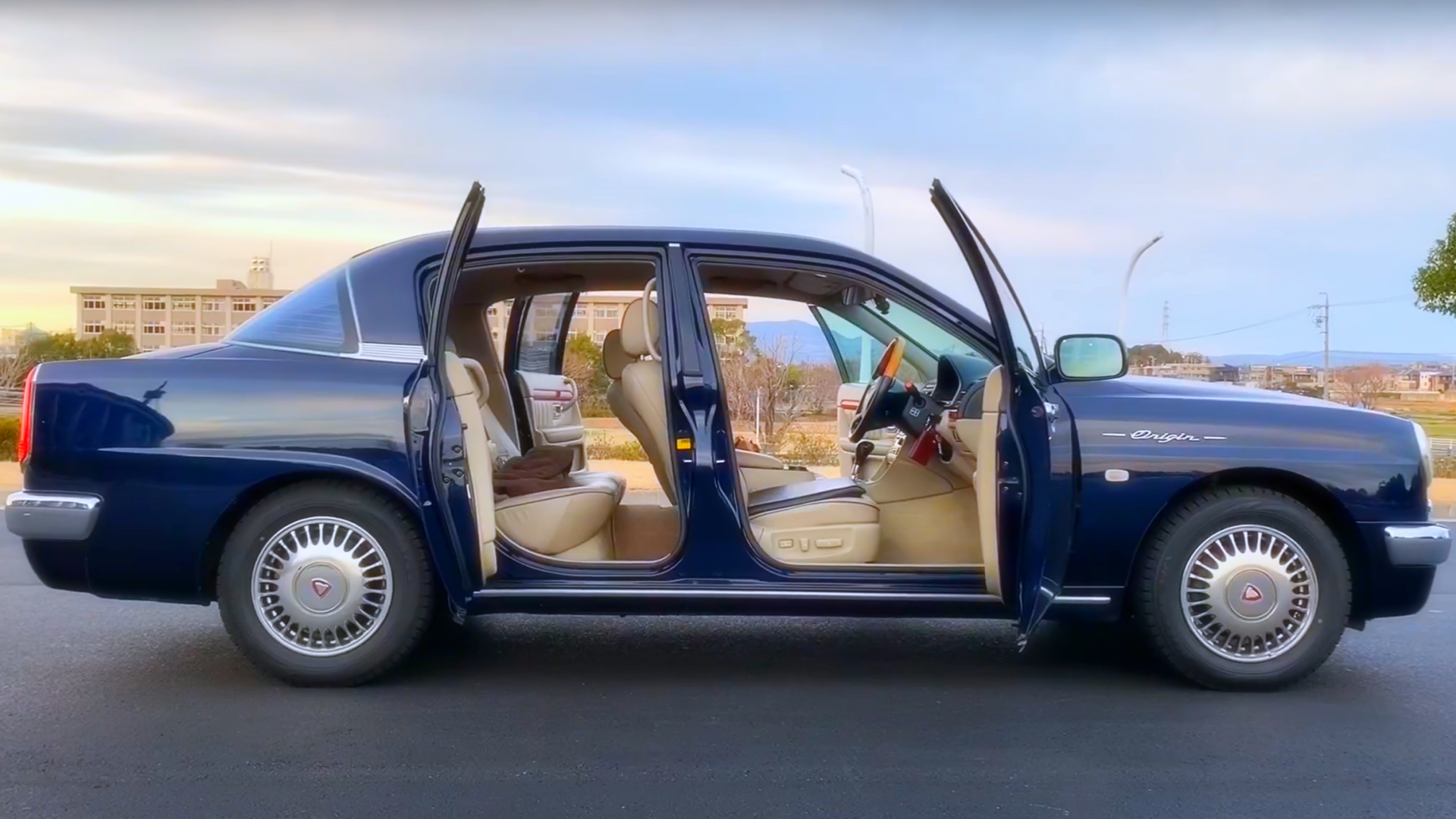
However, if you’re a fan of extremely obscure luxury vehicles, the following write-up is perfect for you. The luxurious Toyota in question is the Toyota Origin, a limited-production midsize luxury sedan produced from 2000 to 2001. It wasn’t sold anywhere but Japan, and it adopted several classic design cues, as Japan was in the grips of a classical automotive styling craze at the time. Not to mention, it also packs the coveted 2JZ straight-six engine under its hood.
Related
5 Times Lexus Beat The German Luxury Automakers At Their Own Game
Lexus has gotten the edge on German auto’s best multiple times and in more ways than one
The following write-up contains information sourced from press materials released by Toyota upon the Origin’s unveiling in the summer of 2000.
The Origin’s Origin
3 Key Origin Facts
- 1,073 examples produced.
- Employs Toyota’s BEAMS 2JZ-GE engine.
- Built in the same factory as the Toyota Century.
As you can imagine, because the Origin is ensconced in relative obscurity, you’re hard-pressed to find detailed specs and reviews like you would with the latest Toyota Camry. But, all is not lost, as a single press release exists for the Origin, dated July 28, 2000. In it, Toyota breaks down everything needing to be known about the then-upcoming Origin and its inner workings. Sales began on November 1st of the same year.
In essence, the Origin, as we touched on above, was meant to commemorate Toyota’s 100 millionth vehicle produced. So, in order to show the world the best aspects of Toyota style and build quality from across the decades, the Origin was drummed up and styled to blend both traditional Toyota style with modern amenities and functionality. Its face may be a strange attempt at retro-modernism, but there’s more to it than that.

Related
The Toyota With More Luxury Than A Mercedes-Benz… And It’s Not A Lexus
As if the world wasn’t upside-down enough these days, a humble Toyota can out-luxury a Mercedes-Benz S-Class.
For one thing, the factory and personnel tasked with building the Origin were the very same tasked with building the Century, Toyota’s most prestigious luxury sedan. It’s an interesting choice, employing the best of the best to tackle the Origin, but Toyota’s top brass take their heritage very seriously, and wanted the Origin to be the crème de la crème of what Toyota had to offer, no holds barred.
The Origin was only produced for less than a year. Each one of the 1,073 units was snatched up immediately, and the Origin’s story was wrapped up, just like that. At least, until recently. They’re beginning to pop up on auction websites for prices that, sometimes, exceed $100,000. It makes sense, seeing as the Origin was a limited-production vehicle built by expert craftspeople for the JDM market only. Next year, the Origin will legally be able to be imported into the US, so you might even be able to see at least one on the road in your lifetime.
What Makes The Little Origin So Luxurious
There’s a lot of detail that went into building each Origin. As we stated above, it was built by the same people who built the Toyota Century. As you can imagine, those who were involved in the Century’s production took their jobs seriously, and the Origin should have been treated to the same care and attention to detail. And it was.
Exterior Poise
Like the Century, the Origin was completely assembled and inspected by hand, with several pairs of eyes and hands touching the same pieces to achieve a system of checks and balances, ensuring everything was millimetrically perfect. On its exterior, the Origin boasted a radiator grille which took inspiration from the first-gen Toyota Crown. Its front fenders and quarter panels were created using a technique called block-molding, which ensures each piece fits together perfectly, i.e. without embarrassing panel gaps.
Yes, you’re correct, those are, in fact, suicide doors. It’s a strange sight, seeing them on a small Toyota sedan, but in keeping with ultimate luxury without compromise, Toyota saw fit to include them on the Origin. It’s side profile is a little strange to look at, as you’d expect the rear end to go on a bit further, but Toyota most likely didn’t want the Origin to encroach on the Century’s long-reaching territory of Toyota’s big luxury sedan. The Origin’s rear end features finned tail lights and a curved rear window, which is heavily reminiscent of cars made in the 1950s across the developed world.
Interior Class
Inside the Origin is much the same story as the outside, with bits and pieces looking like they’re straight out of the 1950s while others were very with-the-times. The full-leather seats feature dark brown piping and double stitching. Origin owners are also treated to real, yet very orange, wood trim and gear stick. The steering wheel is also trimmed with real wood, along with the oddly-placed bezel surrounding the radio and HVAC controls.
Unlike the Century, whose purpose was to be enjoyed from the backseat, the Origin was meant to be driven by its owner, rather than a chauffeur. It’s apparent, this, as the back seats more or less resemble those found in an XLE-trimmed Toyota Camry of the time, albeit with some piping thrown in, and an insignia stitched into the seatback.
The Origin does pack quite a few then-futuristic technological amenities like radar cruise control which was, largely, the precursor to the adaptive cruise control we use today. It also boasted a navigation system that could detect when a driver was about to take a turn and adjust its shift points accordingly.
If you popped over to the linked press release shown earlier in the article, you may have noticed that at no point did Toyota even come close to calling the Origin beautiful or allude to the Origin looking good, and we think we know why, but we’ll let you decide for yourself whether you could call the little hodge-podged Origin a pretty car.

Add CarBuzz to your Google News feed.
The Origin’s Supra Heart

|
Toyota Origin Specs |
|
|---|---|
|
Engine |
3.0-Liter 2JZ-GE BEAMS Straight-Six |
|
Horsepower |
212 hp @ 5,800 rpm |
|
Torque |
217 lb-ft @ 3,800 rpm |
|
Fuel Economy |
39.2 MPG @ 37 mph (Constant) |
We couldn’t go on without touching on the Origin’s powertrain because, as we’ve already mentioned, it packs Toyota’s 2JZ straight-six, made iconic by the Toyota Supra. Sadly, it doesn’t pack the same punch the Supra did, but the 2JZ is a fantastic motor regardless, as it’s also incredibly reliable as well as efficient. The “BEAMS” acronym stands for Breakthrough Engine with Advanced Mechanism System. While this sounds like nonsense, a BEAMS denomination means that a particular engine has futuristic features like electronic throttle control and VVT-i Variable Valve Timing.

Related
Why The BMW B58 Engine Is A Modern 2JZ
Few inline-six motors garner the same adoration as the 2JZ when it comes to tuning potential, but the BMW B58 comes close.
The 2JZ-GE found within the Origin is seriously de-tuned, with it only pumping out just over 210 horses. No performance data exists for the Origin, so stats like 0-60 MPH and top speed are impossible to find, except for theorized metrics and instances of hearsay. We do know the Origin manages an impressive fuel economy rating, judging by its near-40 MPG gathered at a constant speed of 37 mph. The Origin employs a four-speed ECT-iE “intelligent” automatic transmission and a rear-wheel drive drivetrain sporting a fully-independent suspension configuration.
Should Something Like The Origin Happen Again?

It’s a hard question, that. These days, the Origin’s styling would, most likely, result in a gigantic sales flop, as the world has moved past classical styling, for the most part. However, the idea of the Origin is a good one, using a car to commemorate special events in an automaker’s life. Several manufacturers have done it in the past, like Chevrolet’s golden 1955 Bel Air, built to mark the 50 millionth General Motors vehicle produced. It’s a great way to force rarity and collectability, especially if the carmaker involved limits production.

Related
Porsche 911 Turbo 50th Anniversary Is The S/T Of Forced Induction
The Widowmaker is 50, and Stuttgart celebrates its technological brilliance with 1,974 special sports cars.
People certainly loved the Origin when it came out. After all, it sold out immediately, despite its near-$88,000 price tag in today’s money. However, when you see just how much care, time, and effort went into producing the thing, its large price tag makes a lot of sense. It’s a safe bet to say the idea of the Origin will, and should, happen again. Perhaps when Toyota hits their 200 millionth vehicle produced, we’ll get to see another strange little car.
Sources:
CurbsideClassic.com
,
Global.Toyota

