
Reliable Drop-Tops: 10 Memorable Toyota Convertibles

Despite a universal love of sunshine, the popularity of convertible cars has been plummeting in recent years. In major markets like America and the United Kingdom, sales of drop-tops have steadily declined, so what’s gone wrong?
We’re not so sure why convertibles just aren’t flavor of the month anymore, but, we can be sure of the fact that plenty of great used convertibles are still out there to be had. Furthermore, a convertible need not be kept hidden away as a toy for high days and holidays, if you’re clever and pick a dependable one, it can make for an exciting and enjoyable daily driver. So, in an effort to rekindle America’s love of convertibles, we’ve decided to look back at some of the most notable Toyota convertible models ever made.
Available Models
Toyota
Toyota is a Japanese automaker founded in 1937 that has developed a reputation for reliability across a multitude of segments, from sports cars and family sedans to pickup trucks and off-roaders. Famous models from the brand include the Hilux, Land Cruiser, Camry, Crown, and Corolla, the latter being the world’s best-selling vehicle nameplate, with more than 50 million Corolla-badged vehicles being sold since it was first introduced. Toyota typically competes in the mainstream market, but is also famous for launching Lexus as a luxury sub-brand to take on Mercedes-Benz.
- Founded
- August 28, 1937
- Founder
- Kiichiro Toyoda
- Headquarters
- Aichi, Japan
- Owned By
- Publicly Traded
- Current CEO
- Koji Sato
CarBuzz has collected information for this article from Toyota directly. If other authoritative sources have been used, they shall be listed at the foot of the article.

Related
The 10 Most Important Toyotas Ever Made
Toyota has a history stretching back decades. Here are ten of the most important models the company has built.
1 1963 Toyota Publica Convertible

Key Features
- Toyota’s first production convertible
- Replaced in 1966 by a version with a detachable plastic hard-top
- Powered by a 697cc two-cylinder engine
Toyota’s convertible lineage starts here, with the 1963 Publica. Initially a hard-top model, Toyota engineers lopped the roof off this diminutive city car in order to broaden its appeal. The Publica convertible survived in this guise for a number of years, before a detachable plastic hard-top was developed, which then was used to update the model.
While many convertibles are often thought of as luxurious or sporty, the Publica managed to excel at being neither. The interior was spartan and simple, and under the hood things were much the same, with a 697cc two-cylinder engine providing propulsion.

Add CarBuzz to your Google News feed.
2 1965 Toyota Sports 800

Key Features
- The Sports 800 was popular within motorsport circles
- Only 3,131 were ever made
- The Sports 800 weighed in at just 1,279 lbs
Moving on from the handsome Publica, Toyota decided to embrace the sporting potentials of a convertible with its next roofless wonder – the Sports 800. OK, it’s not strictly a convertible, but a targa. Nevertheless, wind-in-your-hair motoring was the net result.
As the name suggests, this Toyota had genuine sporting potential, despite packaging only a 44-horsepower flat-two engine. To make up for the uninspiring output, Toyota made the Sports 800 as small and light as possible, resulting in a weight of just 1,279 lbs. That’s just 19 lbs shy of being 1,000 lbs lighter than an NA Miata.
A total of 3,131 were produced, and numerous examples enjoyed success, or at the very least, a shot at it, on the racetrack. Most notably, in 1967, a Toyota Sports 800 finished third in the Fuji 24-hour endurance race, behind two Toyota 2000GTs. Interestingly, Toyota also developed a convertible 2000GT, but only two were made for the James Bond film, You Only Live Twice, so sadly we opted not to feature it in our list of awesome but production Toyota convertibles.
3 1984 Toyota MR2 T-Top

Key Features
- The MR2 was mid-engined and rear-wheel drive
- When launched, the MR2 was voted as Japan’s ‘Car Of The Year’
- Toyota developed a 600-horsepower rally car based on the AW11, dubbed the 222D
The MR2 is a T-top, rather than a fully fledged convertible, and this first-generation model is perhaps the coolest of the bunch. It wasn’t particularly powerful, but, similarly to the much earlier Sports 800, it used a diminutive footprint and feather-light weight to its advantage. The MR2 became one of the most popular sports cars to come from Japan, until Mazda launched its world-beating Miata, that is.
While the Miata proved so much more popular, the MR2 remains just as desirable as an exciting alternate. Boasting a midship layout and rear-wheel drive, the MR2 certainly has more sports car credentials than the Mazda, and the ‘baby-F40’ styling doesn’t exactly damage its appeal either.

Related
K20-Swapped Toyota MR2 Faces A80 Supra In A Drag Race
The Toyota Supra may have the displacement advantage, but this MR2 can hold its own.
4 1984 Toyota Celica GT-S Convertible

Key Features
- This era Celica housed the largest -ver Celica engine, at 2.4 liters
- Expensive in its day, the ’84 Celica GT-S commanded a $17,669 MSRP
- Only 4,498 were ever built
Debuting in the same year as the first-generation MR2, the Celica GT-S convertible was decidedly more aggressive looking than previous Celica models, and offered four-seat top-down motoring for those who couldn’t cram their lives into the MR2. While Toyota has provided value for money with its models over the years, this Celica GT-S convertible isn’t the best example of that logic, thanks to a starting price of $17,669. For way of comparison, that was $6,470 more than the GT-S coupe.
5 1993 Toyota Supra A80 T-Top

Key Features
- The design of this iconic A80 generation was influenced by the ’60s Toyota 2000GT
- Twin-turbo models developed 321 horsepower
- A80 Supras are shorter and lighter than their A70 predecessors
One Toyota convertible that certainly needs no introduction is the A80 Supra, also known as the Mark IV. The Supra rose to fame through the Fast And Furious film franchise, plus, it’s one of the coolest Japanese sports cars ever launched.
The most potent models were powered by a twin-turbo inline-six that kicks out 321 horsepower, and, with a six-speed manual transmission, it could power from 0 to 60 mph in around 5.5 seconds. Once again, Toyota opted for a T-top design, which meant the Supra could double up as a coupe when so desired.
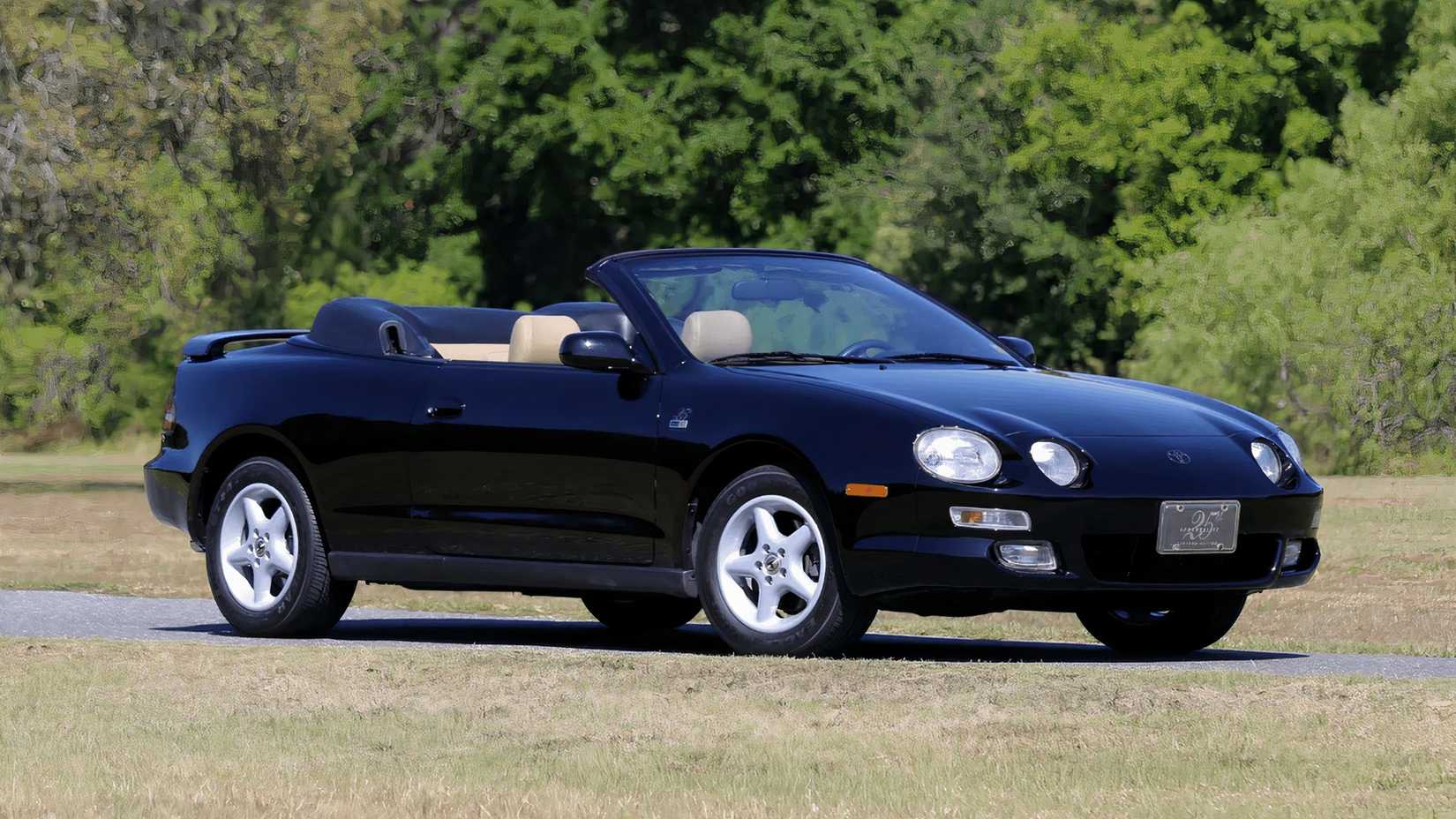
6 1994 Toyota Celica GT Convertible
Key Features
- The 2.2-liter engine was good for 135 horsepower
- Coupe models overshadowed the convertible, thanks to impressive rallying success
Doing away with the T-top design is this, a proper Toyota drop-top model known as the Celica GT convertible. This era of Celica is most famous for turbocharged rally success, achieved by the commanding GT-Four models.
While the GT convertibles are easily overlooked now, they proved quite popular in the era, selling in more markets than previous models, such as throughout Europe, in addition to American and Asian markets.
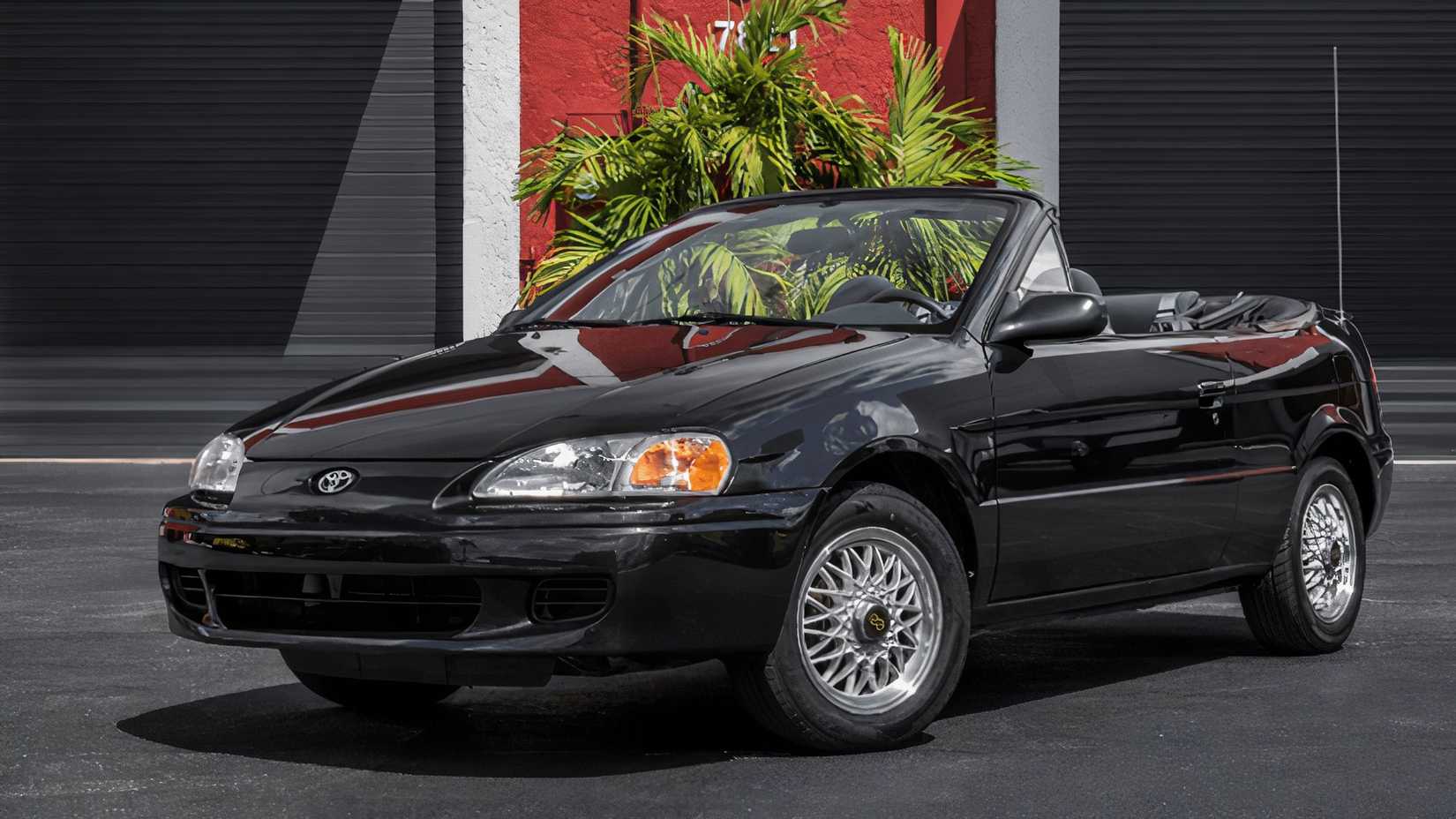
7 1997 Toyota Paseo Convertible
Key Features
- USDM models produced little more than 90 horsepower
- Despite its smaller proportions, the Paseo Convertible is still a four-seater
- Paseo models were available with a four-speed auto or five-speed manual transmission
Cute, quirky and playful – the Paseo convertible is a fun twist on the rather unassuming Paseo compact coupe. Unlike most Toyota convertibles, the Paseo here has hardly any sporting potential, powered along by just 93 keenly motivated horses, courtesy of a 1.5-liter inline-four engine.
Removing any further sporting potential is the front-wheel-drive layout, and, while it was available with a five-speed manual transmission, many were equipped with a sluggish four-speed auto. Still, the Paseo never tried to be sporty, and instead looked to provide a fun twist on what was otherwise a plain and unimaginative platform, which is likely why and how it found fans.
8 1998 Toyota RAV4 Soft Top

Key Features
- The fabric roof folds neatly away and stores on top of the rear door panel, to not impose on rear passenger space
- Those rear window panels are removable
- Prices for the soft-top model were identical to that of the hard-top, at $16,798
Toyota’s RAV4 did well to redefine the role of a 4×4 in the mid-to-late 1990s, proving that this type of vehicle could be just as much fun in urban environments, and that smaller platforms also had a part to play. The first-gen models were fun, both in the way they drove, and the way they looked, and by 1998, Toyota hatched an idea that would make them even more so.
Removing the roof entirely would be quite tricky – could you even imagine how that might look? That didn’t stop Toyota from finding a way to incorporate more fresh air, though, and they settled on a fabric roof which would cover the rear seats. Cargo space was always at a premium in the early three-door RAV4, and so the roof would fold into a space above the rear door panel, rather than into the trunk.

Related
Best Toyota RAV4 Model Years To Buy
These are the best RAV4s across five generations and three decades.
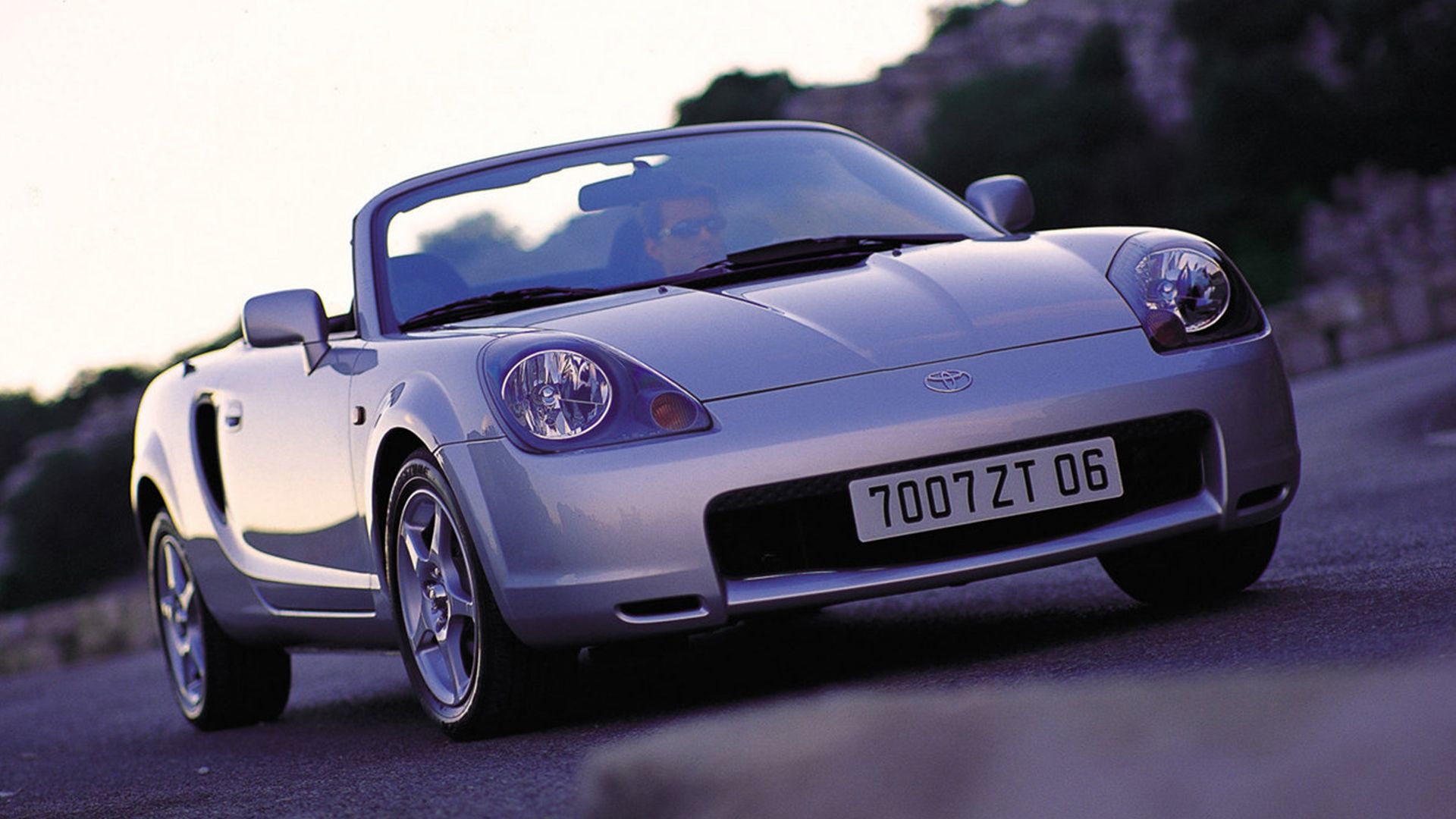
9 1999 Toyota MR2 W30 Spyder

Key Features
- Powered by an all-aluminum 1.8-liter inline-four
- The W30 MR2 produces 138 horsepower
- Unusually, this generation of MR2 has no trunk space
It’s hard to believe that the third and final generation of MR2 launched over 25 years ago now, and while there have been murmurings of a revival, no concrete plans have been revealed yet. This was the only generation of MR2 to completely do away with a fixed top, instead opting for a liberating Spyder design.
The W30 was a proper sports car too, with a 2,282 lbs curb weight, and 138 horsepower, courtesy of an all-aluminum 1.8-liter ‘four’. The proportions of this generation were similar to those of the first MR2, rather than the long, sleek lines which second-gen models displayed. Staying true to its roots, the W30 MR2 was also rear-wheel drive and mid-engined.
10 2000 Toyota Solora Convertible

Key Features
- Based upon the Toyota Camry of the same era
- The interior is more luxuriously trimmed than many other Toyota convertibles
- A 200-horsepower V6 engine was optional for SE models
Proving that Toyota can do more than just produce small, playful soft-tops, the Solara convertible was based upon the Camry, and carried over much of the Camry’s more upmarket amenities. Sure, it’s no Rolls-Royce, but compared to the stripped-back nature of an MR2, it certainly carries a more premium feel.
Leather interiors, powered seats, windows and mirrors, air-conditioning and much more – the Solara was always to be a comfortable cruiser. As standard, a 135-horsepower 2.2-liter inline-four was responsible for motivation, but purchasers of SE Solara convertibles could opt for a punchy 200-hp V6 instead.

Related
Toyota Century Convertible Teased As Ultimate Drop-Top Luxury SUV
But does Toyota really have plans to build it en masse?
What Future Convertibles Might Toyota Have In The Works?
While Toyota has not outwardly revealed a long list of convertibles that are set to appear in showrooms any day now, it has been hinting over the years that some drop-tops may be on the way at some point soon. Only recently did the brand tease a striking Crown convertible, around the same time that a one-off Toyota Century SUV convertible was revealed.
Furthermore, Toyota also presented us with convertible designs when revealing a number of electric concept cars, the bulk of which at least had an intent for production behind them. So, even though the sector is shrinking and public demand seems to be at an all-time low for convertible cars, it’s reassuring to know that Toyota hasn’t dropped the idea of a fresh soft-top design altogether. Keep your eyes peeled.

