10 Times Motorbike Engines Were Used In Cars

The two-wheeled and four-wheeled worlds don’t come into contact that often, but when they do, the results are unique automotive creations with a character all their own. While motorcycle engines, with their small displacement and high-revving nature, are very different from the ones usually found in cars, their characteristics can occasionally come in useful in the car world as well.
Related
Weirdest Motorcycles You’ll Ever See
Weaponized Vespas, motorized unicycles, and a motorbike with gullwing doors.
Some companies, like BMW and Honda, build both cars and motorcycles, occasionally swapping engineering expertise between the two divisions; others, like Ariel, borrow from the world of motorbikes to create something different. Here are ten times automakers decided a motorcycle engine was the best choice for their cars’ powertrain, and the one-of-a-kind vehicles that resulted from that collaboration.
The list includes a selection of cars powered by motorbike engines, listed from the lowest to the highest power output.
1 Peel P50

The Peel P50’s main claim to fame is being the record holder for smallest production car of all time: the teeny-tiny runabout was marketed as just big enough to fit “one adult and a shopping bag” when it was first launched in 1962. The P50 was manufactured in Peel, a town on the Isle of Man, hence the name. The engine was borrowed from German company DKW, which produced both cars and motorbikes.
|
Engine |
49 cc single-cylinder |
|---|---|
|
Horsepower |
4.2 hp |
In 2011, a modern version was designed, and we reported on it in 2012. It went into a limited production run, thanks to dedicated enthusiast Gary Hillman who resurrected the brand. The modern Peel P50 used similar powertrains with an eco-friendly update: a 49-cc engine was available alongside an all-electric option. A total of 50 units were produced.

Related
10 Of The Worst Cars Ever Made: The Automotive Hall of Shame
A look at the industry’s biggest failures.
2 BMW Isetta

Equally adorable and terrifying due to its less-than-ideal safety record, the BMW Isetta “bubble car” earned its place in history when it saved BMW from bankruptcy. Produced between 1955 and 1962, the Isetta was built under license from Iso, the Italian company responsible for creating its design.
|
Engine |
250-cc single-cylinder |
|---|---|
|
Horsepower |
12 hp |
The Isetta was marketed as an affordable runabout, built to weave its way around the cities of post-war Germany. It enjoyed a good degree of popularity, which helped turn around the company’s fortunes and ensured BMW’s long-term survival. Later on, the Isetta became a collector’s favorite due to its looks and unique front-mounted door design.

Add CarBuzz to your Google News feed.
3 BMW i3 (range extender)

The next entry is not quite like the others. The BMW i3 is, famously, an all-electric car; however, one version of the i3 was equipped with a combustion-powered range extender. In the absence of a suitable unit in their car department, BMW looked to its motorcycle division for an engine that could serve this purpose in the i3’s powertrain.
|
Engine |
647cc inline-two |
|---|---|
|
Horsepower |
34 hp |
The solution arrived in the form of the 647-cc engine (built by Taiwanese manufacturer Kymco) used in BMW’s C650 GT scooter, which underwent some modifications to be adapted for its new purpose. Marketed as REx, this setup eased customers’ worries about range anxiety, which was a major issue when the i3 was first released in 2013.

Related
10 EVs That Would Benefit From Having A Combustion Range Extender
Driving range is often the main drawback between EVs and ICE vehicles. These are ten EVs that could benefit from a range extender.
4 Honda N360/N600

This tiny Honda city runabout was the brand’s first mass-produced car, first introduced in 1967 and remaining in production until 1972. It came in two different versions: the N360 was a kei car built for the Japanese market, while the larger-engined N600 was created for export markets such as Europe and the US. Both variants were powered by modified versions of Honda’s motorcycle engines: while V-Twin setups are most common in the world of motorbikes, the N360 used a “parallel twin” inline-two layout.
|
Engine |
354 cc/402 cc/598 cc inline-two |
|---|---|
|
Horsepower |
36-45 hp |
In 2012, Honda released the N-One microcar, and we ran a story about it at the time. It was a homage to the N360, using retro styling cues and small dimensions that recalled the N360’s design.
5 Morgan 3-Wheeler

The Morgan 3-Wheeler provides a driving experience quite unlike anything else on the road. With its reversed-tricycle layout, it represents a halfway point between a car and a motorcycle, with its V-Twin engine driving a single rear wheel. Last year, the company launched the 2020s rendition of the 3-Wheeler, called the Super 3, but it’s no longer powered by a motorcycle engine, but by Ford’s Dragon 1.5L I3 engine.
|
Engine |
2.0-liter V-Twin |
|---|---|
|
Horsepower |
82 hp |
The Morgan Motor Company is one of the oldest carmakers in England, having first been founded in 1910. The company has a long history of building three-wheelers powered by a V-Twin engine: this design was used between 1911 and 1939, with a good degree of popularity and success in the world of motorsports. The 3-Wheeler is a homage to the iconic Morgan models of the past, maintaining the vintage look that has become the brand’s hallmark.
6 Light Car Company Rocket

Gordon Murray’s career as an automotive designer is well-known to most car enthusiasts, from Formula 1 cars to legendary road cars such as the McLaren F1 and modern-day GMA T.50 and T.33 supercars. Shortly after leaving the world of Formula 1, Murray created his very first road car, something very different from the projects he would later end up working on: the Light Car Company Rocket.
|
Engine |
Yamaha 1,000-cc inline-four |
|---|---|
|
Horsepower |
143 hp / 165 hp |
The Rocket is an ultra-lightweight, track-focused machine (weighing less than the Caterham Seven); it is, however, perfectly road-legal. Powered by Yamaha’s “Genesis” motorcycle engine, the Rocket also had space for a passenger sitting behind the driver. Over the course of seven years, 55 units were built by the Light Car Company, the joint venture founded in 1991 by Murray and racing driver Chris Craft.
7 Caterham Blackbird

The Caterham Seven is well-known among car enthusiasts for being a fun, lightweight car that feels equally at home on the road or on the track. Over the course of its 50 years of production (the last combustion-powered Sevens are currently being produced, as the company pivots towards an electric future), the Seven has had countless different versions and special editions.
|
Engine |
1.1-liter inline-four |
|---|---|
|
Horsepower |
168 hp |
One of them, the Blackbird, is powered by the same engine as the motorbike it takes the name of: the Honda Blackbird CBR1100. The motorbike itself was named after the Lockheed SR-71 “Blackbird”, a legendary American reconnaissance aircraft in use from 1966 to 1999.
8 Suzuki GSX-R/4

Sometimes, it’s not automakers who decide to borrow a motorcycle engine to power their cars, but motorcycle companies who decide to build a car of their own. This is the case with the GSX-R/4, Suzuki’s clumsily-named but futuristic concept creation based on the GSX motorcycle series. First unveiled in 2001 at the Los Angeles Auto Show, the GSX-R/4 was never intended for a production run, but was meant to showcase technology that could be implemented in Suzuki vehicles of the future.
|
Engine |
1.3-liter inline-four |
|---|---|
|
Horsepower |
172 hp |
Far from being a stripped-down track toy, the GSX-R/4 was packed with tech, including a navigation system equipped with circuit navigation functions, as well as telemetry equipment and an onboard camera to capture track footage.
9 Radical SR1

Radical Motorsport is a small British company started in 1997 by amateur racing drivers Mick Hyde and Phil Abbott, who used their engineering background to build open-cockpit race cars that could also be driven on the road. The SR1 was designed as a learning tool for budding racing drivers hoping to hone their craft; it was also the first Radical model to have its own dedicated racing series, the SR1 Cup.
|
Engine |
1.3-liter inline-four |
|---|---|
|
Horsepower |
185 hp |
The SR1’s very low weight (just over 1,000 pounds) combined with Suzuki’s Hayabusa engine results in a fun, high-spirited package, delivering 2.3 g of lateral acceleration. Radical has produced several other models powered by motorcycle engines, including the SR3 and SR8.

Related
Meet The Radical SR1 XXR: Entry-Level Model Gets Huge Upgrade
It’s one of the best ways to get into racing for the first time.
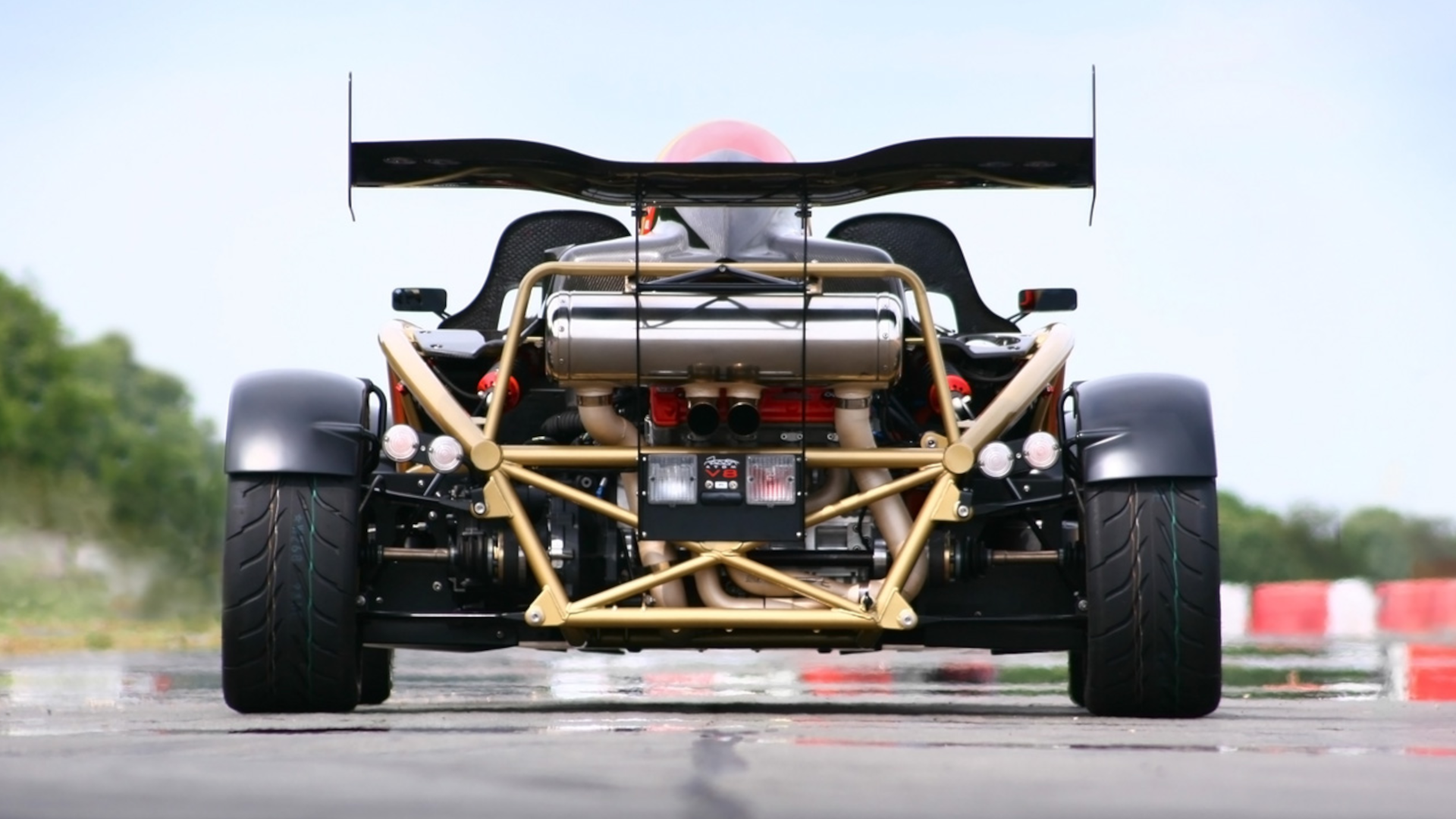
10 Ariel Atom 500 V8

The Ariel Atom is a pretty bonkers car on its own, but the V8-powered 500 version is by far the craziest member of the lineup. In 2007, seven years after the first Atom had arrived on the market, the company introduced the model’s third generation, the Atom 3; three years after that, they decided to take the Atom in a new direction with a V8-powered version of the Atom 3, dubbed the Atom 500.
|
Engine |
3.0-liter V8 |
|---|---|
|
Horsepower |
475 hp/500 hp |
The V8 that powered the 500 was constructed by grafting together two Suzuki motorcycle engines; although the process was fairly complex and eventually resulted in the creation of an engine that had gathered some distance from its original components, traces of motorcycle DNA remained in the finished Atom 500. Only 25 units were produced, with two slightly different versions available.
Sources:
Light Car Company, Radical Motorsport,
Morgan Motor Company
,
BMW
,
Honda
, Suzuki,
Ariel Motor Company
,
Caterham
, Peel Engineering, Motorsport Vision Racing