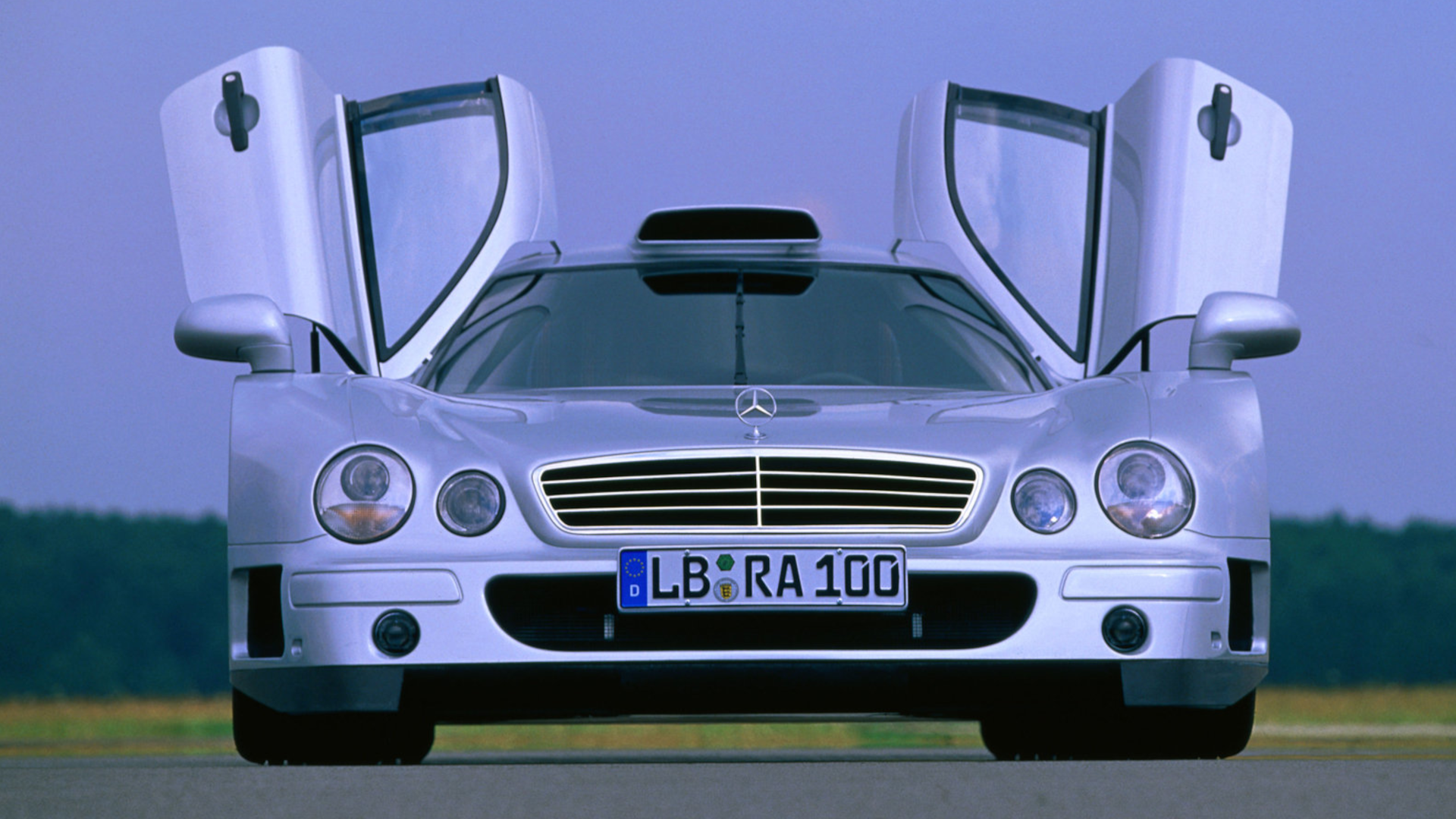
Only 3 Rear-Mid-Engine Road-Legal Mercedes-Benz Models Were Ever Made

For the bulk of its history, Mercedes-Benz has offered vehicles with their considerable, and even not so sizable, powerplants out front. From the fire-breathing 2024 AMG GT and SLR McLaren, to the city-friendly A-Class, having the engine over or behind the front axle has always been the go-to recipe.
This doesn’t mean every one of the marque’s models follows this recipe though, as a few special species were a bit different. CarBuzz decided to explore the Mercedes models that came with a mid-rear engine configuration, which came with some benefits over pure front or rear-engined positioning.
Mercedes-Benz
While its roots trace back to the Benz Patent Motorwagen in 1895, Mercedes-Benz was officially founded in June 1926 when Daimler Motoren Gesellschaft and Benz & Cie. (the world’s oldest car company) merged to create Daimler-Benz. This German manufacturer of premium cars is historically known for its motorsport pedigree in early Grand Prix racing, its off-road prowess in the creation of military vehicles like the Genadewagen (now G-Class), and its focus on utmost luxury and technological innovation in models like the S-Class and SL. Today, it is one of the world’s largest automakers.
The cars included in this feature are the Mercedes-Benz models that feature a mid-rear engine layout. All technical data was sourced from trusted providers such as the vehicle manufacturer.
Mercedes-Benz Has Always Used The Front-Engined Layout
The chief reason most Mercedes’ have their engines in the front is to do with physics, as cars built this way tend to feature more stable handling. A car will tend to follow wherever the most weight is, which is why the rear-engined Porsche 911 was known to be pretty dangerous in the bends in its early days, as the heavily weighted rear acted like a pendulum and could lead to the rear end breaking loose.
With the engine out front, the weight tends to keep the car facing forward, with the main issue being understeer as the engine forces the front to carry on through a corner, as opposed to swinging out. For most drivers, controlling and dealing with understeer is much simpler than dealing with unpredictable oversteer. Considering Merc is in the business of building user-friendly and luxurious models, making them as straightforward to drive as possible is important.

Related
TVR’s Forgotten Sports Cars Paved The Way For Mercedes’ First Hypercar
Mercedes-Benz used a pair of TVRs with some of the ugliest modifications ever, but it was for a good cause.
A Mid-Rear Engine Layout Can Boost Performance In Certain Situations
A mid-engine layout goes against this, but was used by the brand in some of its track-focused road cars. A mid-engine car tends to have better balance than a front or rear-powered one, as the weight is nicely positioned in the middle of the car, meaning the weight bias is shared evenly between the front and rear of the car. Mid-rear means having it placed further rearward, but ahead of the rear axle. A traditional rear-engine car has its powerplant placed above the rear axle.
A mid-rear engine layout helps to ensure the car’s balance is still more equal than a full-rear engine, but with the benefit of added traction. The powerplant at the rear helps to push down on the driven rear tires. This effect won’t be as dramatic on a mid-rear geared offering as on a pure rear-engined vehicle, but they have superior traction to a pure mid-engine car.

Discussion
Of all the Mercedes-AMG models, past and present, which one would you park in your garage?
There are more great Mercedes-AMG models than we can count. We’re partial to the mid-2000s to 2010s period where AMGs tested the limits of RWD with ultra-powerful V8s and V12s and their magnificent soundtracks. These cars were a handful, but that’s why everyone loved them. This group includes the CLK 63 AMG Black Series with 500 hp (and the W204 C63 sedan that shares its front suspension), the E63 AMG of the W212 generation, and the SL 65 AMG with an outrageous 738 lb-ft. Tell us about your favorites.
The CLK GTR Strassenversion Was The First Merc To Come With A Mid-Rear Engine Layout
|
1997 Mercedes-Benz CLK GTR Strassenversion Specifications |
|
|---|---|
|
Engine |
6.9-liter V12 |
|
Power |
622 hp |
|
Torque |
539 lb-ft |
|
0-60 mph |
3.6 seconds |
|
Top Speed |
215 mph |
With Mercedes-Benz looking to rejoin top-level sports car racing after a near 50-year pause, it took it seriously. At the time, GT1 regulations were the so-called FIA GT Championships jam. In theory, they featured normal road-going supercars that were modified to be eligible for the racetrack, like the McLaren F1 GTR. The FIA had left a few too many loopholes in the regulations though, so the manufacturers went to extremes and began building insane road-going prototype racers instead.
The main mistake was the rule that marques only had to build 25 road-going versions of their racers, which meant the brands didn’t have to worry about the cars being cost-effective to mass-produce, allowing them to go more extreme from a design standpoint. Mercedes’ challenger was called the CLK GTR, with the road-going version called the Strassenversion.

Add CarBuzz to your Google News feed.
The Road-Legal CLK GTR Came With A Larger Version Of The Racing Car’s V12
It was a pure racer, as is evidenced by the shockingly bare interior, which was pretty out there for a Mercedes-Benz in the 1990s. It was powered by a more user-friendly version of the racer’s mighty V12 unit, though it was stroked slightly to have a displacement of 6.9 liters. The naturally aspirated unit was crafted from lightweight aluminum, and sent 612 hp to the GTR’s rear wheels via a six-speed sequential gearbox.
To ensure it could actually be used on the road, the independent suspension system was softened off from its track setting, while the car was heightened slightly to better deal with pesky potholes and bumps found on public roads. A roadster version of the car was also offered, allowing owners to experience the wailing V12 firsthand.
Just 26 examples of the CLK GTR were built for the road according to RM Sotheby’s, with 20 being coupes and the remaining six being roadsters.
|
1998 Mercedes-Benz CLK LM Strassenversion Specifications |
|
|---|---|
|
Engine |
5.0-liter V8 |
|
Power |
600 hp |
|
Torque |
531 lb-ft |
|
0-60 mph |
N/A |
|
Top Speed |
224 mph |
While the CLK GTR had proven successful on its debut in the 1997 FIA GT season, the car claiming the drivers’ and manufacturers’ titles, Merc felt it needed to do more. Feeling the GTR was a little too slow down the extensive straights at the Circuit de la Sarthe, the venue that hosted the storied 24 Hours of Le Mans, the brand got to work on an upgraded version called the CLK LM.
The main difference compared to its forerunner was its smoother and more sweeping body, which consisted of a longer tail to reduce drag and help boost top speed. The heavier V12 engine was also dumped and replaced by a 5.0-liter V8 instead, which remained naturally aspirated. Making its debut in the third round of the 1998 FIA GT series, the car picked up where its predecessor had left off and dominated. Aside from Le Mans, where both cars retired, it won the other eight races it started.
The news got even better for Mercedes, as the FIA had even ditched the 25-car homologation rule, meaning it only had to build a single CLK LM road car. The aero package was modified to be a little safer, with extra aero added to reduce risk should its owner treat the highway like the Mulsanne Straight. It was also graced with a stronger tubular roll cage, should the worst happen.

Related
The Mercedes-Benz SL 65 AMG Tried To Kill Me, But Here’s Why I’d Still Buy One Used
A V12 too tame for your sporty Benz? Back in 2001 AMG thought so, so they strapped not one, but two turbochargers to their V12 engine.
The Mid-Rear Engine Configuration Returned Two Decades After The CLK Models
|
2022 Mercedes-AMG One Specifications |
|
|---|---|
|
Engine |
Turbocharged 1.6-liter V6 with hybrid |
|
Power |
1,063 hp |
|
Torque |
N/A |
|
0-60 mph |
2.9 seconds |
|
Top Speed |
218 mph |
Following the conclusion of the CLK GTR program at the end of 1998, Mercedes remained loyal to the front-engine layout in its ultra-high-performance road cars, such as the SLR McLaren. Well, at least until the AMG One came along in 2022. The One was built as a Formula 1 car for the road, the closed-top vehicle coming with a turbocharged 1.6-liter V6 engine lifted directly from one of the manufacturer’s F1 cars.

Related
Mercedes-AMG One Just Smashed Its Own Nurburgring Record
When the only competition is yourself, that’s not a bad problem to have.
Even the complicated hybrid system was kept on, ensuring the AMG One could produce the full 1,063 hp the engine could offer. It can even be driven in pure EV mode, though that would miss the point of owning a near-220-mph car. It also came with an elaborate active-aero setup, which ensured the right amount of downforce pushed the vehicle into the road at the most crucial moments.
A set of F1-style ceramic brakes was also on hand to bring the AMG-One to a face-tearing halt. Like the CLK GTRs, the AMG-One had a limited-run production program, with just 275 examples of the hand-built car produced.
With Merc potentially looking at entering top-flight sports car racing via the World Endurance Championship in the next few years, the wait for another mid-rear-engine weapon may be shorter than you think. Good luck affording one though, at least until the brand decides to build a modern version of its crazy rear-engined A-Class.
Sources:
Mercedes-Benz
,
RM Sotheby’s