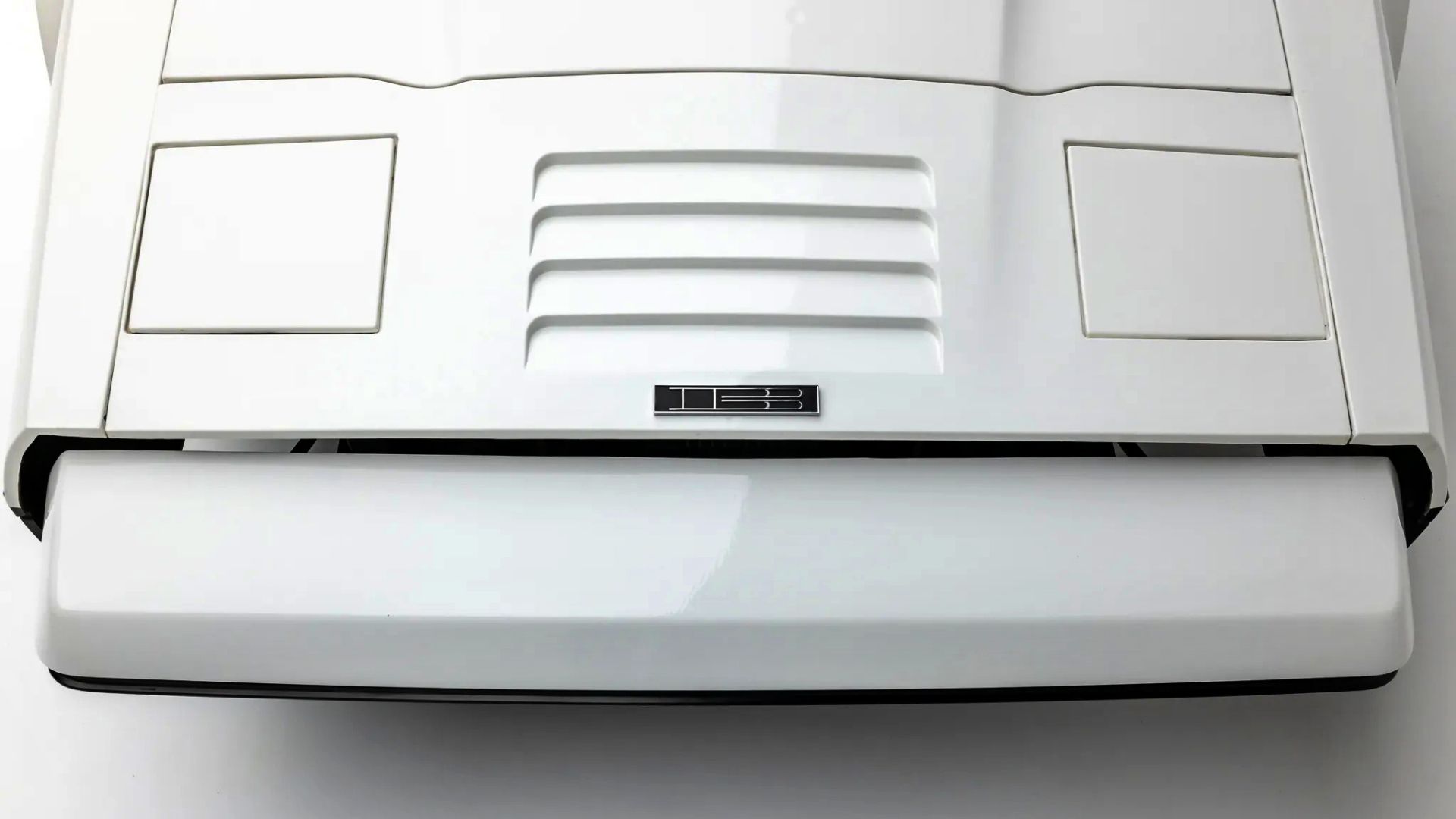
The Failed Canadian-Built Gullwing Rival To The Chevy Corvette

When it came to sports cars built on the North American continent, the Chevrolet Corvette ruled the class alongside the Ford Mustang for decades. Many competitors came about, but the Corvette always managed to stay on top of the game, and has become the embodiment of American car culture. After all, the ‘Vette has offered excellent bang for your buck for the better part of 70 years now, and you can’t argue against the sports-car credentials of the fabled Chevy, which has, in recent years, stepped up into supercar territory.
Chevrolet
Founded in 1903, Chevrolet is one of America’s oldest remaining legacy automakers. Acquired by General Motors in 1918, Chevrolet is the core GM brand responsible for the bulk of GM’s US sales. As a mass-market manufacturer, Chevrolet competes in multiple key segments, primarily the SUV and truck segments, but also sports cars and mainstream sedans and hatchbacks (until recently). Core models for the brand include the Silverado, Colorado, Suburban, Camaro, and Corvette.
- Founded
-
November 3, 1911
- Founder
-
Louis Chevrolet, Arthur Chevrolet, William C. Durant
- Headquarters
-
Detroit, Michigan, United States of America
- Owned By
-
General Motors
- Current CEO
-
Mary Barra
One of the Corvette’s many North America-bred adversaries to rise up over the years was actually more than just another sports car, at least on paper. It was called the Bricklin SV-1, and it was produced in Canada by a well-to-do automobile importer based out of the United States. On top of taking on the Corvette, the SV-1 was also tasked with rewriting sports-car safety standards, and some of those innovations are still seen in cars, even today.

Related
The Canadian Muscle Car With An American Heart
Some people in Canada haven’t even heard of this car – but you really should know about it.
We’ve chosen the Bricklin SV-1 for this article due to the promise it showed as a sports car, and its subsequent market-wide failure. However, its pioneering spirit in terms of safety would have a lasting influence on the automotive world going forward.
The Canadian With An American In Its Sights
Bricklin SV-1 Quick Facts
- Introduced in 1974
- Boasted unique safety features such as an integrated roll cage
- Utilized both Ford and AMC V8s
- Approximately 3,000 Bricklin SV-1s were built
Gunning for the Corvette is a monumental task, and it’s especially brave for a relatively small start-up car company. Bricklin as a whole had only entered the fold three years prior to the SV-1’s release, and was founded by a man called Malcom Bricklin. Bricklin’s Corvette competitor was heavily focused on safety, with its very name, SV-1, standing for “Safety Vehicle 1″.

Related
Bricklin SV1 Revived As Three-Wheeled 3EV
It may be quirky, but Visionary Vehicles is promising a sub-$30,000 starting price and a range that exceeds 275 miles. Color us intrigued.
Once a deal was struck with the Canadian government to produce the SV-1 in the province of New Brunswick, Bricklin received a whopping (for the time) $4.5 million CAD investment from the New Brunswick provincial government. In fact, Canada was so excited to be producing a potential Corvette-beating sports car, the New Brunswick premier, Richard Hatfield, publicly supported Malcom Bricklin’s endeavor. However, the $4.5 million CAD given to Bricklin was meant to cover production costs, but the money actually went toward company salaries, as well as the SV-1’s design and development.
The SV-1’s Borrowed Powertrain
Because Bricklin didn’t have the necessary capital to develop its own powertrain, Malcolm Bricklin first reached out to American Motors Corporation (AMC) with a request to source its 360 CID (5.9L) V8 for his project. Early Bricklin SV-1 models came equipped with the AMC 360 CID V8, but the majority of SV-1s eventually produced utilized a 351 CID (5.8L) Ford Windsor V8, which produced less power and torque than the AMC mill.
|
Bricklin SV-1 Specifications |
||
|---|---|---|
|
360 CID (5.9L) NA AMC V8 (1974) |
351 CID (5.8L) NA Windsor V8 (1975–1976) |
|
|
Horsepower |
220 hp |
175 hp |
|
Torque |
315 lb-ft |
286 lb-ft |
|
Bore x Stroke |
4.080 in x 3.440 in |
4.000 in x 3.500 in |
|
Compression Ratio |
8.2:1 |
8.0:1 |
|
0-60 mph |
8.3 seconds |
9.9 seconds |
|
Top Speed |
118 mph |
111 mph |
|
Curb Weight |
3,470 lbs |
3,520 lbs |
Because the SV-1 was forced to utilize the Ford 351 Windsor V8 following the 1974 model year, Bricklin engineers needed to reconfigure its subframe extensively, which ended up increasing the SV-1’s overall curb weight. Plus, the new engine was less powerful, taking Bricklin’s dreams of Corvette domination down with it. For the 1974 model year with the AMC V8, the SV-1 offered both a three-speed automatic and a four-speed manual transmission. But, once the new Ford motor was installed, only a three-speed automatic was offered.
Safety

As we’ve already touched on, the SV-1’s calling card was its revolutionary use of safety equipment. One of the biggest examples of this was its integrated roll cage, something exceedingly rare for the time period. Other safety features include energy-absorbing 5-mph front and rear bumpers, along with a perimeter frame-type chassis. Interestingly, the SV-1 did not come with an single ashtray or cigarette lighter. It seems that, perhaps, Malcom Bricklin hated smoking, or maybe the fire hazard or the distraction of smoking while driving went against the safety ethos. We’ll never know.
Why The SV-1 Failed
For one thing, the Bricklin SV-1’s performance just wasn’t up to snuff. With its AMC V8, the SV-1 was in the 1974 Chevrolet Corvette’s league, at least when it came to the ‘Vette’s base-level powerplant, which produced 195 hp. However, once the AMC engine was scrapped in favor of the Ford mill and three-speed auto, the Bricklin SV-1 then fell well behind the Corvette’s with its significantly worse performance.
While some motoring publications reported the SV-1’s performance was comparable to the Corvette’s, the majority felt that iit was underpowered. It also didn’t handle like a sports car due to its weight and soft suspension. One motoring publication noted the SV-1 boasted “brick-like” handling, a fitting pun. There were outliers who noted the SV-1 was surprisingly stable at high speeds due to its aerodynamic shape, but the overall verdict was less than favorable. It was certainly not a threat to the typical American muscle car.

Related
17 Iconic Muscle Cars That Shaped American Automotive History
“More Than Just American Muscle” exhibit opens at the Audrain Automobile Museum.
The Bricklin SV-1 also proved to be quite expensive to produce, especially seeing that it had elaborate gullwing doors that weighed 90 pounds each. The composite acrylic/fiberglass body panels were impregnated with the body color, obviating the need to separately paint the bodies, and saving money this way, but it wasn’t enough. Bricklin also experienced persistent problems with the durability of the bodyshells’ finish. Because of slower-than-anticipated sales and the well of money running dry, Bricklin was forced to terminate production near the end of 1975, after failing to secure further funding for the SV-1’s continued production. Not to mention, the Corvette firmly put the SV-1 in its place over the course of its short lifespan.
The Bricklin SV-1 Helped The Automotive World
But there were upsides. The use of relatively new safety features in the SV-1’s production set a new precedent in motoring, especially when it comes to sports cars. Because of the Bricklin SV-1’s safety features, other car companies began to adopt some of these new types of protection measures. When the SV-1 was being designed, it, along with General Motors, pioneered the energy-absorbing front bumper. However, General Motors did not include its version of the bumper on a sports car, so the honor of the first sporty coupe with energy-absorbing bumpers goes to the SV-1.

Related
America’s Safest Cars For 2025 Have Been Crowned
Mazda wins big this year, but it’s not the only automaker with supremely safe cars.
As for its integrated roll cage, while it wasn’t the first to create one for a vehicle as a whole, it’s considered the first to bring such a technology to a road car. Apart from its roll cage, SV-1s contained a few key features which allowed it to be safer than other cars. Embedded into its heavy gullwing doors, Bricklin engineered a set of side-impact beams, which would help to divert crash energy around the occupants in the event of a side impact.
While it didn’t leave much of a mark on the world as a sports car, the SV-1 did make an impact that could very well be considered more important: the pursuit of safety.
Sources: Supercars.net, SlashGear, Hemmings.