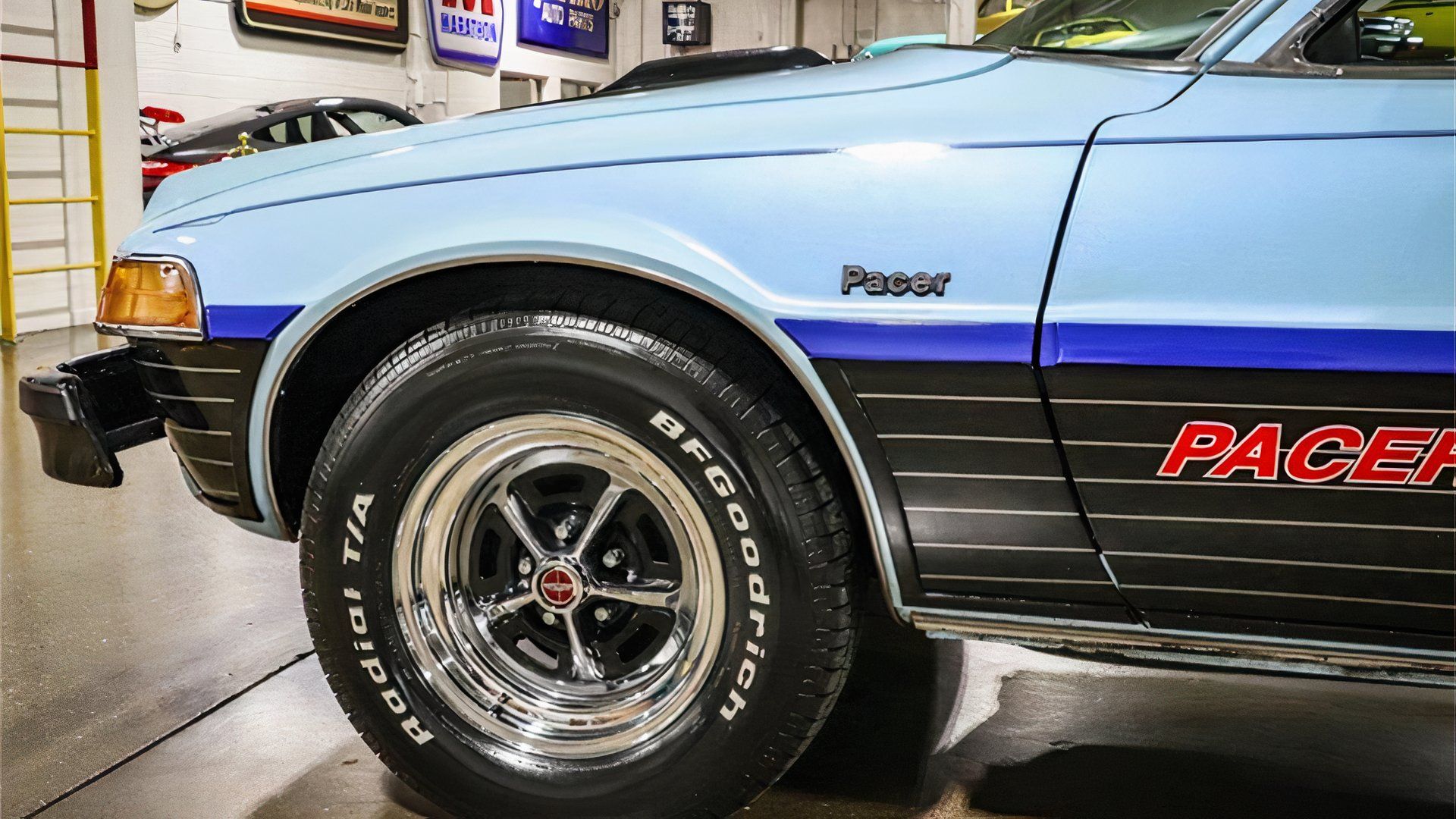
The Forgotten American Hot Hatch With A V8 Engine

While many vehicle segments have been around for over a century, such as the sedan and the truck, the hot hatchback is one that got its unofficial start just under half a century ago. It was 1976, and the Volkswagen Golf GTI debuted to immediate and widespread popularity, having come on the heels of the standard VW Golf’s unveiling in 1974. Since then, the hot hatchback has been a favorite among people who need a practical car, but also enjoy a bit of exuberant driving from time to time.
Volkswagen
- Founded
-
28 May 1937
- Founder
-
German Labour Front
- Headquarters
-
Wolfsburg, Germany
- Owned By
-
Volkswagen Group
- Current CEO
-
Thomas Schaefer
Historically, the hot hatchback has enjoyed a much larger scope of popularity in Europe than it has in the United States. There are a few reasons for this, with the largest being that the US is a big country, and we prefer larger cars. The hot hatch hasn’t gone completely without love over here, though, and we even produced a V8-powered one in the late 1970s. Hearing the words “V8” and “hot hatchback” in the same sentence almost reads like a typo, but it isn’t. That’s because AMC brought us a hot hatchback in the 1970s, which housed a large V8 under its hood. The model to sport this unconventional pairing was the AMC Pacer.

Related
The Supercharged German Hot Hatch You Never Knew Existed
In the 80s, Volkswagen introduced a series of supercharged VW Golf models.
We’ve dedicated this article to the AMC Pacer due to its optional V8 powerplant, and the fact that it was classified as a hot hatchback.
A Big Engine In A Small Package
AMC Pacer V8 Quick Facts
- Offered between 1978 and 1980
- Boasted a displacement of five liters
- Produced only 130 horsepower
- Constitutes a rarely selected factory option
It may seem odd, offering a hatchback with a V8 engine, but AMC saw fit to do so some 47 years ago. Back then, the US was still reeling from the first gas crisis, which hit our shores in October 1973. The resulting ripple effect changed the face of the American automotive market permanently, with many families opting for smaller, more fuel-efficient forms of transportation in order to save on fuel prices, as the sudden price hikes and lack of available fuel still weighed heavily on American minds.
Most of the new small car purchases were awarded to Japanese manufacturers like Toyota and Honda, both of which carried popular, small, and well-built models. American carmakers wanted to get in on the small car action, as well, and we soon began to see domestic options like the Chevrolet Vega and the Ford Fiesta. Another manufacturer to join the dogpile was AMC, which released the Pacer in 1975.
The Pacer was controversial from the start mainly due to its love-it-or-hate-it styling, with most folks swaying to the “hate it” side. In order to quell some of the dislike of the Pacer, AMC decided to offer something the other small car offerings didn’t: a V8. The mill chosen for the job was AMC’s 5.0-liter V8, an engine that had been around since the mid 1960s. AMC managed to shoehorn the giant lump of cast iron into the Pacer’s small, but wide body. However, because the second gas crisis loomed just as the Pacer V8 was launched, it didn’t get nearly as much love as AMC would have liked.
Under The Hood Of AMC’s Mighty V8 Pacer
It was the late 1970s, and American engines weren’t making nearly as much power as they did just under a decade prior. The reason behind the unfortunate reality was a large set of new, strict emissions regulations which went into full effect in 1973. Engines that were producing close to 400 horsepower in 1970 were barely cracking 200 horses by 1974, with most sitting around the 150 to 180 horsepower range. The Pacer V8’s mill was no exception, of course, and it could only manage 130 net horsepower in 1978, its first year of existence.
As for the rest of the Pacer V8’s mechanical underpinnings, its transmission selection was spread out to include three choices. A three-speed manual sat at base level, with an optional three-speed automatic and four-speed manual being offered, as well. The Pacer V8, along with the rest of the Pacer line, sported a rear-wheel drive drivetrain layout. The Pacer’s body was designed with aerodynamics in mind, sporting a drag coefficient of just 0.43, a number deemed above average for its time period.
We’ll lay out the AMC Pacer V8’s detailed engine and performance specs in the table below:
|
Engine Details |
304 CID (5.0L) AMC NA V8 |
|---|---|
|
Power |
130 hp (net) |
|
Torque |
200 lb-ft |
|
0-60 mph |
13.4 seconds |
|
Top Speed |
90 mph |
|
Curb Weight |
3,425 lbs |
|
Original Price (Pacer X 1977) |
$5,036 |
*Specs courtesy of Curbside Classic
The AMC Pacer Faced Underwhelming Competition
Because this was 1970s American motoring, the Pacer V8’s small-bodied competition didn’t boast anywhere near the sort of performance we see today, so its playing field was quite easy to dominate in terms of power. Below, we’ll take a look at two of the AMC Pacer V8’s competitors, the Chevrolet Vega and the Ford Pinto, and see which does better when compared to the AMC Pacer V8. Not exactly a comparison of champions, but this is what shoppers were faced with when choosing between American compact cars during the1970s.
Chevrolet Vega
First up, we’ll take a look at the Chevrolet Vega, one of GM’s responses to the changing American automotive landscape. It was introduced in 1970 as a 1971 model, and featured a new platform coined the H Platform. It was Chevy’s second-smallest model, belonging to the compact car class. It featured a spartan design and kit, with a base price of just $3,301, nearly two-thirds of the V8-equipped Pacer X grade’s price. The Vega never offered a V8, instead boasting a 2.3-liter inline-four engine option.
Ford Pinto
Next up is the Ford Pinto, a namesake the world is a bit more familiar with than the Vega or Pacer. The Pinto itself traces its roots back to 1971, itself seeing its first full model year at the same time as the AMC Pacer and Chevrolet Vega. It, too, boasted a small stature, and made up Ford’s second-smallest vehicle offering. It was slightly cheaper than the Chevy Vega, with a base price of $2,895. A base 1.6-liter engine was on offer for the US-spec version of the Pinto, with no V8 to be found.
What Happened To AMC?
AMC once boasted a widespread American-market presence, and did so until the early 1980s. The company was seen as a less-expensive alternative to several other American automakers, and they even had the rights to the Jeep namesake, with a few of the brand’s iconic models having been born under AMC’s ownership, such as the Cherokee. However, sales began to falter significantly in the mid-1980s, and the company was promptly sold to Chrysler in 1987, who immediately began capitalizing on the Jeep namesake, along with the famous 4.0-liter Jeep inline-six, which was an AMC mill first and foremost.
After the buyout, the AMC namesake was simply forgotten, and it gets very few mentions outside of Jeep brand history lessons these days. However, even without the fame enjoyed by the rest of the Detroit Big Three, we can thank AMC for giving the world the first V8-powered hot hatch, something that hasn’t been recreated on the mass-market since. In addition, with the tightening of emissions restrictions and other laws, we’ll probably never see a V8-powered hot hatch today, either. In that case, the AMC Pacer V8 could go down in history as a “been there, done that” model. As sad as that is, it’s just the way things go in our ever-changing society.
Sources: ClassicCars, Motor1, TheDrive, Hagerty, Classic