
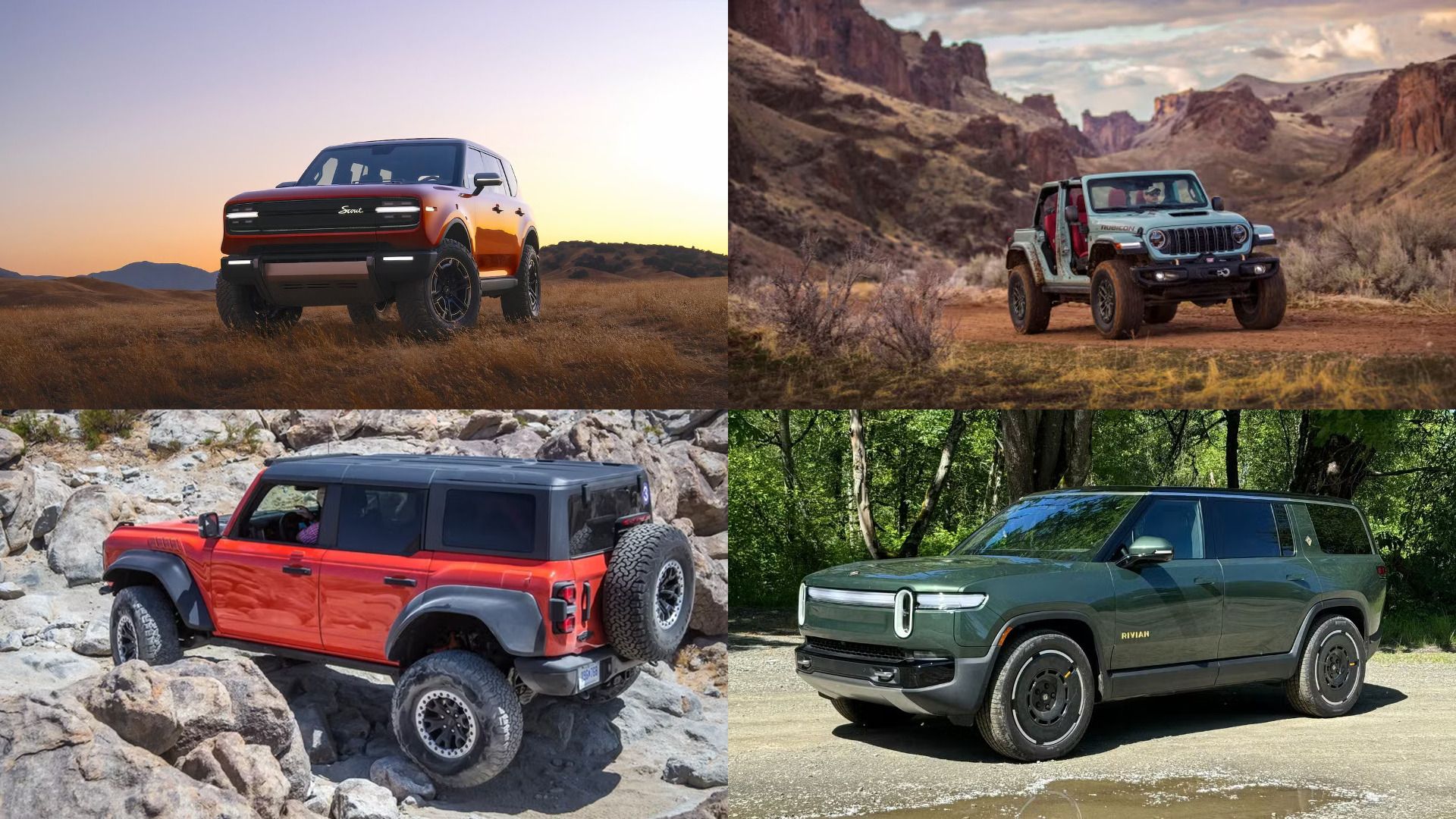
How Does The Scout Motors Traveler SUV Compare To The Competition?

Scout Motors has finally unveiled the production-ready concepts of the highly anticipated pickup truck and SUV models. The former is called the Terra, while the latter goes by the Traveler moniker. It’s an apt name considering Scout Motors intends for its all-electric SUV to go anywhere and do almost anything.
Related
Scout Returns With 500-Mile Electric Traveler SUV And Terra Pickup
An American brand reemerges with new style and a new heart.
We recently presented the benchmarks for Scout to beat if it wants to make a stand against serious off-road icons, and now that the Traveler has been revealed, we can revist those ideas to see what chance the Scout electric SUV has of coming out on top.
Scout Motors has not revealed all the specs for the 2027 Traveler; this comparison is based on what we know so far.
Meet The Scout Traveler SUV
The Traveler and Terra models will be built on a new proprietary body-on-frame platform and utilize 800-volt electric architecture. The all-electric Scout Motors models can charge at speeds of up to 350 kW and are capable of bi-directional charging. Additionally, the Traveler model will employ zonal software architecture that will allow it to implement over-the-air updates and remote diagnostic checks. It also comes with its own bespoke Scout user interface for use with the infotainment system.
Scout Motors uses two electric drive units, one for each axle, making the Traveler all-wheel drive. And while no horsepower figures have been revealed, the automaker has said that models will have up to 1,000 lb-ft of torque with a targeted 0-60 sprint time of 3.5 seconds. It’s likely this won’t be on base models, however, but that’s on par with what you get from the combustion-powered Ford F-150 Raptor R.
0:54

Related
Ford Resurrects The Best Bronco Trim For 2025
An off-roader with classic styling always works best in its simplest form.
There more to the newcomers from Scout though, including impressive towing capacities, high payload figures, and currently class-leading range estimations. Pricing will also be super competitive – if everything stays the same by the time the Traveler arrives on our roads in 2027. When we last reported on the Scout Motors SUV, we discussed its possible off-road capabilities compared to the Ford Bronco Raptor and the Jeep Wrangler Rubicon 392; let’s see how the Traveler compares, now that we know a little more about it.
How Does It Stack Up Against The Legends – And Another EV
Although the Traveler is designed for daily use and regular adventuring (as the company put it), the automaker has emphasized the new SUVs ability to take on the road less traveled – and that’s suitable, given the brand’s heritage. In our previous discussion on what the Scout SUV would need to achieve to come out on top, we pit it against the Ford Bronco and its Raptor trim, as well as the legendary Jeep Wrangler Rubicon 392.
Dimensions

Right out of the gate, the Scout Traveler has more imposing dimensions than both of the rivals – its wider, and in terms of overall length, it stretches out far beyond what either the stubby Jeep or Bronco do.
|
Scout Motors Traveler |
Ford Bronco Raptor |
Jeep Wrangler Rubicon 392 |
Rivian R1S |
|
|---|---|---|---|---|
|
Length |
207.9 inches |
191 inches |
188.4 inches |
200.8 inches |
|
Height |
76.3 inches |
77.8 inches |
74.5 inches |
77.3 inches |
|
Width |
91.6 inches |
85.7 inches |
73.9 inches |
82 inches |
|
Wheelbase |
120.4 inches |
116.5 inches |
118.4 inches |
121.1 inches |
|
Ground Clearance |
> 12 inches |
13 inches |
11.1 inches |
14.7 inches |
|
Water Fording |
> 36 inches |
37 inches |
34 inches |
43.2 inches |
|
Approach Angle |
TBC |
47.2 degrees |
47.4 degrees |
35.8 degrees |
|
Breakover Angle |
TBC |
30.8 degrees |
29.5 degrees |
29.6 degrees |
|
Departure Angle |
TBC |
40.5 degrees |
40.4 degrees |
34.4 degrees |
Significantly, it rides on a longer wheelbase – by almost four inches compared to the Bronco, and two inches versus the Jeep. That’s important because in the world of off-roading, shorter wheelbases translates to better maneuverability, tighter turning circles, and easier navigation through obstacles. A longer wheelbase typically offers a more comfortable driving experience, especially when dealing with bumps as a result of the spacing between the front and rear wheels. This feeds into the fact that Scout wants this car to be comfortable on the daily, too – but is the extensive length going to be detrimental? To put that into perspective, the Traveler is much closer to the Cadillac Escalade in length than it is to either of it’s rivals: the Escalade measures around 212 inches overall, which is just four inches longer than the Scout SUV. The difference between the Scout and the Bronco is nearly 17 inches.
Unfortunately, Scout Motors hasn’t included the approach, breakover, and departure angles of the Traveler, but has stated that it will be a highly capable off-road model with “excellent approach, breakover, and departure angles”. However, we get similar dimensions when comparing the Rivian R1S – that SUV is over 200 inches in length, has a wheelbase of 121.1 inches, and sport the same short front and rear overhangs. It’s likely to be somewhere between the R1S and the other rivals.

Add CarBuzz to your Google News feed.
Scout does say there’s ground clearance of “over 12 inches” on offer, which soundly trumps the Wrangler Rubicon 392’s 11.1 inches and closes in on the Bronco Raptor’s 13. Most impressive in the segment, however, is the R1S, which maxes out at 14.7 inches. It’ll be interesting to see how ramp, approach, and departure angles stack up.
Wading Depth

Wading depth is one of the most important things for those who take off-roading seriously. The wading depth refers to the maximum depth of water a vehicle can traverse with minimum risk, which means off-roaders have a more impressive wading depth than say, a regular truck or passenger car. Whereas the Ford Bronco Raptor can ford up to 37 inches of water, the Wrangler Rubicon 392 can manage 33.6 inches. The Traveler fits somewhere in between those two figures, with the automaker saying there’s “over three feet” of water fording. In this regard, the Rivian R1S trumps them all with more than 43 inches of water fording capability.

Related
The 10 Most Popular SUVs In America
Explore the best-selling SUVs of 2024 (so far), featuring top models from the likes of Toyota, Honda, and Tesla.
Off-road hardware

Power, wading depth, towing capacity, and payload capacities are great aspects to excel in. However, beyond that, the Scout Motors Traveler is underpinned by a handful of hardware that furthers its affinity for off-road applications. The Bronco and Wrangler are supported by capable suspension systems. The same can be said for the Traveler. Scout Motors’ SUV and Pickup truck are equipped with air springs, and active damping systems, alongside a solid rear axle. An off-road package will be offered, which includes off-road tuned dampers. It also features a front sway bar disconnect, which allows for greater articulation in off-road settings.
Another aspect that greatly affects off-road ability is the vehicle differentials. The Ford Bronco Raptor has two electronic locking differentials, one at the front and the other positioned at the rear. The Scout Motors Traveler is equipped with a mechanical-locking rear differential as standard, with a mechanical-locking front differential offered in the optional off-road package.
Add CarBuzz to your Google News feed.
Performance

We don’t have the low-down yet on exactly how much horsepower the Traveler will have, but we can compare performance in other ways:
|
Scout Motors Traveler |
Ford Bronco Raptor |
Jeep Wrangler Rubicon 392 |
Rivian R1S |
|
|---|---|---|---|---|
|
Torque |
up to 1,000 lb-ft |
440 lb-ft |
470 lb-ft |
up to 1,103 lb-ft |
|
0-60 |
3.5 seconds |
6 seconds |
4.5 seconds |
2.9 seconds |
|
Towing Capacity |
7,000 lbs |
4,500 lbs |
3,500 lbs |
7,700 lbs |
|
Max Payoad |
2,000 lbs |
1,100 lbs |
1,088 lbs |
1,973 lbs |
It’s worth noting in the table above that we don’t have the breakdown of what powetrain the supplied Traveler figures are for, but we can assume they belong to a higher-tier model, likely with three electric motors, as it comes closer in outputs to the figures quoted for the Rivian R1S in tri-motor guise.
In all respects, the Traveler soundly trumps both the gas-powered off-roaders in this specification. A lower-tier dual-motor model may come closer to the Bronco Raptor and Rubicon 392’s outputs, however.
Driving range

When it comes to electric vehicles, range is often a deciding factor for buyers – and the 300-mile mark has long been the psychological barrier automakers have to break to convince buyers they don’t have to be anxious about running out of charge. In this regard, the Traveler is one-up on it’s gas counterparts: it can go for 350 miles without needing to be filled up, and it charges at super fast speeds, so that’s not a hassle. And, with the Harvester range extended system (which comprises a gas engine charging up the batteries), range is extended to 500 miles.
The first important comparison here is to the Rivian, which offers a lower standard driving range of 270 miles. This can be extended to a maximum of 410 miles with the larger battery pack, putting the Traveler well in the lead.
It’s important to note that the Scout Motors Traveler SUV only goes into production in 2027, so by the time it arrives, these figures may not be as competitive anymore – rivals may have upped their game, so this comparison will need revisiting in the future.
Naturally, the powerful engines in the Jeep and Ford competitors are thirsty, and need good old fossil fuels to power them. EPA ratings for these two off-roaders look as follows:
- 2024 Ford Brono Raptor: 15/16/15 mpg on city/highway combined cycles
- 2024 Jeep Wrangler Rubicon 392: 16/19/17 mpg on city/highway/combined cycles
The authority also rates that the Bronco Raptor has a max of 312 miles to a tank of gas, while the Jeep can go for 366 miles. A quick calculation from the EPA shows that the annual “fuel” cost of an entry-level 2025 Rivian R1S is a third of what it would take to run the more frugal of the combustion-powered cars mentioned here – the Traveler, as it stands, will be much, much cheaper to run.
Pricing Matters
The Scout Motors Traveler SUV concept is promising, considering it has some aspects that are on par and better than two of its main rivals in its segment; it’s also on good footing with the Rivian R1S. However, one of the most important aspects of the new concept model is its price. The Ford Bronco range starts at $40,370 with its entry-level Bronco Big Bend, but the Raptor has a base MSRP of $90,035. In Jeep’s camp, the 2024 Wrangler range starts at $36,595, with the 2024 Rubicon 392 asking for $92,140. For 2025, you can buy a new base model Rivian R1S for $75,900, with the tri-motor models starting at over six figures.
A huge win for Scout Motors is that it aims to price the Traveler “under” $60,000, with federal tax credits bringing that down to the lower $50,000s. If that remains the case in three years time when Traveler production kicks off, this will be a winner in almost all regards – but we’ll have to revisit a comparison like this in the near future to be sure.
Sources:
Scout Motors, Ford, Jeep

