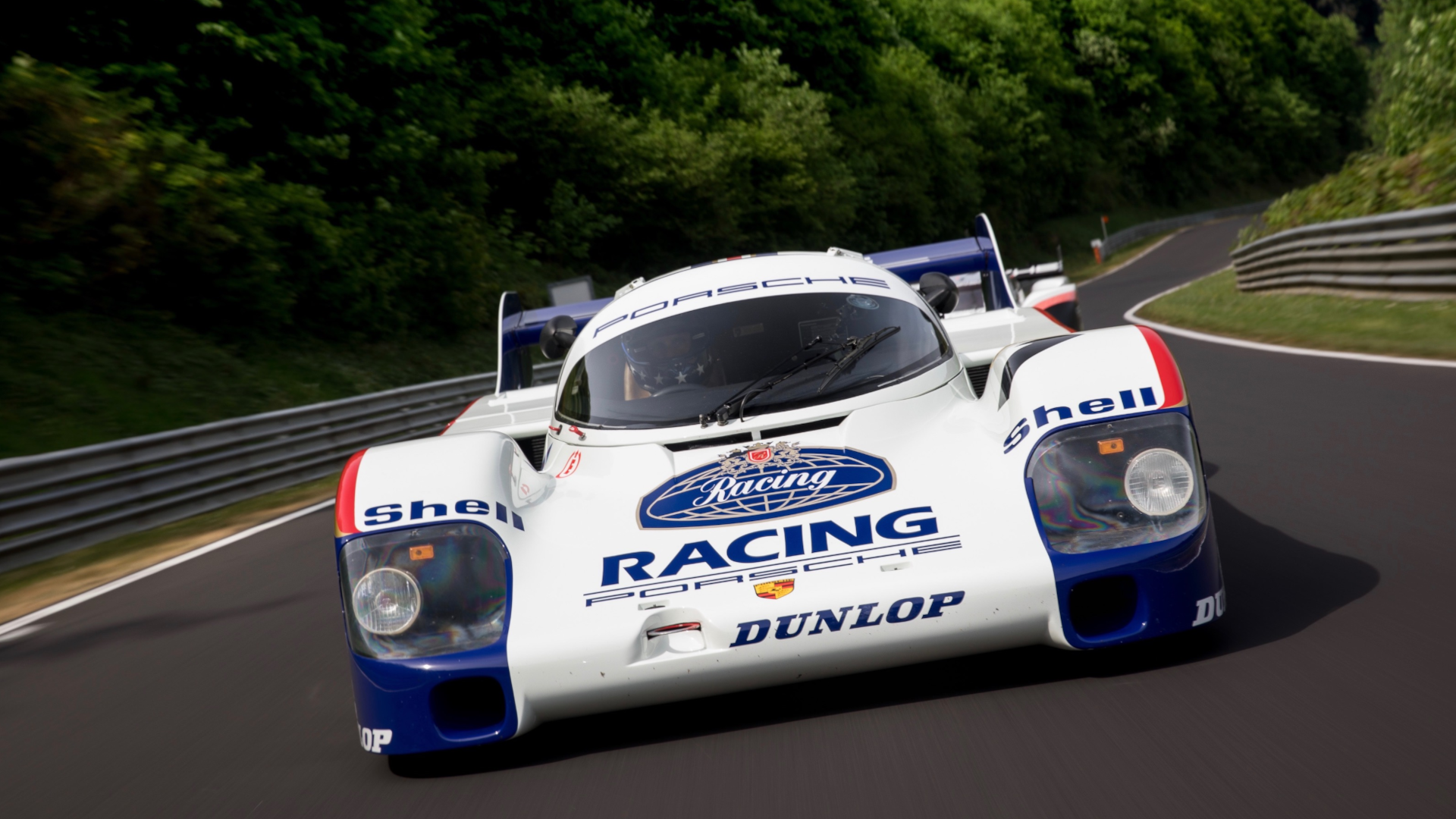
The Porsche Nürburgring Record That Stood For 35 years

Stefan Bellof was his name. In 1983, the 25-year-old German rookie took the motorsport world by storm, blitzing his famed Porsche 956 factory teammates like Jacky Ickx, Jochen Maas and Hans Stuck, at various European tracks.
Round three of the 1983 World Sportscar Championship was held at the infamous Nürburgring Nordschleife. Also known as the Green Hell, or The Ring, the 12.9 mile track has more than 170 corners, testing car and driver to the limits.
Stefan Bellof was part of the factory Rothmans Porsche team, sharing a car with English racing legend Derek Bell.
Related
Porsche Models Ranked By Their Nürburgring Nordschleife Times
Porsche’s 911 is dime a dozen at The Ring. Stock ones, modified ones, racing ones. But Porsche’s motorsport DNA runs much deeper than just the 911.
Some say Stefan Bellof’s lap in the Porsche 956 will forever remain the GOAT lap on the Green Hell. Some say the staggering record lap by the Porsche 919 Evo is the greatest ever. Whichever you believe, the story behind the record story is a fascinating one. And it’s a story of a racing legend taken far too early.
The Legend That Was The 956

At the time the Group C 956 represented the tip of Porsche’s motorsport spear, and the car to beat in the Sportscar championship. Powered by a 2.6-liter flat-six breathing through a turbocharger, the 956 had 620 hp of power on tap and could reach a top speed of 220 mph.
The rules that governed this class were of particular interest too. In an effort to curb ultimate horsepower and speed, the regulations stipulated that the minimum weight of a car must be 1 767 pounds, the fuel tank is limited to 26.5 gallons, and each car is limited to five refueling stops during a 1 000 km (625 mile) race.
In effect, each car had to complete the 625-mile race with a maximum of 159 gallons of fuel. But don’t think this restriction slowed the Porsches down. The engineers managed to squeeze that 620 hp from the 2.6-liter six, while curbing the motor’s drinking habits, so the team could better manage the 159 gallons during an endurance race.
But back to the Green Hell, and a young little upstart called Stefan Bellof. He took to the track in the Rothmans Porsche 956, with clear intent to secure pole position from his esteemed teammates. After an eventful out lap, where he had to overtake the reigning Formula One world champion Keke Rosberg, also piloting a Porsche 956, he put the hammer down.
It is said that, on that flying lap, a Porsche 911, competing in a lower class, temporarily impeded his lap. And he had to drive around lots of other slower traffic too. But no matter: when the 956 completed that lap, the clock was stopped at 06:11.13. Some say it was a lap of the gods. A once-in-a-lifetime lap.
The second-fastest driver was Formula One legend Jochen Maas, who recorded 06:16.85 – more than five seconds down the road, a lifetime in motorsport terms. Reigning F1 champion Rosberg was more than 30 seconds slower. After the session was finished, Maas was asked about his impressions of that lap. Maas replied, simply and without an ounce of doubt: “It is plain skill, I guess. He’s got more skill than us, I’m afraid so.”
It was a record that stood for 35 years, only broken in 2019 by Porsche’s modified 919 Evo with more than 1 000 horses, and 50% more aerodynamic downforce than the original 919 that won the Le Mans 24 Hour.

Related
10 Things You Need To Know About The Nurburgring Nordschleife
Equally loved and feared by car enthusiasts all over the world, the Nordschleife is one of the most famous racetracks in history.
Bellof. The Man, The Legend

After that lap, and limited success in the Sportscar series, the young German was drafted into Formula One, driving a so-so Tyrrell, powered by a naturally aspirated Ford engine that is said to have had about 200 hp less than the turbocharged cars. During the Monaco Grand Prix, a race heavily affected by rain, the youngster stormed from the very last position on the grid in atrocious conditions, catching front-runners Alain Prost and Ayrton Senna.
The young Senna had also sensationally blitzed through the field from 13th position, lapping four seconds per lap quicker than Prost. Prost frantically waved at the marshals to stop the race when the rain started belting down even more, and race director Jacky Ickx – ironically Bellof’s Rothmans Porsche teammate – obliged.
Senna had comprehensively rattled the establishment’s cage. But so had Bellof, who finished in third place.

Related
10 Fastest Nurburgring Lap Times For Production Cars
These road-legal machines are criminally quick.
With talk of a Ferrari Formula One contract in the pipeline, fate would intervene in 1985. Back in the day, top drivers like Belloff competed in both Formula One and the Sportscar championship. So Bellof lined up for the 1 000 km Spa-Francorshamps endurance race.
He was fighting for the lead against his former Rothmans Porsche 956 teammate Jacky Ickx, by then a bitter rival after Ickx made it clear that he would not let the German youngster beat him. For three laps, the factory Porsche blocked Bellof’s privateer Brun Motorsport Porsche 956. On the straights, the Rothmans car pulled away from Bellof’s Porsche, and in the corners Ickx apparently blocked the young German, preventing him from overtaking.
After three laps of battling the factory car, Bellof set up a brave overtaking move in what is arguably the world’s most famous motorsport corner: Eau Rouge.
Heading up a hill, Eau Rouge is a daunting, high-speed prospect, an S-bend that requires an inordinate amount of commitment. Some observers later said that Bellof’s talent was obvious, but that he had a tendency not to know when to back off, and when to attack. This was a day when a more circumspect approach would most probably have gifted us the opportunity to see Bellof win many championships.
As it stands, Bellof bravely stuck his Porsche on the outside of Ickx’s 956, leaving enough space. Running next to each on the entry of Eau Rouge, a side draft effect caused the two Porsches to touch… Ickx’s car went backwards into a barrier, saving his life. Bellof was not so lucky. His Porsche hit a concrete pillar, smashing through a barrier.
The mangled Porsche 956 caught fire, marshals battling the blaze. Ickx, marshals and members of the Porsche team rushed to extract Bellof from the wrecked 956, and finally managed to get him out, about 10 minutes after the crash. Doctors immediately attended to him, but it was soon obvious that nothing was to be done: the initial impact had caused massive internal damage, and he was pronounced dead shortly afterward.
It was nearly a decade later that Germany finally crowned a new Formula One champion, one Michael Schumacher, who made it clear that Bellof was his idol.
To this day, many motorsport fans regard Bellof as the one and only king of the Green Hell – he set the record in a racing car that conformed to the racing rules of the time, similar to other cars on the track. He did not use a no-trick-spared one-off special like the Porsche 919 Evo.

Add CarBuzz to your Google News feed.
The Car That Finally Smashed The Record
Designed to compete in the LMP1 class at the famous Le Mans 24 Hour race, the 919 Hybrid won the World Endurance Manufacturers Championship from 2015 to 2017, winning Le Mans three times in succession.
Porsche pulled out of the LMP1 endurance class early in 2018 to focus their motorsport efforts on the then new Formula E all-electric formula. But in 2019, Porsche rolled out a highly modified version of the 919, called the Evo.
With no rulebook to worry about, Porsche’s engineers went to extraordinary lengths to create a one-off special that would aim to smash lap records at selected tracks around the world.
This included Spa-Francorchamps. In 2019, the Porsche 919 Evo did claim the overall record with a time of 01:41.77, but the very next year, Lewis Hamilton, driving his AMG-Mercedes Formula One car, reclaimed the overall record with a qualifying time of 01:41.25.
The famous Green Hell was the big target, and the 1160 hp Evo obliterated the time set by Bellof in 1983, stopping the clock at 05:19.54 – almost a minute faster than the 956 managed. Note, it was completed on a closed track, with no other traffic.
Weighing 1870 pounds, with virtually double the power of the 956, and with modern tricks like torque vectoring and all-wheel drive and aero that provides 50% more drive than the original 919 racecar, it was kind of inevitable that this tricked out pony would break the record.
A Lap Of The Gods?

All this technological trickery only highlights how amazing Bellof’s lap actually was. He had 620 hp. He had only rear-wheel drive, and no fancy driving aids. He had a manual five-speed gearbox. He had traffic to deal with. At least the 956’s aerodynamics were also state-of-the-art, with an underbody tunnel providing additional downforce. But it was not nearly as trick as the 919’s system.
Bellof’s lap was indeed a lap of the gods.
And it is no wonder that the record stood for an amazing 35 years.