10 Famous Cars And The Concepts That Inspired Them

A couple of weeks ago, we re-introduced you to the Mazzei Formula Five, a sub-2,400-pound Le Mans-style machine that’s road-legal, with a five-rotor engine that screams like a V10 Formula 1 car and has a better power-to-weight ratio than a Bugatti Tourbillon. It’s a piece of (superb!) lunacy that reminded several of us in the CarBuzz office of Mazda’s little-remembered Furai concept from 2008, which also has an odd-numbered rotor engine, sleek bodywork, and a vague Le Mans racing connection.
Mazda
- Founded
-
January 30, 1920 (as Toyo Cork Kogyo Co)
- Founder
-
Jujiro Matsuda
- Headquarters
-
Hiroshima, Japan
Unsurprisingly, that arbitrary trip down automotive memory lane got us thinking about other concept cars and what became of their designs. And no, we’re not talking about the likes of BMW’s Vision EfficientDynamics or Nissan’s GT-R concepts, where production plans were already in the pipeline.
We’re talking about design and/or engineering studies that went on to influence some of the most significant sports cars in history. One of which may surprise you. By the way, if you were wondering what happened to the only Furai ever built, it burnt to a crisp during a Top Gear road test in 2013, by which point Mazda had already turned its attention to working on the CX-9.
All details and most of the below images came from each manufacturer’s respective online media centers.
10
Volkswagen ID.3
IRVW Futura

One, at its fiery GTX Performance best, is a 322-horsepower, all-electric hatchback that Volkswagen contends is as significant for the brand as the original Beetle and the Golf. The other is an egg-shaped concept with gullwing doors and a 1.7-liter inline-four barely capable of 82 horsepower. There are surprising parallels, though.
The Integrated Research Volkswagen Futura concept, for example, featured four-wheel steering, distance/parking sensors, and an onboard computer, which were novel features for this vehicle from 1989. Like VW’s first mass-produced EV that followed 30 years later, the Futura was innovative. Volkswagen even stated that “elements of its original design could be seen in the production ID.3.” The ID.3 bore a strikingly similar bright blue paint to its predecessor when the cover came off at the Geneva Motor Show in 2019.
9
Corvette C3
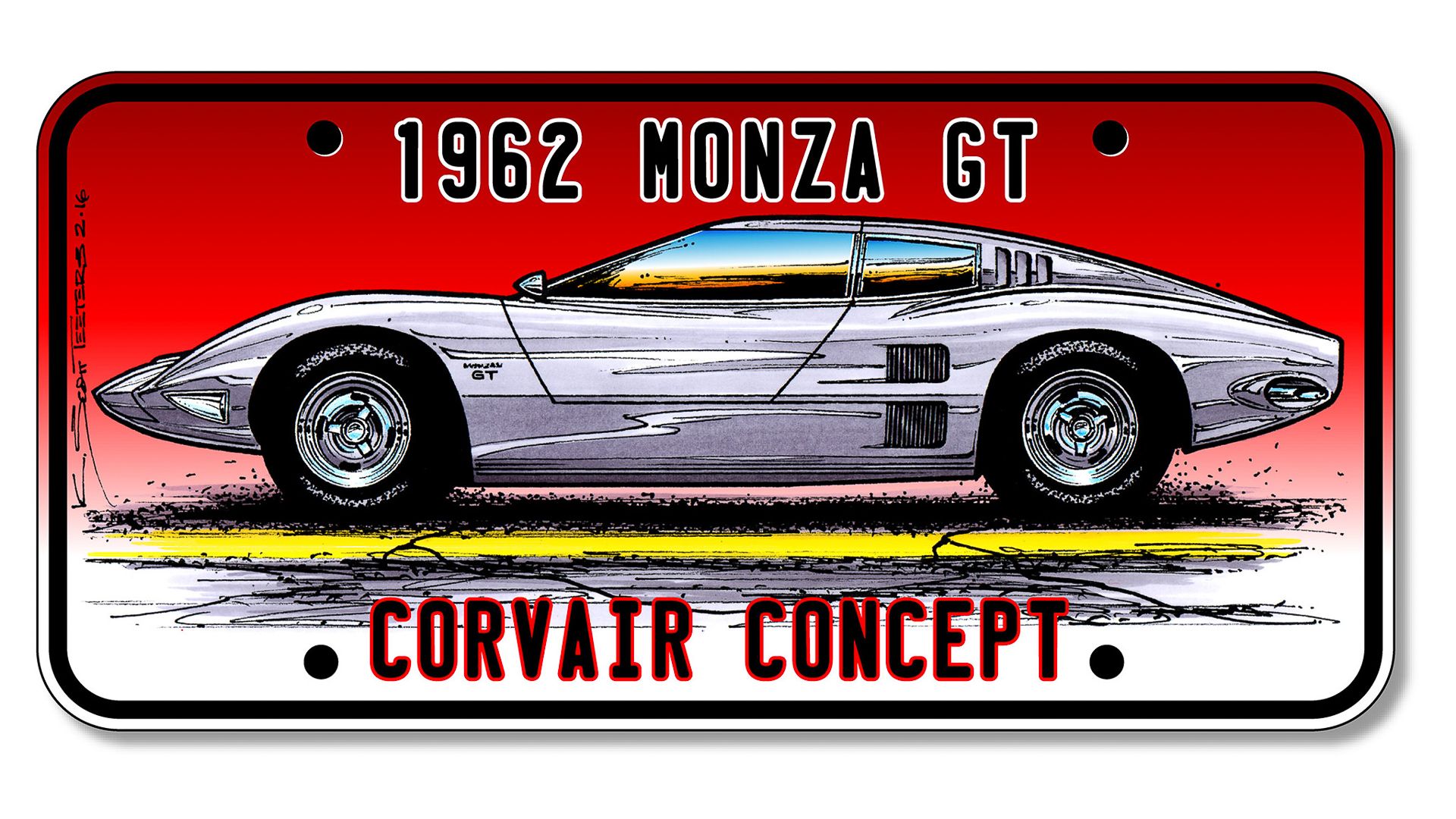
Monza GT
Nope, Chevrolet never intended the ‘Monza’ to replace the original Corvette. This concept was instead designed to showcase the flexible platform and innovative transaxle on the VW Beetle-rivalling Corvair. So much so that most of the Monza’s design was wildly impractical. The wraparound canopy, for example, with a missing A-pillar and creased windshield, hinged upward and out of the way for easier access and egress. However, this panel wasn’t legal for a production car. The air-cooled six-cylinder sat behind the driver for better weight distribution, but still produced just 102 horsepower. The “alligator headlights” and their folding doors barely worked. The Monza design clearly struck a chord, though, as just three years later, the Chevy Mako Shark concept echoed this car’s undulating lines. In 1968, the third-generation Corvette brought the shape into production.

Related
Max Verstappen’s Car Collection Is As Impressive As You’d Expect
What do you drive when you’re not only rich, but arguably the best driver in the world?
8
Renault R.S.01 (and Alpine)
DeZir
While this entry could have gone to the fourth-generation Renault Clio, the first production vehicle to feature the DeZir concept’s Circle of Life design language, the R.S.01 seems more fitting. For starters, the company dropped the 2010 concept’s electric powertrain in favor of a 500-plus-horsepower twin-turbo V6 from the Nissan GT-R, and the DeZir’s design was carried over almost wholesale.
Secondly, the R.S.01 marked the first time Renault seriously considered going against Ferrari, Porsche, and Audi with a track-focused model. Plus, the R.S.01 was the last Renault sports car to be launched before – and thus helped draw significant attention to – Alpine’s revival in 2017.
7
Lamborghini Espada
Lamborghini Marzal / Bertone Pirana
Ferruccio Lamborghini greenlit two projects in 1965: a two-seater sports car that would eventually become the Miura, and a four-seater money-maker that promised Rolls-Royce-esque comfort with Italian passion. Both of them used the same TP400 chassis. The future Espada’s design, penned by Bertone’s Marcello Gandini (not the first time you’ll see that name on this list) eventually debuted as the ‘Marzal’ at Geneva in 1967 featuring two enormous, transparent gullwing doors, space-age silver leather masquerading as chrome, and a refined inline-six in place of the 350’s fiery V12.
The design underwhelmed Mr. Lamborghini. Meanwhile, he commissioned Bertone to design a more down-to-earth show car for the London Auto Show. Gandini took elements of the Marzal for his creation.”By George, I think he’s got it,” quoth Lamborghini when he saw the more practical four-seater design. In 1968, the newly renamed Espada, complete with longer chassis, conventional doors, and a V12, debuted in Geneva. It remained the Raging Bull’s best-selling model for more than a decade.
6
Jaguar F-Type
‘F-Type’ X600

Though Jaguar had looked to rekindle its vaunted E-Type during the 1980s, ignoring the cool but unreliable XJS, it wasn’t until 1999 that the Big Cat revisited the idea. The result was a one-off ‘X600’ concept with inspiration coming heavily from Jaguar’s 1999 XK180 design study that featured no roof, door-mounted side mirrors, and E-Type-esque bodywork.
Upon its debut, there were 50,000 orders on the spot! One problem, though:, was that its custom chassis made a production version of the X600 nearly impossible. A mid-engined example might still have worked had Jaguar parent company Ford not pivoted towards diesel-powered sedans, and the ‘two-seater roadster’ route was binned in 2002. Jag’s new design director, Ian Callum, nevertheless slotted the idea away for a future date, and in 2011, the Callum-penned C-X16 concept debuted in Frankfurt. On a production-ready chassis. Forty years after its predecessor disappeared, the F-Tyoe finally arrived in 2014.

Related
The Maserati Boomerang Concept Gets New Life Thanks To Giugiaro’s Son
Inspired by the wedge-shaped 1972 Maserati Boomerang concept, the GFG Style Peralta S is based on a modern MC20.
5
DeLorean DMC-12 (and the Lotus Esprit, And the Lancia Delta, And…)
Maserati Boomerang
Giorgetto Giugiaro’s wedge-shaped Boomerang proved so significant, its design can be seen in almost a dozen ItalDesign creations across the mid-to-late 1970s, including Volkswagen’s Mk.1 Passat and Golf, and Lancia’s most successful rally car ever. Debuting as a static model at the 1971 Turin Motor Show, the bullet-shaped concept, produced by Italdesign, stood just 42 inches tall, featured a driver cluster within its spoke-less steering wheel, and boasted a windshield so aggressively raked (13 degrees) that most OEM glass manufacturers refused to replicate it, claiming the design severely restricted driver visibility. They’d be proved wrong (sort of…) when ItalDesign incorporated a 22-degree windshield rake onto the 1976 Lotus Esprit. Five months later, a rolling prototype was unveiled, boasting the same 310-horsepower, 4.7-liter V8 as Maserati’s Bora. Infuriatingly for Giugiaro, though, the Trident refused to put the Boomerang into production, and it wasn’t until 1975, by which point he was contracted by former General Motors executive John DeLorean, that Giugiaro’s wedge-shaped design would finally be realized.
4
Bugatti Veyron
Audi Rosemeyer

CarBuzz’ very own Nigel Evans provides a thorough overview of the Audi Rosemeyer HERE, so just think of this as the Cliffnotes version. Unveiled in 2000, the Rosemeyer concept was named in honor of Audi – né Auto Union – factory driver, and posthumous land speed record holder, Bernd Rosemeyer. It was certainly a looker, boasting as it did brushed aluminum – and incredibly aerodynamic – bodywork and truly massive wheels à la Auto Union’s 1930s Grand Prix racers. More than ‘just’ another design study, however, and like parent company Volkswagen’s W12 Nardo that landed in 1997, the all-wheel drive Rosemeyer featured a hulking 8.0-liter W16 engine that eventually found mainstream clout with sister brand Bugatti following the French marque’s acquisition by VW in 1998. Come production time, of course, the Rosemeyer’s adorable 700-horsepower output had been stoked out to 1,001-horsepower in the newly-renamed, and history-making, Veyron.
3
Lamborghini Countach
Alfa Romeo Carabo
Is the Alfa Romeo Carabo the most important concept of them all? For starters, and even though it used the same chassis as the famously curvaceous 33 Stradale, the Carabo showcased the radical ‘wedge’ as early as 1968. The design was practical, too. Mounting a small but potent 2.0-liter V8 midships, for example, allowed room for an almost completely flat fiberglass nose that prevented the front-end from lifting at high speed, a notable problem on the Lamborghini Miura. The front-hinged doors, meanwhile, meant passengers could scramble over the extra-thick sills even in the tightest of parking spaces. And while budget issues – and the fact it wasn’t even close to being road legal – meant Alfa Romeo never put the Carabo into production, Gandini later recycled the design for Lamborghini’s LP500 concept, the precursor to, arguably, the greatest wedge-shaped supercar of them all.
2
Lancia Stratos
Stratos Zero

Contrary to popular belief, the Stratos Zero concept that debuted at the 1970 Turin Motor Show was never meant to go into production. As well as being the latest haymaking throw in an on-going duel between Italian design houses Bertone and Pininfarina (which, incidentally, debuted the equally insane Ferrari Modulo at Geneva seven months earlier), the internally-dubbed Stratolimite and/or Zero – i.e. ‘limit of the stratosphere’ – was explicitly developed to see how low a functioning prototype could be built: from the ground-up, the ‘Stratos HF’ concept stood just 33 inches tall. It was powered by the only Lancia engine that could fit – the Fulvia’s 1.6-liter four-cylinder – and access to the horizontal front wheel seat was via the flip-up windshield. It was only after his company’s creation had caused such a stir that Nuccio Bertone went to visit Lancia to discuss a production model. One that, whilst bearing little resemblance to its forebear, went on to rock the rallying world.

Related
This Might Be The Wildest Customer Porsche 911 Of Them All
What happens when your Porsche hits a kangaroo?
1
Porsche 911 (901)
T7 Concept
Porsche’s Type 754 ‘T7’ concept was the spark that lit the blue touch paper. Developed by brand heir apparent Ferdinand ‘Butzi’ Alexander Porsche in the latter stages of 1959 as a successor to the 356, the first T7 design study – the ‘Type 695’ – used the same round headlamps and chrome detailing as its muse, but featured a flat tail with horizontal taillamps, wraparound rear windshield, and an elongated wheelbase that allowed four actual seats. Erwin Komenda, father of the 356, suggested a more harmonious, fastback look when he gave the T7 design a crack, and also added longer vents for the overhauled flat-six. All of which Butzi later refined into the Type 754 – now renamed the ‘901’ – that debuted at the Frankfurt Auto Show in 1963. Only a few examples were built with that nomenclature, of course, and after Peugeot kicked off over naming rights, Porsche decided to rebrand its new 2+2 as the 911. Motoring history had been made, and none of it would have been possible without the T7.