Chevrolet Reached Back to 2009 For One Of The C8 Corvette’s Best Features

When the latest Chevrolet Corvette arrived in its C8 generation in 2021, it changed the game for the legendary nameplate in many different ways. The Corvette had always used the latest technologies to its advantage, often launching new features and systems that would wind up on other performance and luxury models under the GM umbrella. Among these new features and systems in the latest Corvette were several that make nighttime driving an especially memorable experience, including one that had been extinct for a decade before its resurrection for use in the latest Corvette.
Chevrolet
- Founded
-
November 3, 1911
- Founder
-
Louis Chevrolet, Arthur Chevrolet, William C. Durant
- Headquarters
-
Detroit, Michigan, United States of America
- Owned By
-
General Motors
- Current CEO
-
Mary Barra
Whether considering a new or used Corvette from its latest generation, you’re in for a pretty special nighttime driving experience. Below, we’ll look at one of the C8’s most clever after-dark features, and where it came from.
This feature focuses on the 8th generation C8 Corvette. Technical data is sourced from the manufacturer.
A Very Different Corvette Arrived In 2008
The most controversial Corvette yet marked the first generation for a mid-engine design, and a stronger presence among the world’s fastest exotics. Behind the two-seat cockpit was a 6.2-liter V8 engine with the better part of 500 horsepower as standard, and an 8-speed dual-clutch transmission that could shift from one gear to the next at eye-watering speed, with no axle lash or interruption in power flow.
|
2025 Chevrolet Corvette Stingray Specifications |
|
|---|---|
|
Engine |
6.2-liter V8 NA GAS |
|
Horsepower |
495 hp |
|
Torque |
470 lb-ft |
|
Transmission |
8-DCT |
|
0-60 |
3 sec (approx) |
Elsewhere, GM’s latest performance car tech was on display, with little from the automaker’s technological gene pool going unused. The interactive performance display kept drivers up on all vital telemetry and more, including the real-time lockup factor being applied across the rear axle by the electronically controlled limited slip differential, for heaven’s sake. An around-view camera monitor eliminates the visibility compromising challenges of the C8’s styling, and the suspension can even read and adapt to the road in real time, or lift its front axle with a button press to clear speed bumps and curbs.
Still, somewhere beneath all of that cutting-edge new tech was a largely unadvertised, often-unnoticed little touch that made a big difference in the dark – and it came from Saab.

Related
BMW Might Get Colorful With Its Headlights
Or at least, as colorful as laws will allow.
An Old Secret Weapon For After Dark Driving
Driving can be hard on the eyes, especially if you’re flying a jet. In a car, things are bad enough: you’ve got the bright sky in the upper half of your vision, and the darkened car interior and instruments in the lower half. Glancing between one and the other in harsh lighting can cause significant eye strain as your pupils adapt to the changing brightness. Eye strain makes your eyes tired and weak until they’ve had a rest, and if your eyes are often strained in daylight, they’ll be tired and sore by the time the sun goes down.
If you’re flying a fighter jet, things get worse. There’s much more sunlight in your cockpit, it’s much brighter, much more of the time, and there are a lot more instruments to read. That’s the basic reason why some aviator sunglasses are darkened only on top: this allows pilots (or drivers) to protect their eyes from the glare of the sun up ahead, while keeping the lower-mounted instrumentation ahead of them easy to read.
Aviator sunglasses like these are one solution to an eye-fatigue problem faced by pilots and drivers alike. Another was launched by Saab with the name ‘Black Panel’, which eventually became ‘Night Panel’ for more clarity. According to lore, defunct Swedish automaker Saab brought this feature to market in the mid-90s under the Black Panel name, and was the only automaker offering it. Back then, it was a clever adaptation of a feature used in aviation to help pilots reduce eye fatigue and focus in the dark. Saab’s history was rooted in the world of aviation, and Black Panel – soon to be renamed ‘Night Panel’ – was a great way to remind shoppers of it.
The feature was subtle, but activating it shut off all forward illumination in the car’s cabin, including most of the instrument panel other than a portion of the speedometer, and the fuel gauge. If other gauges needed attention, they’d light up automatically. This seems pretty basic on paper, but from behind the wheel, the result was stark: all light-based distractions from within the vehicle could be eliminated, making the cockpit invisible to the driver on a dark road. With virtually no onboard lighting, the only thing visible is literally the road ahead – which helps drivers focus more easily once the sun’s gone down, and makes the nighttime drive feel more personal since it’s just you and the road.
Saab started circling the drain in the mid-2000s, and by 2007, things weren’t looking great at all. Saab cars and dealerships soon disappeared, taking Night Panel technology with them. After taking full control of Saab in 2000, GM sold the brand off in 2010 for it to change hands a few more times en route to bankruptcy a short time later.
Night Panel died with the Saab brand in the late 2000s (technically the 2011 Saab 9-5 was the last car to offer it) but in 2021, the Chevrolet Corvette C8 resurrected it. It’s likely GM designers and engineers were aware of the technology and its benefits, perhaps tying it into the development of the C8’s interior, which does look jet-inspired.
It’s the same simple idea: turn the instrumentation dimmer switch down to its lowest setting, and all forward lighting dims to the minimum. Turn the dial further for a ‘click’, and a discrete digital speed readout and fuel gauge are the only light emitted by the forward cabin. Now called ‘Night Mode’ by the Corvette’s owner’s manual, activating it means the driver’s forward view consists only of the road ahead, bathed from one side to the other in clean, white light that thickly saturates the surface of the tarmac and punches into nearby roadside culverts. Your eyes feel supercharged and focused. If you prefer, lighting the forward dash back up is just a few millimeters worth of dial-twist away.
Is Night Panel a safety feature? A novelty? A driver assist? We figure it’s a handy bit of all three.

Related
10 Tips For Safer Night Driving
Driving in the dark is considerably more dangerous than driving in the day. Don’t let daylight savings throw you off your game.
Other Tech That Makes The C8 Great In The Dark
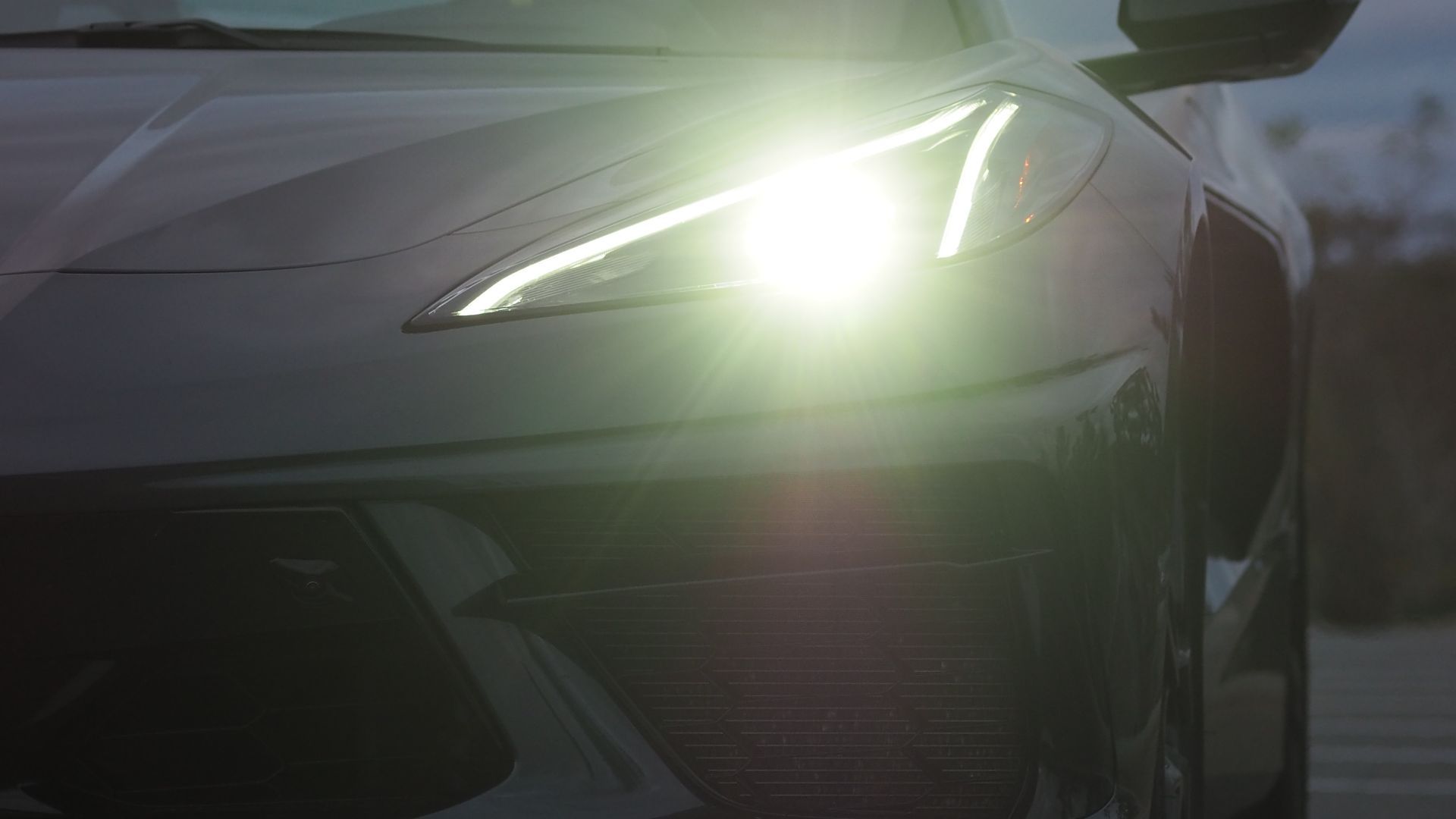
A few other notable touches make the C8 particularly great to drive in the dark. The first is its potent LED headlights. Most drivers will appreciate a wide, bright, even spread of consistent light up the road, with a clean white color that makes it easy to pick up detail far away. The automatic high-beams are well controlled, and on my 500-plus miles of after-dark driving I noted no issues being ‘beamed’ by other motorists. The C8’s headlights have impressive engagement and reach to far-away reflectors, too. A powerful lighting system means you’ll enjoy more of what your C8 can do in the dark, and that’s what’s on offer here.

Related
Saab’s Final Luxury Sedan Is A Sublime Used Buy, But Can You Maintain It?
Saab’s final luxury sedan offers a unique blend of style and performance, but should its distinctness scare buyers off?
Ditto the rear camera mirror system. The C8’s stunning shape has some major compromises to outward visibility for the driver, so various camera-based systems have been employed to help. Usually found in crossover SUVs, the rear-camera mirror system features a small exterior-mounted camera that feeds a live image to the rearview mirror, itself a high-resolution screen. The image on the screen shows a rear-looking view of the back of the C8 that’s multiple lanes wide, making lane changes a cinch despite the C8’s blind spots. Best of all, special software helps improve image quality in the dark, all but eliminating glare and giving drivers more quality information about what’s going on the world around them.
The best and most useful technologies don’t always have to be complex, and the C8 Corvette shows how a few modern-day adaptations to existing technologies continue to help give it a competitive edge.
Sources: GM, Chevrolet, Saab