Chrysler Is Officially A Minivan-Only Brand In 2025

Quick Links
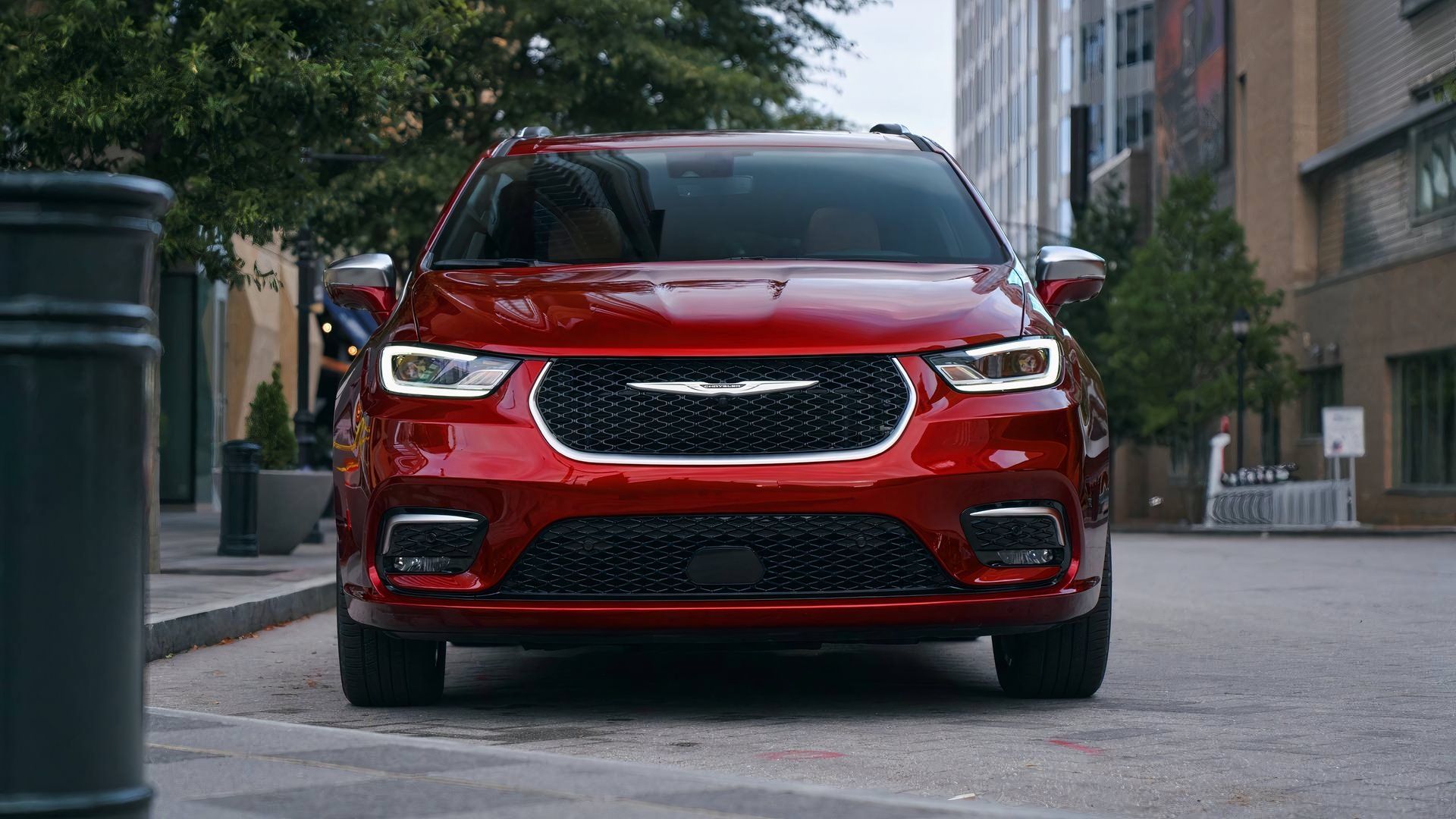
For some years now, Chrysler has been a dead brand walking. Offering outdated vehicles, and focusing on unpopular segments, it has slowly eroded its range to the point where, in 2025, the only new Chrysler you can buy is a minivan. While the Chrysler Pacifica is actually a great family van – it’s consistently scored highly in CarBuzz reviews and won our 2020 Family Fun Award – the push towards SUVs and EVs has left it competing in a dwindling segment.
That puts Chrysler in a tricky position; with no other model to fall back on, it may be the beginning of the end. The demise of automotive icons is nothing new; Oldsmobile, Plymouth, Packard, and Studebaker are just a handful of once-great US automakers that are no more. The potential demise of Chrysler seems to hit harder, though, especially as it will be celebrating its 100th birthday in June this year. We take a look back at this marque’s incredible history, where we are today, and what the future could potentially hold for this troubled brand.
As of 2025, Chrysler’s website lists only minivans for sale. We delve into how this once-revered automaker has arrived at its sorry state and what plans it has to turn things around in the future.
Chrysler Now Only Offers Minivans From New
To many younger car fans, Chrysler represents either the 300 sedan or the Pacifica minivan. That’s all it’s had on offer since 2017, when the Chrysler 200 was discontinued. The 300 was axed in 2023 after 18 long years and two generations on the market. At its core, it was a mid-level luxury sedan, but despite the aging Mercedes-Benz-based platform, the V8 versions were fast and great fun on the open road. The final model to be sold was the 6.4-liter 300C. Just 2,000 were allocated to the US. After these units were sold out in 12 hours, we were left with the V6-powered 300, and the lesser 5.7-liter V8 model. Those have finally disappeared from the website, and we are left with the Chrysler Pacifica and Voyager minivans.
Take a look at Chrysler’s website, and there seem to be three models on sale for 2025. However, the Voyager is more of a de-contented Pacifica than a separate model, and the Pacifica Plug-in hybrid is just an alternative engine option that is otherwise identical to the gas-powered version.
|
Model |
Pacifica |
Pacifica Plug-in Hybrid |
Voyager |
|---|---|---|---|
|
Engine |
3.6-liter V6 |
3.6-liter V6 + Hybrid |
3.6-liter V6 |
|
Power |
287 hp |
260 hp |
287 hp |
|
Max Seating |
8 |
7 |
8 |
|
Starting MSRP |
$42,450 |
$51,055 |
$39,995 |
As far as minivans go, the Pacifica has a lot going for it. It looks sharp, can be specced with a whole host of family-friendly extras, and has the useful Stow ‘N Go seats that no other minivan offers. However, it’s been on sale since 2017, and slightly fresher alternatives, like the Toyota Sienna and Kia Carnival, are also available. Still, it remains the only plug-in hybrid minivan on sale – the Sienna is a mild hybrid – and the option of AWD on gas-powered models also extends its appeal.
Despite its age, the Pacifica is still the sales volume leader, currently outselling the Honda Odyssey, Kia Carnival, and Toyota Sienna. And just in case you didn’t know, Chrysler created the minivan segment in the first place. But with the threat of major tariffs being placed on the automotive industry in Canada (that’s where the Pacifica is built), it may be priced out of contention in the near future.
How Did We Get Here?
Let’s get a quick recap of Chrysler’s origins out of the way first. Chrysler was founded from the remnants of the Maxwell Motor Company in 1925 by Walter Chrysler. Chrysler went from strength to strength thanks to the combination of technologically advanced and solidly engineered vehicles and the introduction of sub-brands like Plymouth, DeSoto, and Dodge to serve several market segments.
It was at the forefront of innovative design in those early years, and cars like the 1934 Airflow and 1957 300C were sleek, stylish and paved the way for continued growth and expansion, eventually spreading to Europe in the ’60s. The tough economic and regulatory situation in the 1970s saw Chrysler’s fortunes take a turn for the worse. It couldn’t adapt quickly enough to changing consumer tastes, and rushed vehicle designs resulted in reliability taking a dive. Loans from the government, offloading European business interests, new leadership, and badge-engineered Mitsubishi clones started turning things around.

Related
10 Famous Chrysler Models Celebrating How Great The Brand Once Was
Chrysler is on the ropes – again – with just one model currently for sale. But it wasn’t always this way as evidenced by these greats from the past.
In between this turmoil, the Dodge Caravan Minivan was introduced in 1983, creating a new segment and signaling a return to profitability. Then, with the incorporation of American Motors Corporation (AMC) into the fold, Chrysler gained access to the Jeep brand and a compact front-wheel-drive platform. Then things started to go wrong. In 1998, Daimler-Benz and Chrysler merged to form DaimlerChrysler, an ultimately ill-fated move that ended in 2007, after which the 2008 recession dealt another blow to Chrysler. A buyout by Fiat ensued, and after some restructuring and name-changing, Chrysler now falls under the multinational auto company, Stellantis.
Like any automaker that has been around long enough, Chrysler has also created some automotive howlers along the way. The PT Cruiser and LeBaron were unforgivable heaps, but the road to oblivion for large automakers is often a slow descent, signposted by sloppy mediocrity. And Chrysler had plenty of models that fit the bill. Whether it was the Sebring sedan that was so middle-of-the-road that it straddled two lanes or the Cirrus sedan, the epitome of average, Chrysler slowly lost its brand identity and desirability. With so many alternatives to pick from, mediocre just didn’t cut it.
There were some tantalizingly close near misses, too, like the Prowler, a retro-inspired roadster that was a decent engine away from greatness. But in the 2020s, the V8-powered 300 was the closest we got to a cool Chrysler product.
So, What’s Next?
Chrysler may be down, but it’s not out just yet. The Pacifica remains a compelling buy in its class, and plans are underway to introduce new EVs, including an all-electric Pacifica. Chrysler’s EV aspirations were first showcased by the 2020 Airflow concept and, more recently, the Halycon concept. Both introduced interesting new tech, some of which may make it into an all-electric crossover, slated to be introduced as early as 2026. As is the case with most upcoming Stellantis EVs, the all-electric Pacifica will use the STLA Large Platform and should be a strong competitor to the VW ID. Buzz.
With the industry moving wholesale toward an EV future, Chrysler may be able to reinvent itself with a new range of vehicles that once again emphasize technological prowess and advanced engineering. Only time will tell.

Related
Chrysler Says Its Next Car Will Make Tesla Nervous
Chrysler is down to just the Pacifica and Voyager minivans, but has big plans for the future.
Conclusion
Chrysler, as a brand, has a long way to go before it can once again be seen as a true Big Three competitor. Some exciting new Chrysler-branded vehicles are in the pipeline, but whether they see the light of day depends on several factors, not least of which are Stellantis’s current woes with dealer oversupply, delays in new EV vehicle launches, and the possibility of a 25% US tariff on Canadian goods making Chrysler’s current Minivan range unprofitable to manufacture. Ex-CEO Carlos Tavares cited high vehicle prices as one of the reasons for Stellantis’s dismal recent sales results, so let’s hope this does not come to fruition.
It would be unthinkable to see Chrysler disappear from the market altogether, and it has proven itself to be a survivor. Making it through tough times in the past, only to resurrect itself with an innovative new product or savvy merger. What Chrysler needs now is another game-changing vehicle, most likely with an electric powertrain that will shake up the establishment and turn its fortunes around once more.
Sources: Chrysler