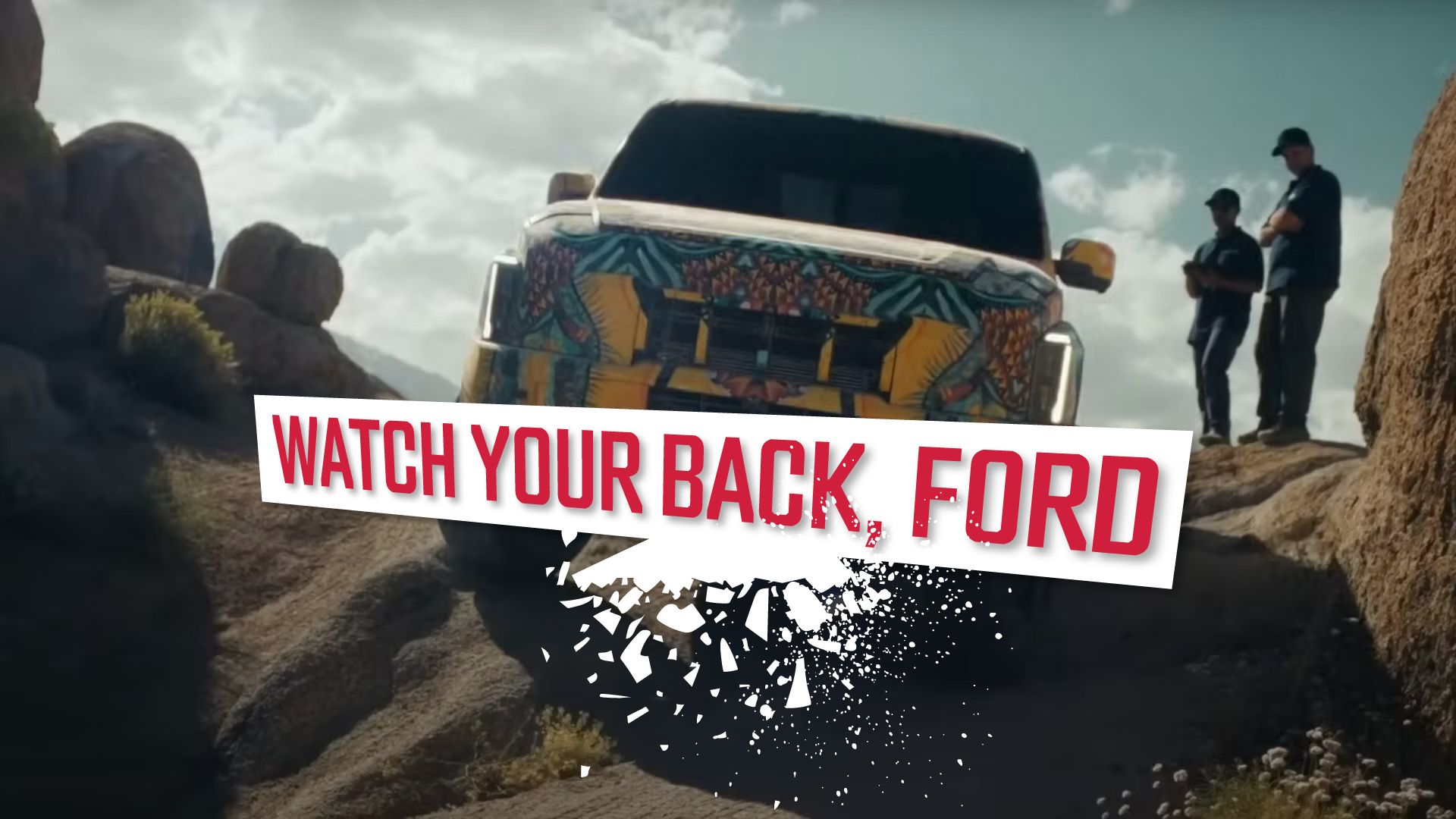
Everything The Kia Tasman is Doing To Prepare Itself For War With The Ford Ranger

The arrival of Kia’s highly anticipated pickup truck is growing ever closer. All it needs to do is complete its grueling testing process before debuting next year. The new ladder-frame midsize pickup truck first appeared in April this year, but the name “Tasman” has been floating around for much longer. The model was first unveiled to the world by Kia Australia, adorned in a bright camouflage wrap designed by Boyd-Dunlop.
Ford’s Ranger pickup is the main adversary poised to tackle the inevitable debut of the Tasman, but, like the rest of Ford’s pickup fleet, the Ranger is no easy model to surpass. In preparation for the fight against Ford’s established and widely popular mid-size pickup truck, Kia has put its Tasman pickup through the wringer and, fortunately for the masses, has documented each phase of testing. The videos are merely simulations of the testing that the Tasman was subjected to but do offer some insight into the features that may come with it.
1 1 Ute And More Than 18,000 Miles
Kia is taking the “no stone left unturned” approach with the Tasman model. As of July 2024, it had subjected the pickup truck to 18,000 rounds of tests and promised to subject it to one final round, which had, at the time of the publication of this article, been presented in four parts. The first spoonful of information Kia offered the public was the setting and what better place than the demanding Australian Outback? In the first batch of videos of the Tasman’s testing, it can be seen crawling through mud and over rocky terrain for more than 18,000 miles.
One of the first tests the Tasman was subjected to was a tow test which involved lugging a water ballast trailer across several locations while traversing dirt roads, and in one of the videos we can see the Tasman tackling an incline while attached to the trailer. The Ford Ranger has two different maximum payload capacities, with the XL, XLT, and Lariat capable of towing a maximum load of up to 7,500 lbs. The most potent and range-topping Raptor model is limited to just 5,150 lbs. Since the Tasman will be a direct rival to the Ford Ranger, it is more than likely that it will have the same towing capabilities and will be on par with the Ranger and, at the very least, the comparatively less capable Raptor.
No Mountain Too High, No Valley Too Low
Off-road capability is paramount for most pickup trucks, although many spend most of their lives crawling on pavements instead of traversing harsh off-road terrain. In the second installment of Kia’s video series of the Tasman’s testing, the camouflaged Kia can be seen conducting high-speed off-roading and demonstrating its ability to navigate over demanding obstacles. There’s quite a bit to dissect in the video. Firstly, the Tasman approaches an incline with speed before going down a narrow decline.
Some of the things that immediately stand out are the approach angle, the breakover angle, and ground clearance. Kia hasn’t released any details regarding these aspects of the Tasman. However, we do know that the Ranger has an approach angle of the Ranger that varies from 29.2 degrees in its base model to 33 degrees in the Raptor variant. The breakover angle follows the same variation as the base model, which has a maximum angle of 21.8 degrees and the Raptor has a maximum of 24.2 degrees. Ground clearance starts at 8.8 inches and the Raptor, with its model-exclusive suspension system, has a ground clearance of 10.7 inches. What these numbers tell a consumer is how well-suited the bodies of these models are to demanding off-road terrain. Higher values across the board typically mean a pickup truck will have an easier time off-roading.
Later in the same video, the Tasman is seen articulated on a bumpy incline with a gradient of 40 degrees. This is where we see the four-wheel-drive system spinning the front left tire as it hovers above the ground and the rest trying to propel its boxy frame forward. It does so with ease and the video transitions to a scene where the Tasman goes into “4-Low”, which alludes to the idea that it will likely have an adjustable four-wheel-drive drive mode selector, possibly to the same extent as the Ranger, although at this point it is merely speculation. A 4-Low setting is typically used to prioritize high torque while keeping the rpm low to avoid unnecessary wheel spin in rough conditions like heavy mud, or, in this case, sand. In the video, the Tasman selects the mode before descending a slight decline and being hindered by soft sand at the bottom. We can see the pickup truck’s 4-Low system in action, allowing the Tasman to break free and climb another incline.
Add CarBuzz to your Google News feed.
2 Waterborne Warrior
A go-anywhere, do-anything pickup truck needs to be able to deal with whatever is thrown its way, which is why Kia has decided to emphasize its ability to wade in water. It is worth noting that Kia does mention that this was done under controlled circumstances and that the tests should not be replicated. The test covers a handful of variables. The first is an approach to a body of water of varying depths and at various speeds with one clip showing the water covering the entire hood.
Kia doesn’t go into detail about the parameters of the wading test, however, but we do know that Ford’s Ranger has a wading depth of up to 800mm, so it might be close to that depth or even much greater than that. An interesting part of the wading test was the in-water idling that was done to test the engine’s intake system in the event of an emergency. At the end of the in-water idling test, the Tasman is brought out of the water and its intake system is inspected and shown to be entirely dry.
3 Jack Of All Trades
The last video uploaded covered the Tasman’s fourth test, which revolves around the encounters that customers could face every day. Unlike previous tests that were conducted in Australia, this testing phase took place at Kia’s California test circuit. There are a handful of tests that are conducted in this phase of testing. The first is handling and high-speed driving stability which is conducted by having the pickup be driven spiritedly around the circuit where long sweeping corners and long straights reveal any possible chinks in its armor. We know that the Tasman will launch with a four-cylinder engine and that a V6 may be introduced at a later date. There’s also the possibility of hybrid variants on the table, but that remains pure speculation at this point. That said, no information regarding performance figures or the suspension system.
The next test involved towing a large trailer and then weaving through a chicane at 19 mph, purposed to further the Tasman’s chassis development and towing capability. Following this is a test of the pickup’s lane-keeping technology while towing the same trailer. An interesting portion of this phase is the payload capacity testing where the Tasman’s cargo bed is loaded to the brim with wood and sent around a dirt track at a fair speed and then curtails the test with an uphill climb on a dirt road. We know that the Ford Ranger’s abilities have been spoken about at length, but they do offer a good idea of what to expect from a model positioned as a direct rival. In terms of payload, the Ranger can tow anywhere from 1,375 lbs to 1,805 lbs.
The fifth installment of Kia’s Tasman is on its way and, from the looks of it, will be another test conducted on tarmac rather than dirt and sand. The goalpost is still set for 2025, so it will still be a little while before we see an unmasked Tasman unveiled to the public. Stay tuned as we’ll cover any updates as they happen.