
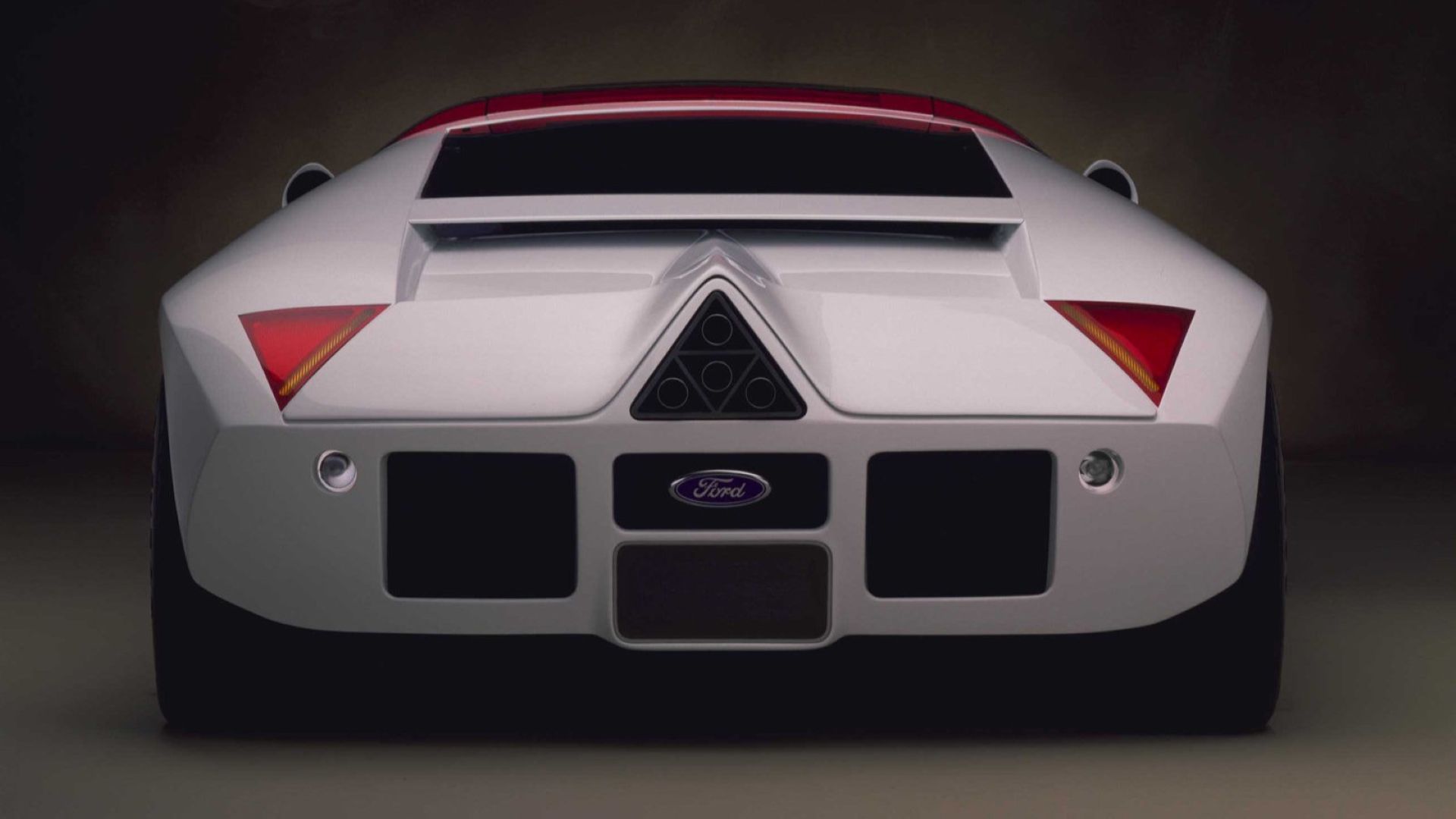
Ford’s First Road-Ready V12 Since 1948 Was A 720-HP Monster

The V12 engine. Normally associated with sports car brands like Ferrari, Lamborghini, Aston Martin. Fast cars. But a Ford sedan? Actually, yes. From 1931 to 1948, V12 engines in various configurations powered high-end Ford sedans.
Ford fans had to wait nearly 50 years for the company to produce the next V12 engine. And while the original Ford V12s were… okay, this new 720 hp went straight up against the likes of Ferrari, Lamborghini and Aston Martin.
This is the amazingly brazen story of the Ford GT90 concept car’s quad-turbocharged, 48-valve V12 engine. An engine that was so hot, Ford had to employ NASA Space Shuttle technology to prevent the GT90 melting.
The V12 Project
In 1987, Ford acquired an up to 75% share in the Aston Martin brand. It then acquired Jaguar in 1989, along with a shed full of engineers who were experienced in creating fast sports cars with big-power, big-capacity engines. So it really was not a question of if Ford would get round to building a big old engine with lots of horsepower, but when.
Ford’s Special Vehicle Team (SVT) did not wait long to get their shot at a new, many-cylinder engine. In 1994, Ford decided to build its own V12. But, it wouldn’t simply be a copy of an existing design, it had to be Ford, from the engine block up.
So the engineers got hold of two 90-degree Ford Modular 4.6-liter V8 engines. They cut two cylinders off each engine, welded the aluminum engine blocks together and ended up with a new V12. The new configuration displaced 5.9 liters.
With a V12 engine on the table, and a new performance halo model called the GT90 in mind, the engineers added some forced induction. Well, they added four Garrett T2 turbochargers. As an aside: it would take another decade for another car to feature four turbochargers… the Bugatti Veyron 16.4, which would claim the ‘fastest car in the world’ title.
With the four turbochargers feeding the engine more air, the V12 engine produced a reputed 720 hp and 660 lb-ft of torque, with an Aston Martin-derived head. The engine revved to 6,300 rpm, and the power was sent to the rear wheels via a specially developed five-speed manual gearbox.
The theory was great. The power was there. But the new V12 engine required some proper research and development. And Ford chose a rather unlikely test mule for the job.
Taking The Engine To The Town (Car)
The small Ford SVT team, working in secret on the V12 project, installed the 720 hp V12 engine into a Lincoln Town Car. Clearly, no-one would suspect a humble Town Car driving around Dearborn’s streets of harboring one of Ford’s most powerful engines ever produced.
Importantly, it featured a body-on-frame chassis, the perfect base to fit a lumpy V12 engine with four turbochargers.
Besides the chassis, the Lincoln Town Car had some other unique attributes that ensured it formed the ideal test mule for the V12. This included the fact that the Ford Modular 4.6-liter V8 engine was already in use in the car, so the basic architecture was already in place.
It also has rear air suspension, rear-wheel drive and came with 10-inch solid rotor disc brakes. It was the perfect car to test a V12 engine, blending in seamlessly with the rest of the Dearborn traffic.
That said, we do suspect the SVT driver behind the wheel of this special Town Car may have worn a much bigger smile than your average Town Car driver. We’ll just call it ‘The 720’ effect.
Adding Some (Jaguar) Backbone
|
1993 Jaguar XJ220 |
|
|---|---|
|
Engine |
3.5-liter twin-turbocharged V6 |
|
Power |
542 hp |
|
Torque |
475 lb-ft |
|
0-60 mph |
3.6 seconds |
|
Top speed |
212 mph |
With the engine development in full swing, the SVT team worked on the chassis, another vital part of the concept car. In a move that made the Ford accountants smile a lot, the team dipped into the existing parts bin instead of creating a bespoke design from scratch.
The SVT team settled on the Jaguar XJ220 chassis for this purpose. The story behind the XJ220 adds a layer of cool to the Ford GT90 concept car.
A small group of Jaguar employees, working informally on the project after hours, in their own spare time, was the driving force behind the project. Their aim was to create a 1990s version of the magnificent Jaguar racing cars that competed in the 24-Hour Le Mans race in the 1950s and 1960s.
The cash-strapped Jaguar decided to create a one-off concept car, to gauge public interest. The aluminum-bodied Jaguar made its debut at a British car show in 1988. It had a mid-mounted V12 Jaguar engine with all-wheel drive, and its creation was made possible through industry suppliers providing their services or products virtually free of charge, with the promise of future collaboration if the concept proved to be a viable commercial prospect.
The public reaction to the sleek new Jaguar? It was utterly overwhelming. According to urban legend, Jaguar received 1,500 deposits of around $65,000 each. Not surprisingly, Jaguar green-lit the project.
The XJ220 name? XJ referred to the model series, and 220 was in reference to the top speed potential of the car in miles per hour.
The new Jaguar required some bespoke components. These included a suitable manual gearbox and a four-wheel-drive system. FF Developments, with former Jaguar factory driver and Le Mans winner Tony Rolt at the helm, developed an intricate new 4WD system and, importantly, the new five-speed gearbox with a twin-plate AP Racing clutch.
The bespoke chassis is constructed from specially bonded aluminum, ensuring lighter weight.
Ford’s SVT team tapped into the Jaguar parts bin and poached the chassis and the FF Developments gearbox for its GT90 project.
The XJ220 would later hit the streets, after Tom Walkinshaw Racing (TWR) was contracted to handle the drivetrain development, powered by a 3.5-liter twin-turbocharged V6 engine producing 542 hp. The V6 engine replaced the original V12 to ensure the XJ220 met emission standards, and it was also lighter and more compact than the V12.
When A Plan Comes Together
|
1995 Ford GT90 |
|
|---|---|
|
Engine |
5.9-liter quad-turbocharged V12 |
|
Power |
720 hp |
|
Torque |
660 lb-ft |
|
0-60 mph |
3.1 seconds |
|
Top speed |
253 mph |
After just six months of research and development, and an inconspicuous Lincoln Town Car driving around Dearborn with a driver with a very big smile, the Ford GT90 came together for the 1995 Detroit Auto Show.
With the XJ220’s aluminum chassis as the base, and the new V12 quad-turbocharged engine living behind the driver in a mid-mounted, rear-wheel-drive configuration, the supposed spiritual successor of the original and legendary GT40, was alive.
The resemblance to the iconic GT40 was limited. It featured Ford’s so-called ‘New Edge’ styling and, unlike what the Jaguar XJ220 had managed to do in 1989 when it captivated the imaginations of hundreds of thousands of people, Ford failed to get enthusiasts to form a line to put down a hefty deposit.
The carbon fiber body panels were light, yes. But the overall design just did not seem to form a cohesive, practical and iconic shape. It was neither here, nor there.
Things were looking up on the performance side. Ford claimed that the GT90 could sprint from 0–60 mph in 3.1 seconds and complete the 0-100 mph dash in 6.2 seconds. It would do the quarter-mile run in 10.9 seconds (at 140 mph), said Ford. The top speed was quoted at a very, very brisk 253 mph. That was Bugatti Veyron territory – 10 years before the Veyron burst upon the scene.
The one-off Ford GT90 went on to feature on several television shows, most notably the British series Top Gear, when Jeremy Clarkson had the opportunity to drive the car… with the turbochargers turned way down on boost.
Just Not Meant To Be
Cars like the Honda NSX concept, the Land Rover LRX (later called the Evoque) and, indeed, the Jaguar XJ220 concept car proved so popular after they made their public debut, the car companies had little choice in turning the concepts into fully-fledged production cars. But Ford management decided not to go ahead with the GT90 project, and turn it into a production car.
Why? Because the Ford GT90 simply did not make the same impression. Enthusiasts marveled at the V12 quad-turbocharged engine, the aluminum chassis and the performance potential. But the same enthusiasts were hardly moved by the styling, nor by some of the quirky design elements. As a complete package, the GT90 just didn’t cut it.
Relegated to history books, the GT90 concept car ended up in the small Hajek Motorsports Museum in Ames, Oklahoma. The V12 engine, as glorious as it may have been, never made it into a Ford production car.
In 2002, Ford revealed its new GT concept at the 2002 North American Auto Show. With Carroll Shelby part of the team, the so-called Petunia project was an instant hit. Enthusiasts loved it. Gearheads loved it. The media loved it. The project got the green light, and by 2006, when production ended, more than 4,000 cars were blasting around the world.
The GT40 circle was (properly) completed.
Sources: Ford, Lincoln, Jaguar, Top Gear,

