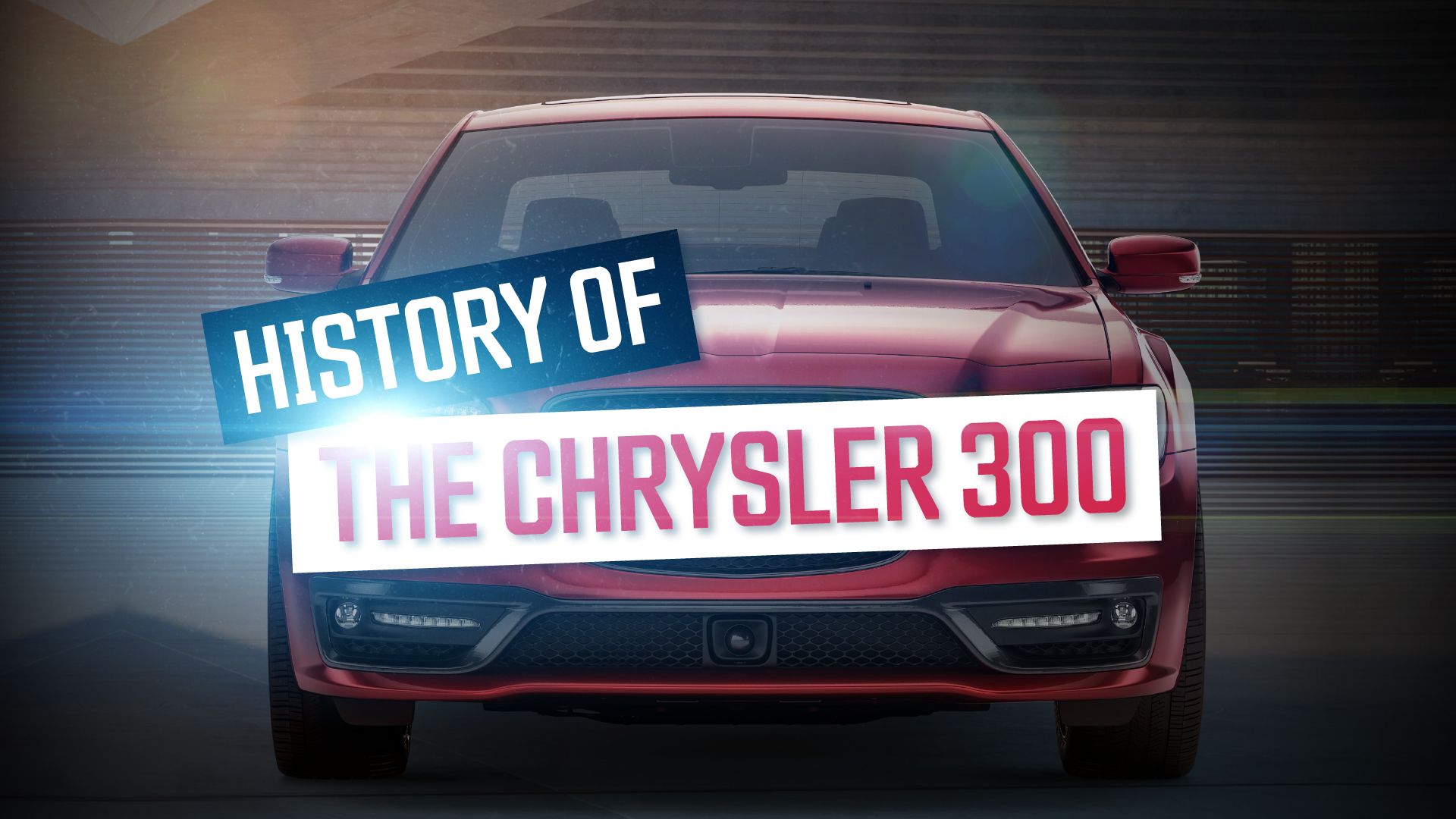
History Of The Chrysler 300

While there are many vehicles being put down and mourned as the era of electric vehicles dawns nearer and nearer, many have flirted with the idea of coming back in new forms. The most notable example is the Dodge Charger, which has been reborn as the Charger Daytona EV and the more traditional gas-powered Charger. The Charger badge will now be used for EV, ICE, two-door, and four-door models. The Challenger badge is officially dead. Dodge still owns it, but isn’t sure if it will be used again in the future.
And yet one of the Charger’s corporate siblings seems set to stay dead. The Chrysler 300, one of the many models based on the now-defunct LX platform, has been culled. To be blunt, it was time for the 300 to go. Sales were dwindling, even though the last version equipped with a 6.4-liter Hemi sold out in less than 12 hours. It seems this is a case of not knowing a good thing until it’s gone, which means it’s the perfect time to look back at the history of the 300. While it may have come to an unceremonious end, the Chrysler 300 has a rich history, which is intertwined with American muscle car power and constantly pushing the envelope on what a luxury sedan could be.
The Chrysler 300’s Origins
The Chrysler 300’s production dates back to 1955, when it was launched as the C-300, which has retroactively been considered and referred to as the 300A model, given that this original line was known as the “letter series” in its first decade. Likewise, each new model was followed by a new letter, with the 300A becoming the 300B, the B becoming the C, and so on and so forth, until the letter series concluded in 1965 with the 300L. By this point, the power had increased to 360 horsepower. The original 300 made 300 horses using a 5.4-liter naturally aspirated V8 engine, which is where its name came from. The 300A also has the distinction of being the most powerful American vehicle on the road at the time. It was a behemoth, at 220 inches long and nearly 80 inches wide with a curb weight of just a hair over 4,400 pounds. The letter-series cars were never produced in vast numbers, with the peak being 3,647 units sold in 1964.

Related
Chrysler 300 Generations: Everything You Need To Know In One Place
Chrysler’s striking sedan with its distinctive, classic proportions endured for two generations before the public’s appetite for crossovers killed it.
The 300 name only returned decades later in the form of the 1999 Chrysler 300M, built on the Chrysler LM platform. The 1999 version was marketed as a full-size luxury car, powered by a 3.5-liter naturally aspirated Chrysler SOHC V6 that produced 253 horsepower and 255 lb-ft of torque. The engine was paired with a four-speed 42LE automatic transmission with a manual drive mode that allowed drivers to manually select gears in certain modes while still offering an automatic transmission on the whole. This was paired with front-wheel drive, which was a big departure from the OG 300. The 300M was produced until 2004, with 2005 seeing the revamp of the Chrysler 300 as it’s known today.
The Modern-Day Chrysler 300
First debuting as the Chronos concept car at the 1998 New York International Auto Show, the Chrysler 300 officially hit showroom floors in the 2005 model year, being designed as a modern interpretation of the original 1955 C-300 and the letter series that followed. One of the key differences from its direct predecessor, the 300M, is that the new 300 was configured in a rear-wheel drive setup based on the Chrysler LX platform. Taking advantage of its partnership with Daimler AG, Chrysler executives confirmed that engineers were sent to Germany to study the upcoming Mercedes-Benz E-Class, resulting in plenty of parts being borrowed from the E-Class, and front double-wishbone suspension from the W220 S-Class.

Related
The Maddest Chrysler Concept Ever Had A Straight-Eight Engine
Straight-eight engines were phased out in the 1950s… except in the Chrysler Atlantic, a one-of-a-kind retro-inspired concept from the 90s.
First Generation
The base model came with a naturally aspirated EER DOHC 2.7-liter V6 engine from the LH engine family that Chrysler developed for its FWD LH-platform cars, making 190 horsepower, with higher trims offering the previously mentioned 3.5-liter SOHC V6 from the same engine family making 250 hp and 250 lb-ft of torque. A 5.7-liter Hemi V8 producing 340 hp and 390 lb-ft of torque sat at the top of the standard range. The sporty SRT-8 trim was equipped with a 6.1-liter Hemi V8 producing 425 hp and 420 lb-ft of torque, enabling it to get from 0-60 in 4.9 seconds.
|
Chrysler 300 Mk1 Specifications |
|
|---|---|
|
Model Years |
2005-2010 |
|
US Engines |
2.7L/3.5L/3.6L NA V6, 5.7L/6.1L NA V8 |
|
Horsepower |
190-425 hp |
|
Torque |
190-420 lb-ft |
|
Drivetrains |
4/5-speed automatic |
All of these engines were paired with either a four-speed 42RLE automatic transmission or a Mercedes five-speed W5A580 automatic transmission. In addition to the sedan, the vehicle was also offered as a station wagon in Europe, Australia, South America, the Middle East, and Japan, called the Touring.
The 300 had one major selling point. It was based on a car that cost twice the price, and it had more equipment as standard. In order to make a profit, Chrysler had to cut some corners, however. The quality of the interior was well below par, and the suspension simply couldn’t provide the sporty driving experience the styling promised. Despite this, the 300 quickly built a loyal following, mostly because of its cool design. It was used in several hip-hop videos and helped Chrysler gain a reputation for being cool, if only for a little while. In the end, it was a smash hit, so a successor was guaranteed.
Second Generation
The biggest change from the first to second generations of the Chrysler 300 was the core platform of the car, called the LD and marketed as an updated version of the original LX platform despite still being strikingly similar. The biggest changes included the suspension being revised, a full redesign of the vehicle’s exterior, and updated powertrain offerings.
|
Chrysler 300 Mk2 Specifications |
|
|---|---|
|
Model Years |
2011-2023 |
|
US Engines |
3.6L NA V6, 5.7L/6.4L NA V8 |
|
Horsepower |
292-485 hp |
|
Torque |
260-470 lb-ft |
|
Drivetrains |
5/8-speed automatic |
The 2.7 and 3.5-liter V6s were phased out and replaced by the at-the-time brand-new 3.6-liter Pentastar V6 engine, which made 292 hp and 260 lb-ft of torque. The 5.7-liter Hemi V8 was carried over, but updated to produce 363 hp and 394 lb-ft of torque. The SRT-8 trim received a larger 6.4-liter Hemi V8 (which can also be found in the 2023 300C trim), good for 485 hp and 470 lb-ft of torque. A 3.0L version of the Pentastar gas V6 was available in China.
There was nothing inherently wrong with the second-gen 300. In fact, the interior was a vast improvement over that of its successor. It was also reliable, and the Australian Police used 300s as patrol vehicles. Considering the harsh climate out there, that’s quite a compliment. The reason the 300 eventually failed is the same reason most sedans started falling by the wayside in the 2010s. SUVs and crossovers started gaining popularity, and sedans were the victim of this mass migration.
The Chrysler 300’s Swansong
Thus came 2023, the 300’s final model year, which saw the car go out with a bang. In celebration of its imminent retirement, Chrysler brought back the 300C, equipping it with the aforementioned 6.4-liter Hemi V8 seen in various other MOPAR SRT-8 tuned vehicles. Sprinting from 0-60 in just 4.3 seconds, the vehicle is largely unchanged from the second-generation post-facelift in 2015. Those small changes that are present include a refined interior, Brembo brakes, and the adaptive suspension found on the Dodge Charger and Challenger Scat Pack models, as well as additional technological improvements to bring it into the modern era.
Unfortunately, the 300C was destined to be a death rattle for the platform, regardless of how well it sold or how well it was received. Chrysler is clearly looking to shift to an all-green future given that the only remaining vehicle in their lineup is the plug-in hybrid Pacifica minivan. All we have is the new Halcyon concept, which comes with loads of features we’d love to see in the inevitable product it will spawn.
Sources: Stellantis.