Honda Only Built One V8 SUV, And It Was Horribly Unreliable

Picture the scene… it’s the early 90s and the sports utility vehicle (SUV) boom is very much underway. Most car companies had realized the writing was on the wall, and had already started developing new SUVs. Like the Ford Explorer, the Toyota RAV4 and the Jeep Grand Cherokee, all introduced early in the 90s. Some car companies were less proactive. Like Honda, for instance. With its new CR-V still in development, the company needed a quick fix, or miss its piece of the SUV frenzy.
Land Rover
- Founded
-
1948
- Founder
-
Rover Company
- Headquarters
-
Coventry, United Kingdom
- Owned By
-
Jaguar Land Rover (JLR)
- Current CEO
-
Adrian Mardell
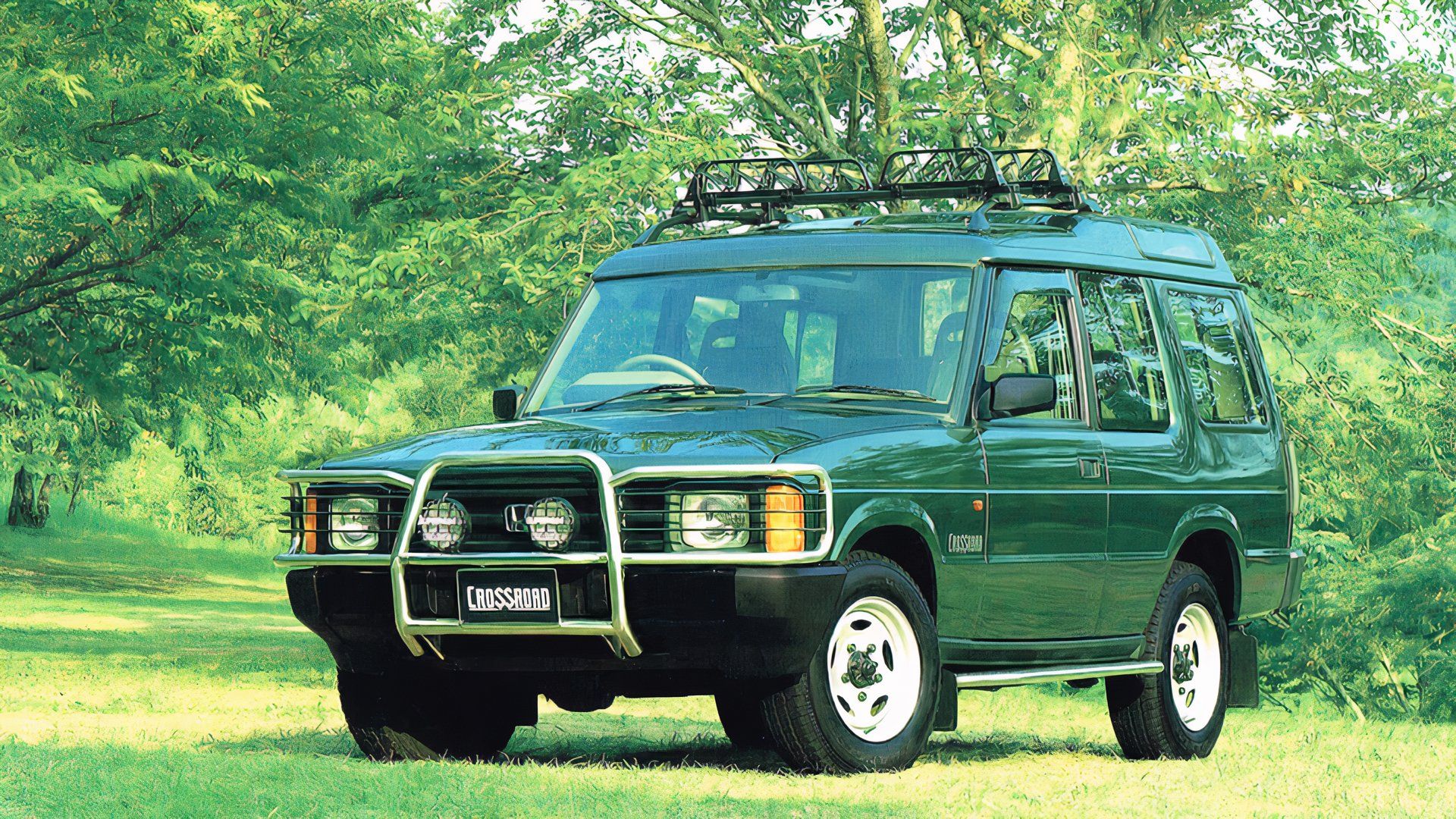
That quick fix came in the form of the Land Rover Discovery I, powered by a 3.9-liter V8 engine which was essentially a Buick 215 V8 mill, dating back as far as the 60s. Honda called the rebadged Discovery the Crossroad, and it went on sale in Japan in 1993. As it turns out, the Crossroad was not Honda’s finest moment. At all.
We take a closer look at the Honda Crossroad, the only Honda product to ever be powered by a V8 engine. As the Crossroad proved, a quick fix is not always a good fix, as the unreliable 4WD did little to instill confidence among Honda’s regular customers. This is its controversial story.
Penny Wise, Pound Foolish?
|
1993 Honda Crossroad |
|
|
Engine |
3.9-liter V8 |
|
Power |
178 hp |
|
Torque |
230 lb-ft |
|
0-60 mph |
11 seconds |
|
Top speed |
105 mph |
In the early 90s, with Honda’s engineers developing the upcoming CR-V, the company needed a vehicle for the Japanese domestic market to compete with popular 4WDs like the Toyota Land Cruiser, Nissan Patrol and Isuzu Trooper. The solution? Take the Land Rover Discovery I, selling strongly in markets around the world, and rebadge it as a Honda. The theory seemed perfectly sound, and Honda and Rover entered an agreement where Rover would build the Honda Crossroad in its Solihull plant in the United Kingdom.
Make no mistake, this was not a Honda by any stretch of the imagination. It was simply a Land Rover Discovery 1 with Honda logos. The Crossroad came standard with the same 3.9-liter V8 engine, and a four-speed ZF automatic gearbox (no manual was available). The 3.5-liter, overhead-valve V8 engine started life as a General Motors product in the 1960s. The Buick 215 is an all-aluminum, compact engine that was used in models like the Buick Skylark and Special, the Pontiac Tempest and LeMans, while Oldsmobile developed its own version of the 215, called the Rockette V8.
Rover acquired the rights and tooling to produce the ‘215’ in England in 1965, and recruited a retired Buick engineer to run the engine project for them. The result was an alloy, 3.9-liter V8 engine that produced 178 hp and 230 lb-ft. The Rover V8 version would go on to serve in numerous Rover products and performance cars.
But back to the Honda Crossroad. With the Rover V8 engine, the Disco’s luxurious cabin, some real 4WD capabilities and a massive dealer network agreement, the Crossroad was expected to be a roaring sales success. Honda was expecting to sell thousands of cars per year. Yet three and five-door Crossroad failed to set the sales charts on fire. In fact, it failed miserably. In 1995, Honda sold just over 100 cars. By 1996, Honda apparently dropped the price of the entry-level V8i model by as much as 25%, but it had no significant impact on the Crossroad’s sales figures.
Some punters believe that Honda may have underestimated its customers. If customers wanted a Land Rover, they would rather go to Land Rover and buy a Land Rover, instead of heading to Honda to buy a Land Rover that was also a Honda. With an American V8 engine. Additionally, the product was plagued with some quality issues.
Besides well-documented Disco 1 issues like rust, electrical problems and blown head gaskets, the Crossroad was also affected by a significant factory recall. The recall revolved around the driver’s door, with a malfunctioning locking mechanism that apparently caused the door to swing open while the vehicle was driving. This is not a desirable feature of any car, and it certainly did not instill confidence in the brand. The unfortunate recall hurt the slowing Crossroad sales even more.
By 1997, there was more drama. With Rover due to be sold off to BMW, Honda was up in arms about its deal with the company to produce the Crossroad. With Honda’s own CR-V hitting showroom floors in 1995, and proving a popular crossover SUV option, Honda finally pulled the plug on the Crossroad project in 1998, relegating the Honda – which was also a Land Rover that was also kind of a Buick – to the ‘golly gosh’ pages of the car history books.
At least the CR-V set Honda’s SUV aspirations back on track, with the crossover SUV eventually manufactured in seven countries and sold in markets around the globe. But, if you thought that Honda made only one SUV blunder, you’d be mistaken. There were also the curious cases of the original Honda Passport and the Honda Horizon.
More Is Better! Well, Sort Of
|
1993 Honda Passport |
|
|
Engine |
3.2-liter V6 |
|
Power |
175 hp |
|
Torque |
220 lb-ft |
|
0-60 mph |
11.5 seconds (estimated) |
|
Top speed |
110 mph (estimated) |
In the early 90s, Honda entered into an agreement with fellow Japanese auto company Isuzu. At the time, Honda wanted that quick SUV fix, and Isuzu – renowned for its commercial vehicles – wanted to expand its operations to the passenger car market. And so the Honda Passport and Horizon – as well as the Isuzu Gemini and Oasis projects – came to be.
The Honda Passport was the brand’s first truck entry into the US market. Based on the tough underpinnings of an Isuzu pick-up, the Passport was a more rugged and hardy SUV option. It was available in both 4WD and 2WD versions, and was powered by a 3.2-liter V6 engine with 175 hp. A five-speed manual gearbox and a four-speed auto were available. Unfortunately, the Passport was also plagued with some quality issues, and a major safety-critical rust issue, requiring the recall of around 150,000 cars sold in the USA, did not inspire great brand confidence. Truth be told, the original, Isuzu-based Passport did better in the USA than its Land Rover Discovery cousin had managed in Japan.
In 2002, Honda discontinued the Passport in the USA. In the same year, Isuzu pulled out of the market with its Isuzu-branded passenger cars. The badge-swapping business was clearly not going down so well. But there was one more rebranded Honda 4WD in the SUV game in the 90s, the Honda Horizon, based on the Isuzu Trooper 4WD.
And… Another One!
|
1991 Honda Horizon |
|
|
Engine |
3.2-liter V6 |
|
Power |
175–200 hp |
|
Torque |
188–195 lb-ft |
|
0-60 mph |
12.5 seconds (estimated) |
|
Top speed |
105 mph (estimated) |
Yep, in the early 90s, Honda was determined to cast its badge-engineered net as far and wide as possible. This also included the Honda Horizon, which was simply a rebadged Isuzu Trooper SUV. The Trooper was aimed at the likes of the Toyota Land Cruiser and Nissan Patrol, so aimed at the more luxurious end of the real 4WD scale. It was again squarely aimed at the Japanese domestic market. The vehicle was badged as the Acura SLX in the USA, where it was on sale from 1996 to 1999.
In the Acura version it was powered by the same 3.2-liter V6 engine that did service in the Passport, but a 3.1-liter turbodiesel version with 135-hp was also available in the Horizon. The Horizon and Acura were tough and highly capable 4WD vehicles, with a part-time 4WD system with low-range gearing and a limited slip rear differential.
But the Isuzu Trooper – and indirectly the Horizon and Acura versions – were negatively affected when a prominent magazine claimed that the Trooper had a high potential for a rollover during emergency lane-change maneuvers. A long and bitter court case followed, but the negative publicity around the case certainly did not make the process of selling cars any easier. By 2002, the Honda Horizon and Acura SLX were discontinued, along with the original Isuzu Trooper.
Honda, On A New Course
|
2026 Honda Passport TrailSport |
|
|
Engine |
3.5-liter V6 |
|
Power |
285 hp |
|
Torque |
262 lb-ft |
|
0-60 mph |
7.2 seconds (estimated) |
|
Top speed |
115 mph (estimated) |
It is not difficult to imagine that all new product planning recruits at Honda are made to study the company’s product strategies hailing from the 90s, and are told to steer well clear of any such ideas.
At the time, the quick-fix solution to slap a Honda badge on another brand and believing loyal Honda customers would fall in line and buy them in droves, seemed like a cunning plan to make more profit. It may have solved a short-term supply problem, but the long-term impact on the brand’s image was far more significant, offsetting any minor financial gains the company may have posted in the 90s.
The Honda Passport is still around. Nowadays, it is a Honda, designed and made in the USA, and it is selling much better than the original Isuzu version ever did. Customers may not always be right, but loyal customers know what they want. And it’s the real McCoy they want.
Sources: Land Rover Monthly, Isuzu, Honda, Buick, General Motors, Land Rover.