How Do Micro Via Handle Moisture and Humidity?

Micro Via Handle Moisture and Humidity
The PCBs we use in modern electronics rely on microvias for critical connectivity. These tiny pathways ensure the smooth transmission of signals and power between layers. They also help with high-density interconnection (HDI) designs where larger vias would be too bulky. As with any component, the microvias need to be well-constructed in order to function properly. This involves the correct choice of fill material, plating, and aspect ratio concerns. Aspect ratio refers to the relationship between a microvia’s depth and diameter, and deviations from this ideal can impact their functionality.
Stacked or staggered micro via are important in modern PCB design, as they can reduce the amount of copper needed while reducing the height of the structure. This is important for keeping costs down while maintaining performance and reliability. However, when designing stacked or staggered microvias, it is necessary to keep in mind the possibility of failure at the interface between the different levels of the stack. This is a concern because it could cause electrical currents to run through unintended areas of the circuit board, potentially leading to malfunction or damage.
A major challenge for microvias is their vulnerability to moisture and humidity. High moisture and humidity in the air can damage the microvias by causing metal migration and decreasing their lifespan. It can also increase the resistance of the copper within them, which decreases their overall performance. Consequently, it is essential to understand how microvias handle moisture and humidity in order to avoid these issues.
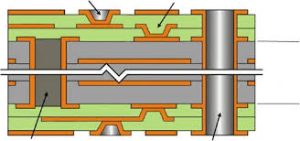
How Do Micro Via Handle Moisture and Humidity?
Moisture and humidity can also cause thermal shock in the microvias. This can result in thermal stresses that can weaken the structure of the circuit boards and lead to microvia failure. This is because of the difference in coefficients of thermal expansion between the base materials and the metallization. In addition, moisture can also lead to oxidation that results in decreased conductivity and higher resistance.
When designing a PCB with microvias, it is important to consider the manufacturing process as it can significantly impact their durability. The PCB fabrication process exposes the plated holes to high temperatures and pressures, which can affect their structural integrity. This is particularly true when the PCBs are laminated. For this reason, it is important to consult with your PCB fabricator before making any design decisions about the type of PCB you need.
Taking the time to consult with your PCB fabrication team can prevent you from committing any costly mistakes that can damage your microvias and cause expensive production delays. This is especially important when you are using HDI microvias in your PCB assembly. Proper PCB fabrication practices, such as proper stack-up configurations and adherence to IPC-T-50M guidelines, can greatly improve the durability of your microvias. Moreover, continual resistance monitoring during reflow can detect any latent failures that may occur in the future. Contact your PCB manufacturer to learn more about the latest in PCB fabrication standards.