How The All-Wheel Drive King Fell Behind The Competition

One of the most game-changing innovations surrounding the automotive world over the last four decades was the mainstream adoption of all-wheel drive. Before, nearly every family vehicle made do with a front- or rear-wheel drive setup, meaning winter driving or even motoring about in the rain made for a slippery experience. While some of us like kicking the tail out on a snowy day, it’s usually not a welcome behavior for most drivers who just want to get from point A to point B.
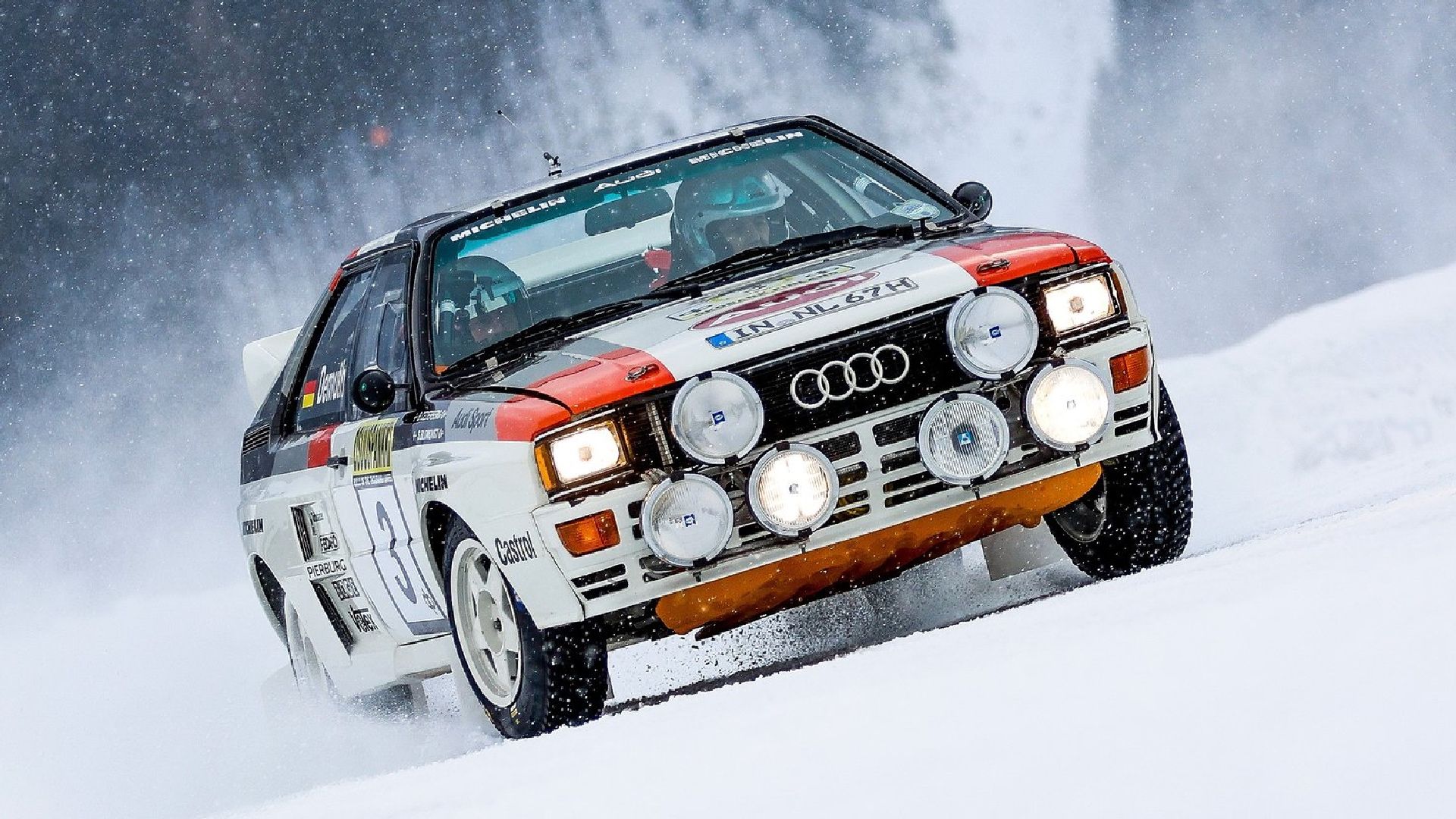
However, one German automaker changed everything. In 1980, Audi released the Quattro, the first mass-market sedan to feature an all-wheel drive setup. The AWD system, dubbed quattro, was rally-bred, meaning it was no slouch when it came to its ability to grip in snowy, wet, or muddy conditions. While Audi was the first to do it, AWD drive has become standard or an option for most cars, and, over the years, Audi has fallen from its original place as AWD king for more reasons than one.
In this piece we look at the origins of quattro, and how the modern version compares to AWD systems from other automakers.
How Audi Brought AWD To The Masses
|
1980 Audi Quattro Specs |
|
|---|---|
|
Engine |
2.1-Liter Turbocharged Inline-Five |
|
Horsepower |
197 hp @ 5,500 rpm |
|
Torque |
210 lb-ft @ 3,500 rpm |
|
0-60 MPH Time |
6.5 Seconds |
|
Starting Price (1980 / 2024) |
$35,000 / $137,777.61 |
1980 Audi Quattro Quick Facts
- First car to bring AWD to a mass-market scale
- Originally built to out-perform the Volkswagen Iltis, a military vehicle, in snow
- Produced for 11 years with virtually no aesthetic changes
- Used a turbocharged, five-cylinder engine
If your Ford Fusion parked outside has an all-wheel drive system, you may as well thank Audi for it. Audi’s road-going use of all-wheel drive spans nearly 45 years now, and, as we stated previously, began with the 1980 Audi Quattro. The nexus of the AWD Quattro was rally racing, as rule changes in 1979 finally allowed for the use of AWD in the World Rally Championship. The following year, Audi debuted an AWD rally car, but Audi was the first to bring it to the road with the Quattro, which is now getting its very own restomod. That’s how you know you made an impact on the automotive world.
The truth is, the road-going Quattro was almost DOA before it even got to mass-production. At the time, Audi executives were hesitant to offer the road-going Quattro for sale on a massive scale. Basically, most of the Audi and Volkswagen management were unaware of the road-going Quattro project. Once the cat was out of the bag, one of the men behind the Quattro project, Ferdinand Piëch, decided to take matters into his own hands and show the beancounters what the Quattro could do.

Related
Old ’80s WRC Footage Shows Why Group B Rally Cars Were Killers
To be honest, spectators also have to take some of the blame.
The decision was made to, literally, drive the Quattro up a man-made ski slope. If you’ve never laid eyes on an artificial ski slope in person, it’s basically a gigantic playground slide covered in snow. It has quite a steep angle, meaning driving up one of these things without all-wheel or four-wheel drive while it’s covered in snow is impossible. Piëch went for it, made it up the ski slope in the Quattro, and the decision to begin producing the Quattro was made because of his stunt.
Because the Quattro was a rally car at heart, it was no slouch when it came to speed, especially for the time. The engine used was a 2.1-liter five-cylinder unit sporting two valves per cylinder and a single overhead camshaft. While the road-going Quattro was similar mechanically to its rallying cousin, the rally version received a slightly smaller dual overhead cam version in order to satisfy the WRC’s complicated engine size requirements of the time.
Thanks to the WRC, the Quattro was an instant hit with enthusiasts. It remains one of the best examples of racing on Sunday and selling on Monday.
Audi Was The Only Premium Brand To Use AWD For Decades
For roughly three decades, Audi was the only premium brand to use all-wheel drive on a massive scale in its passenger cars. Loads of buyers turned to Audi for the sole reason that they could get a premium car with AWD. Because of this, Audi had the AWD market cornered when it came to premium brands. As for other AWD-heavy brands, Subaru, largely, held the market captive when it came to mass-market AWD cars. However, things started to fall apart regarding Audi’s AWD dominance near the beginning of the 2010s.
Enter the W212 Mercedes-Benz E 63 AMG. More specifically, the facelifted W212 E 63 AMG which debuted in 2014. Mercedes, of course, uses their 4MATIC system, and has for a few decades. However, the 4MATIC system wasn’t nearly as well-sorted as Audi’s Quattro system. The 2014 E 63 AMG marks the first premium, purpose-built sports sedan made by Merc to feature all-wheel drive.
A few years later, BMW released their F90 M5, which, for the first time, took advantage of BMW’s xDrive AWD system. BMW’s xDrive and M xDrive are marvels of modern engineering. You see, basic AWD systems have a tendency to induce understeer, but BMW gave its customers the option to choose how they want the torque to be split via driving modes. To this day, you can choose the safe 50:50 option, a sportier split with a rear bias, or you can decouple the front axle entirely if you’re brave enough. The same can be said of Mercedes’ AWD systems. BMW and Mercedes also started including advanced torque vectoring, while Audi stuck to a brake-based system for years. The 2025 Audi RS3 still uses a brake-based system.

Add CarBuzz to your Google News feed.
Audi’s Quattro System Is Now Behind The Times
We touched on Audi’s main competition and their AWD systems previously. The two systems, BMW’s xDrive and Mercedes-Benz’s 4Matic system, are now both ahead of Audi’s Quattro system in terms of usability.
For one thing, both the xDrive and 4Matic systems are rear-based systems. In short, this means that when the vehicle is driving in normal road conditions, both the xDrive and 4Matic systems send most of the power to the rear axle. In the case of the 4Matic system, power is split 45 percent on the front axle, and 55 percent on the rear. As for the xDrive system, it’s even more rear-biased with a 40/60 percent split on the front and rear axles.
Having a rear-biased all-wheel drive system means these cars, generally, handle much better and are more fun to drive. Audi, while its Quattro system does carry a default rear-bias with a 40 percent front and 60 percent rear power split, no current Audi allows drivers to disengage the quattro’s front axle.
Now, Audi has recently debuted a version of their quattro system on the Audi RS3 which features a “Drift Mode” which allows for a near-total disengagement of the front axle in order to allow drivers to, well, drift. The new system, released in 2022, uses a clutch-driven differential and throws tons of power onto the RS 3’s outboard wheel in a turn, allowing for oversteer to occur rather easily. Oversteer, of course, is car-speak for drifting. However, this advancement came five years after BMW’s xDrive debuted with the ability to switch off the system’s front axle power supply.
The State Of Mainstream All-Wheel Drive
While Audi’s quattro system is still a well-sorted and reliable system, it’s not a system that stands out for any particular reason among the horde of other AWD systems on the market today. While it’s a rear-biased system and lends itself to better performance than front-wheel-biased systems such as Acura’s SH-AWD and Mitsubishi’s S-AWC, it still can’t compete with the likes of car companies such as BMW.
Audi has, also, recently unveiled the quattro Ultra system, which is a front-drive-biased system for use on models with longitudinally-mounted engines, or engines whose crankshaft is positioned front to back of a car, rather than side to side. The Ultra system is meant to increase fuel efficiency and mitigate something called parasitic power loss, which occurs more in rear-biased AWD systems.
Despite this innovation, Audi has fallen behind the curve in the AWD arena. The automaker who pioneered the AWD system for the masses as a whole has dropped the torch, and the likes of BMW, Acura, and several other carmakers have picked it up.

Related
Here’s What Subaru Symmetrical All-Wheel Drive Really Means
It’s not your average, every-day all-wheel drive, that’s for sure.
Sources:
TheDrive.com
,
AudiUSA.com
,
JDPower.com