Mini Once Built A Twin-Engine Moke To Impress The US Military

When most people think of the word Mini, the classic pocket-sized car that became a symbol of 1960s Britain is usually the first thing that comes to mind; immortalized on the big screen thanks to The Italian Job, the Mini has broken the confines of the automotive world and become a bona-fide pop culture icon.
There is, however, one vehicle based on the Mini which is far less known: the Moke, a utility and recreational vehicle originally designed for military use and later sold to civilians. Even less known is the off-road variant of the Moke, which never made it to full-scale production: this curious, ill-fated off-roader was powered by not one, but two engines. Here is the story of the short-lived Twini Moke.
Pocket-Sized Fun: The Mini Moke
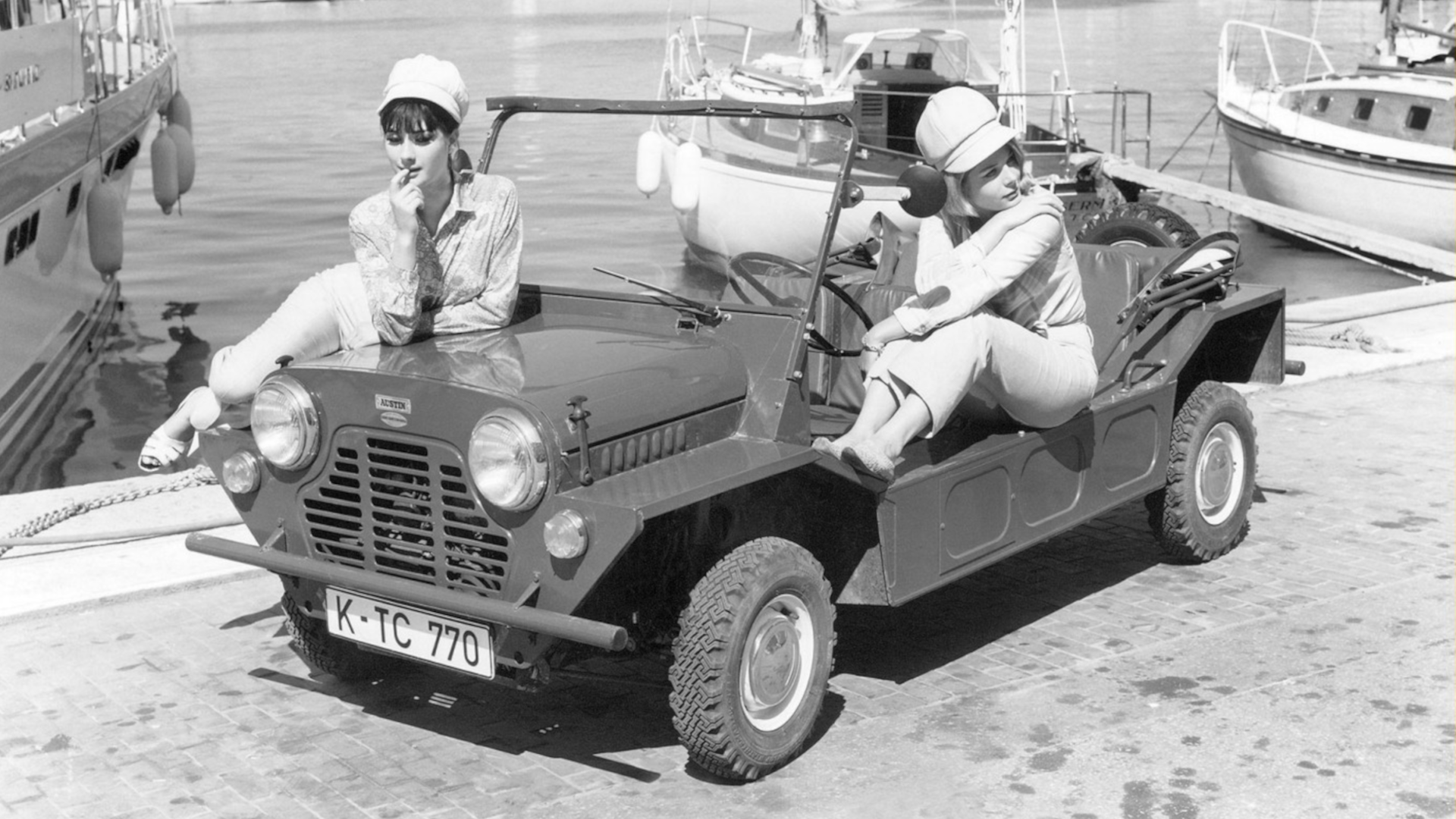
The Mini Moke’s story begins in the early 1960s. The BMC (British Motor Corporation) originally envisioned the Moke as a military vehicle, with early prototypes being showcased to the British Armed Forces. The Moke’s main selling points at this stage were being parachute-droppable, lightweight, and compact; however, it also had a number of flaws that made it unsuitable for military service, such as an underpowered engine and very low ground clearance- it was, after all, a Mini underneath it all. As a result, the British Army was not interested; only the Navy showed brief interest, seeing the vehicle’s potential for use on aircraft carriers, but nothing ultimately came of it.
The BMC, having a prototype on their hands and nothing to do with it, decided to persevere and pivot to the civilian market, selling the Moke as a recreational vehicle. Sales began in 1964, with the Moke being shipped to customers in fairly bare-bones form. At at the start of the model’s life, passenger seats, a removable canvas top, windscreen washer and heater were all sold as optional equipment, which owners installed on the car themselves. The Moke enjoyed a good degree of success, even gaining cinematic fame by being featured in several Bond movies throughout the ’60s and ’70s, including You Only Live Twice, Live And Let Die, The Spy Who Loved Me and Moonraker.
Related
New Mini Moke Goes On Sale In The USA As Upmarket Electric Car
It’s the perfect car for EV-friendly California.
The Mini Moke was sold under several different brands (including Morris, Leyland, and Austin) and in several different markets across the world. In 1966, an Australian version began production, with slight modifications that made it more suitable for use as a beach buggy or on slightly uneven terrain.
Interestingly, Leyland Australia (which was responsible for marketing the Aussie Moke in the mid-70s) also worked on a four-wheel-drive prototype version; this variant only had one engine and was completely separate from the Twini Moke. Only two units were built, as the model never entered production. Towards the end of the Moke’s life cycle, production shifted from Australia to Portugal (British manufacturing having long since ended in 1968), where the Moke continued to be built from 1980 to 1993.
A modern interpretation of the Moke, built by Chinese automaker Chery, has been on sale since 2013. Both gas-powered and electric versions of the new Moke (stylized as MOKE) exist, and the electric version has also made it to the US market, after initially being sold in Australia and later in Europe. A James Bond-themed version was released in 2022, to celebrate 60 years of Bond and as a homage to the Moke’s role in several of the movies.

Add CarBuzz to your Google News feed.
Dashing Through The Snow: The Twini Moke
| Engine | Two 848cc Mini engines (front and rear) |
|---|---|
| Power | 71 hp (combined) |
| Top Speed | 75 mph |
The British Army’s lack of interest in the Moke did not discourage the BMC, who continued to try and build a military-oriented vehicle alongside the civilian production model. This time, the intended target market was the US Army. In order to make the Moke more rugged and suited to being a military vehicle, the BMC team came up with a unique idea: adding a second engine to create a four-wheel-drive version. The prototype quickly gained the nickname of the Twini Moke; its two engines were located at opposite ends of the vehicle, and were connected by linked clutches and gearboxes to make the car drivable. Two levers, installed on either side of the driver’s seat, allowed the driver to select individual engines, only bringing in the rear engine when the conditions called for it.
In 1963, a British motoring journalist took the Twini Moke out for a test drive in the snow, carrying eight bales of hay as cargo. The test was a success, with the Moke keeping traction even while driving in a foot of snow. However, BMC’s marketing endeavor was once again unsuccessful, as the addition of a second engine did not do much to solve the issues that had made the original Moke unsuitable for military use. The US Army was not interested, and the Twini Moke prototype was consigned to automotive history.
A Racing Version: The Twini Mini That Never Was
Inspired by the Twini Moke after paying a visit to BMC, John Cooper decided to build a twin-engine, four-wheel-drive version of the Mini itself: dubbed the Twini Mini, this prototype was envisioned to enter the world of rallying. If Cooper’s vision had become a reality, the Twini Mini would have been the first rally car to use four-wheel-drive, long before the iconic Audi Quattro made its debut.
Only a handful of Twini Mini prototypes were built; John Cooper himself tested one of them, but things did not end well. Though the car was fast, well-balanced and performing beautifully at first, it experienced a rear engine failure which resulted in John Cooper ending up in the hospital. The Twini Mini project was not immediately scrapped, however. British firm Downton Engineering collaborated with BMC to build a Twini Mini that raced in the 1963 Targa Florio. Despite several mechanical issues, including excessive tire wear and overheating, the car managed to finish the race.
No examples of the Twini Mini are known to have survived to the present day, although automotive enthusiasts have since attempted to recreate their own replica versions over the years.
What Happened To The Twini Moke?
A total of three Twini Mokes were built before the project was scrapped. The whereabouts of the first one, a prototype, are unknown. However, we do know what happened to the other two. One currently resides in England, being exhibited at the British Motor Museum; the other, a left-hand-drive variant, was fitted with 12-inch wheels and shipped over to the States. After changing hands a few times, from military testing facilities to an army reservist to a farmer, it eventually broke down and was confined to a barn, where it remained for several years.
In 2013, the Twini Moke’s fortunes changed. Grady Shaner, a mechanic working on a farm vehicle, spotted the Moke, now in poor condition. He decided to buy it and take it to his garage, embarking on a complex restoration project. He accomplished this with the help of several enthusiasts who wanted to see the Twini Moke run again, including motoring photographer Ned Lawler and his wife Kate, as well as the British Mini Moke Club.
It took around a year to restore the American Twini Moke to its former glory; a number of clever mechanical workarounds had to be employed to make the complex dual-engine system run smoothly. Eventually, though, the Twini Moke ran again, and Shaner got to reap the rewards of a year’s hard work.
Other Notable Cars With Two Engines
A car with two engines might seem like a veritable oddity, but the Twini Moke and Twini Mini are in good company in the automotive world. Several other automakers have built cars with two engines over the years, with varying degrees of success.
The Citroën 2CV, France’s legendary mushroom-shaped runabout, had a twin-engine, four-wheel-drive version of its own, called the Sahara; its two engines produced a mighty 12 hp each. It was originally designed for use by the French military in North Africa, but did not end up being widely used, and surviving examples are very rare.

Related
The Only Dual-Engine Production Car Ever Was Built To Search For Oil
Twin-engine cars make sense in hot-rods and customs, but at a production level? They’re almost unheard of.
AMG also attempted to build a twin-engine version of the first-generation A-Class. The resulting prototype achieved a 0-60 time of 5.7 seconds and a top speed of 143 mph, but it never made it to production; only around 5 units were built in total.
In more recent years, Jeep has created their own take on a twin-engine off-roading vehicle, in the form of the Hurricane concept. First revealed in 2005 at the Detroit Auto Show, this off-roading beast not only had two engines, but a suspension and steering configuration that allowed it to spin 360 degrees on the spot in a crab-like motion. The Hurricane was highly complex and expensive to build, and as a result, never made it into production.
Sources:
Moke Club, Lane Motor Museum, AROnline, TwiniMini, MiniMarcos, Classic & Sports Car, Downton Engineering