Most Elegant Cadillac Concept Cars Ever Made

Cadillac has started to return to its roots as being the “Standard of the World” once again, starting with the release of its $300,000 Celestiq flagship model, and the giganticEscalade IQ . Cadillac even wanted to build a hypercar at one point. Just this year, Cadillac unveiled the Sollei and the Opulent Velocity concepts, representing what’s more to come from the fabled American luxury automaker.
However, just like the Sollei and Opulent Velocity, Cadillac has a track record of showcasing stunning concept cars in the past that never made it into production, some of which could have elevated them back as the “Standard of the World.” Despite not having them built, many of its stunning design elements have influenced many Cadillac models, some of which have led to where Cadillac is today.
Here are the most elegant Cadillac concept cars that were ever made (and some should’ve been put into production).
10 Cadillac Voyage – 1988
Cadillac the Voyage concept at GM’s Teamwork & Technology Show in New York back in 1988. Mainly intended to showcase the concept’s technological advancements at that time, Cadillac still managed to implement a sleek and groundbreaking design, by implementing a long hood and short rear-end. The Voyage’s aerodynamic shape also has a coefficient of drag of 0.28, which can hypothetically reach the 200mph barrier despite its sheer length of 212.6 inches. Just a year later, Cadillac unveiled the Solaitaire as the two-door version of the Voyage, but with a Lotus-developed V12 engine. While both were “rolling laboratories,” some of their design elements influenced the STS Seville introduced in 1992.
9 Cadillac InnerSpace – 2022
TheInnerSpace was unveiled at the 2022 Consumers Electronics Show (CES) as one of Cadillac’s three Halo Concepts, which includes SocialSpace and PersonalSpace. What made the InnerSpace unique is its stunning silhouette, which has a low and sleek roofline, and long wheelbase, all of which were made possible through the Ultium Platform, with its batteries mounted on the floor. The concept also features panoramic views on the car’s glass roof and parts of the sides, which also open together with the side doors for more convenient access when entering and exiting the car.
Not only did Cadillac make the InnerSpeace aesthetically pleasing, but also create a holistic and personal user experience, by creating a spacious interior that consists of panoramic LED display with Ultifi software system, and two reclining seats that provide a comfortable yet luxurious autonomous riding experience. These were achieved through the omission of a steering wheel and pedals, as well as having the concept’s battery modules being spread out around the vehicle.

Google News
Add CarBuzz to your Google News feed.
8 Cadillac Le Mans (1953)
Cadillac presented the Le Mans concept at GM’s 1953 edition of the Motorama in New York. Named after its participation in the 24-hour race, the Le Mans concept features a low and sleek profile, measuring 191 inches long, and 51 inches tall on the windshield. The Le Mans concept hosted a number of groundbreaking features at that time, such as a wraparound windshield, and its tail fin design that was later adopted on Cadillac models from the late 1950s. Only four examples were built, with one being missing since it was last spotted in Oklahoma. One of the four concepts featured quad headlamps, and a revamped tail fin.

Related
Did You Know Cadillac Built A Monster For Le Mans?
Cadillac entered the 1950 24 Hours of Mans with a car called “Le Monstre.”
7 Cadillac Escala (2016)
Cadillac presented the Escala concept at the 2016 Pebble Beach Concours D’Elegance, which completed the “holy trinity” of its Pebble Beach concepts in the 2010s with the Ciel in 2011, followed by the Elmiraj in 2013. Unlike the other two, however, the Escala featured a fastback design, with sleeker and lower rooflines, large 22-inch wheels, and a new facial expression on its front design that features a thin horizontal headlights design. The Escala also featured a monotone version of the crest logo around the front and rear fascias, as well as its steering wheel, which later became Cadillac’s logo for electric vehicles.
What made the Escala’s design so unique was its interior layout, which consists of three curved OLED displays that are placed throughout the dashboard, with the first screen replacing the traditional instrument cluster. This unique configuration was implemented on the fifth-generation Escalade with the 38-inch curved display, and evolved into a 55-inch pillar-to-pillar display that was adopted on the Celestiq and the Escalade IQ. As for the Escala’s gorgeous exterior was initially approved for production with V8 power, until it later evolved into the Celestiq, as the Cadillac pivoted towards developing more luxurious EVs.
6 Cadillac Skylight (1958)
Cadillac and Italian coachbuilder Pininfarina worked together to create four bespoke bodies, with one of them being the Skylight concept, in both Coupe and Convertible versions. It was unveiled at the 1958 Geneva Motor Show, and it was the continuation of the partnership between the two iconic names after their early collaboration for the Eldorado Brougham program came to an end. The Skylight’s unique silhouette with sharp yet elegant lines represented a major contrast to the brand’s “Jet Age” design in the early 1950s. The Skylight also has smoother surfaces on the bodywork than Cadillac’s previous concepts, along with twin headlights attached above the simplified radiator grille and chrome bar that extend throughout the car’s width. The Skylight concepts were followed by the Starlight (1959), and the Jacqueline (1961) concepts. Of the four bodies that were made by Pininfarina, the Skylight Coupe and Jacqueline have appeared to be the only surviving examples to this day.
5 Cadillac Elmiraj (2013)
Cadillac showcased theElmiraj at the Pebble Beach Concours D’Elegance in 2013, as the follow-up of the Ciel concept 2 years earlier. The Elmiraj modern interpretation of a 2-door grand tourer with an emphasis on performance. Named after the El Mirage lake bed in the Mojave Desert, the Ciel’s elegant body is 205 meters long, and features evolution of the brand’s Art & Science design language. The Elmiraj was also the first car to wear the brand’s new crest emblem, which was also embossed on the headrest of the concept’s camel leather interior. Just like any other Cadillac concepts, the Elmiraj was never put into production as they think that the appetite for an American two-door coupe is simply not big enough.
4 Cadillac Starlight (1959)
The Cadillac Starlight was another creation between Cadillac and Pininfarina . Unveiled at the 1959 Paris Motor Show, the Starlight’s design took inspiration from theEldorado Brougham project that they had collaborated on previously. Just like the Skylight, the Stalight’s design also broke the norm of Cadillac’s previous designs in the early 1950s. One of Starlight’s standout design features, thanks to Pininfarina’s creative magic, was the plexiglass rooftop. It featured a headliner consisting of 4 articulated metal plates, which can be detached and stored on its parcel shelf when they’re not in use. While the Starlight was received with great enthusiasm during its exhibit in Paris, it was never put into production and its unique body shell was destroyed.
3 Cadillac Sixteen (2003)
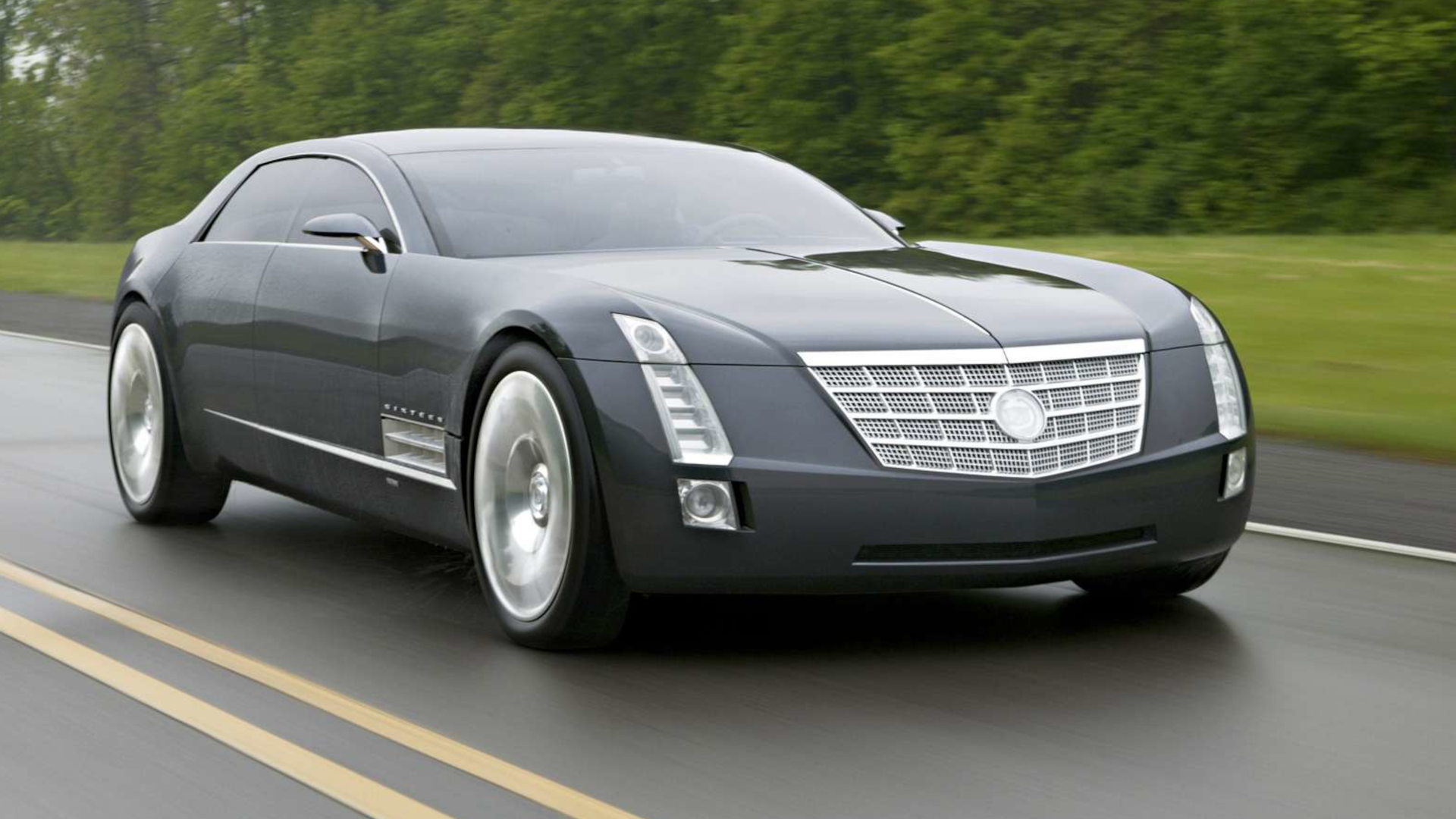
Cadillac presented the Sixteen concept at the 2003 Detroit Auto Show, and it paid homage to the original Cadillac V16 from the 1930s. The Sixteen measures 19-feet long, thanks to the 13.6-liter 32-valve V16 engine under the bonnet. The Sixteen has a sharp yet understated design, thanks to the absence of B-pillars and door handles, and is wrapped in a polished set of 24-inch wheels. The Sixteen’s minimalist design is also applied to the interior, which consists of hand-stitched Tuscany leather, a tasteful mix of polished aluminum and wood.
The dashboard is complemented by the Cadillac logo on the steering carved out of a solid block of crystal, and a top-mounted clock made by Bvlgari. There were rumors circulating that Cadillac would put this into production as a limited-run halo mode. The dream of a modern-day V16-powered Cadillac has never materialized. Instead, the halo Cadillac that we’ve dreamed of became the all-electric Celestiq, while the Bugatti Tourbillon Coupe became the modern-day car with a V16 engine. .

Related
Meet The Bugatti Tourbillon: V16 Masterpiece Redefines The Hypercar
Molsheim has mastered the hypercar once again, creating a piece of incomparable automotive art that would make Ettore Bugatti proud.
2 Cadillac Cyclone XP-74 (1959)
Cadillac presented the Cyclone XP-74 concept during the Daytona 500 in 1959. It was the final car that was penned under Harley Earl’s direction before retiring in 1985 as GM’s Vice President of Design at that time. Unlike Earl’s previous concepts, the Cyclone XP-74 featured a much more compact design. The Cyclone’s silhouette is reminiscent of a fighter jet and rocket ship, while still managing to incorporate design elements that are recognizable as a Cadillac. One of them being the wraparound windshield, along with a seemingly-stretched swooping line and the tailfin that is reminded of the Eldorado Biaritzz, but what it would look like in 30 years. The XP-74’s rocketship look wasn’t just a testbed for futuristic styling, but also for technology with some useful functionality. Among them was the front nose design that houses the radar antennas that act as a proximity warning system.
1 Cadillac Ciel (2011)
Cadillac Ciel was unveiled at the Pebble Beach Concours D’Elegance in 2011 as the first of Cadillac’s trilogy of stunning concepts. The concept’s name means “sky” in French, and its main design inspiration came from the breathtaking drives around the Californian coast of Highway 1. The Ciel’s 125-inch long body, along with a low-slung profile, harks back to their past four-door convertibles of the past, while expressing their vision of what the Ultimate America luxury convertible would be like in the future.
Measuring 125-inches long, the Ciel’s roofless design also features suicide pillarless doors, which opens up with its uber-luxurious interior that consists of a delicate combination of Italian Olive wood grain, hand-sewn leather, and hand-polished aluminum. While the Ciel was highly-praised by everyone at Pebble Beach, the Ciel was rather a styling exercise, which shut down the hopes of having it being put into production, even if produced in limited examples.
Sources: Cadillac Newsroom,
Holman Cadillac
,
Story Cars
,
Cool Hunting
,
Dean’s Garage
,
HotCars
,
Below the Radar
,
Motor Trend
,
conceptcarz.com,
The Drive
, MyCarQuest.com, Supercars.net, Audrain Automobile Museum, & Roarington