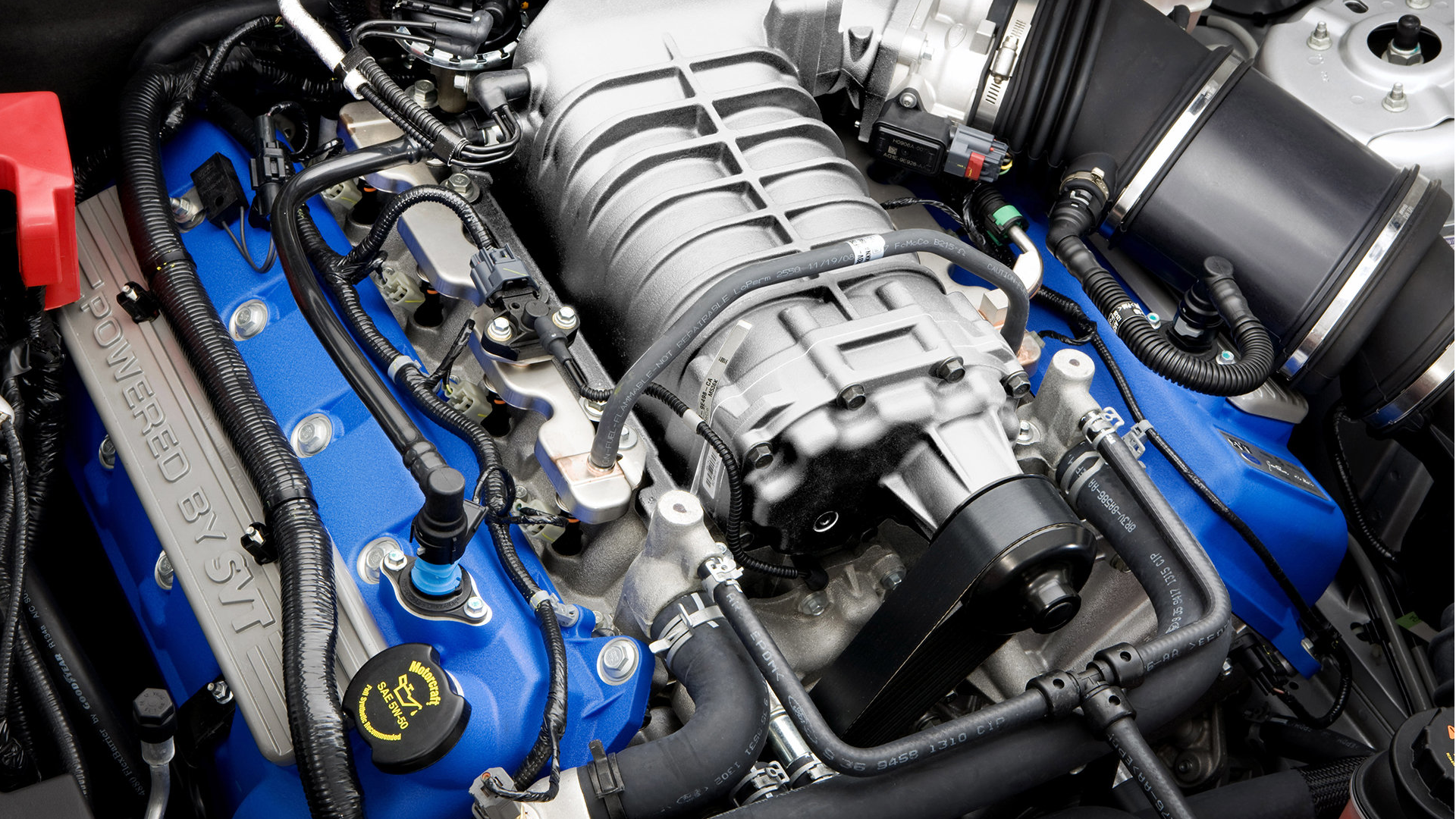
The 10 Most Powerful Versions Of Ford’s Modular V8 Engine

The Ford Mustang is the last all-American muscle car and one of the few performance cars left that will continue to rely on a V8 engine until it’s no longer possible. That V8, a fourth-generation Coyote, has a long history and is the descendant of Ford’s modular V8 engine family that first appeared back in 1990, in the form of the 4.6-liter SOHC V8 engine. In 1987, Ford was committed to producing a new V8 based on Ford’s Modular engine architecture and subsequently invested $4 billion (close to $9.5 billion in 2024) to repurpose the Romeo tractor plant in Michigan to produce these new V8 engines. The 4.6-liter V8 engine was intended to power the 1991 Lincoln Town Car, giving it a leg up on its successor.
There would be multiple variations of this 4.6-liter V8, mainly distinguished by the number of valves per cylinder. It was used in most of Ford’s models from the late ’90s into the mid-2010s. These include models like the Ford E-Series, the fourth-generation Mustang, the F-Series, the Ford Thunderbird, the Crown Victoria and the Expedition. The Modular V8 engine would eventually evolve into the well-known Coyote engine, which debuted in 2011. Ford’s Coyote engine was developed to compete against GM’s 6.2 LS3 engine that was used in the Chevrolet Camaro and the 6.4-liter Hemi V8 used in the Dodge Charger. It shared some of the characteristics of the 4.6L V8 engine it superseded, like the bore x stroke and connecting rods. There are many versions of Ford’s Modular V8 engine that have debuted since it was showcased for the first time. These are the most powerful versions that ever debuted using Ford’s Modular V8 engine.
10 2020 Mustang Bullitt
480 hp
|
Engine |
5.0-liter, naturally aspirated, V8 |
|---|---|
|
Horsepower |
480 hp @ 7,000 rpm |
|
Torque |
420 lb-ft @ 4,600 rpm |
|
0-60 |
4.6 seconds |
The Mustang Bullitt has been a part of Ford’s lineup for years, spanning multiple decades and generations, but all share a similar theme inspired by the Mustang GT 390 that was featured in the 1968 movie, Bullitt. Ford’s most recent rendition of the Bullitt sub-genre was based on the S550 generation Mustang, powered by the third-generation Coyote V8 engine paired with a six-speed manual transmission and distinguished by its green paintwork, an active valve performance exhaust, an Open Air Induction System, an intake manifold borrowed from the GT350, and a recalibrated powertrain control module.
9 2024 Mustang GT
486 hp
|
Engine |
5.0-liter, naturally aspirated, V8 |
|---|---|
|
Horsepower |
486 hp @ 7,250 rpm |
|
Torque |
418 lb-ft @ 4,900 rpm |
|
0-60 |
4.2 seconds |
The S650 generation Mustang is still hot off the press, with the latest generation of the Coyote V8 at its core. Compared to the previous S550 generation, this new Mustang GT has 36 hp more and a slight increase in torque, despite retaining the same naturally aspirated 5.0-liter V8 architecture. The power increase comes as the result of a new dual-air intake and a new dual-throttle design.
Add CarBuzz to your Google News feed.
8 2024 Mustang Dark Horse
500 hp
|
Engine |
5.0-liter, naturally aspirated, V8 |
|---|---|
|
Horsepower |
500 hp @ 7,250 rpm |
|
Torque |
418 lb-ft @ 4,900 rpm |
|
0-60 |
4.1 seconds |
The Mustang Dark Horse is a new nameplate within the Mustang family and in the S650 generation, it reigns as the most powerful Mustang available, sort of. It utilizes the same fourth-generation Coyote engine but features piston connecting rods from the GT500 and is the only Mustang in the range to feature the Tremec six-speed manual as standard. It is positioned as a new level of performance in the Mustang lineup.
7 2020 GT350
526 hp
|
Engine |
5.2-liter, naturally aspirated, V8 |
|---|---|
|
Horsepower |
526 hp @ 7,500 rpm |
|
Torque |
429 lb-ft @ 4,750 rpm |
|
0-60 |
3.6 seconds |
Although the Dark Horse is the zenith of the standard Mustang range, it is outshone by the likes of the bullish GT350, the smaller sibling of the GT500. It was the most potent naturally aspirated Mustang to debut in previous generations. At its core is the powerful Voodoo 5.2-liter V8 which offers its full output from 4,000 rpm to its 8,250 rpm redline thanks to a flat-plane crank. It was uncontested among the naturally aspirated Mustang range and still is.
6 2011 GT500
550 hp
|
Engine |
5.4-liter, supercharged, V8 |
|---|---|
|
Horsepower |
550 hp @ 6,200 rpm |
|
Torque |
510 lb-ft @ 4,250 rpm |
|
0-60 |
3.5 seconds |
One of the earlier renditions of the GT500 badge debuted in 2011 and, like most performance cars purposed to outshine their predecessors, offered a new level of performance in Ford’s fleet. It was the brainchild of the Ford Special Vehicle Team and powered by an all-aluminum block V8 that sounded more visceral than the model that debuted a year earlier and could generate all its torque from as low as 1,750 rpm.
5 2005 Ford GT
550 hp
|
Engine |
5.4-liter, supercharged, V8 |
|---|---|
|
Horsepower |
550 hp @ 6,500 rpm |
|
Torque |
500 lb-ft @ 3,750 rpm |
|
0-60 |
3.7 seconds |
The first generation Ford GT needs little introduction. One of the cornerstones of its design was the all-aluminum 5.4-liter supercharged V8 that shared components from the engine used in the F-150 that was available at the same time. It also used a forged crankshaft, forged H-beam connecting rods, and aluminum pistons. One of the most distinguishing features of the 5.4-liter power plant was its Eaton screw-type supercharger, which contributed significantly to an output that was widely unrivaled in Ford’s lineup at the time.
4 2013 GT500
662 hp
|
Engine |
5.8-liter, supercharged, V8 |
|---|---|
|
Horsepower |
662 hp @ 6,250 rpm |
|
Torque |
631 lb-ft @ 4,000 rpm |
|
0-60 |
4.1 seconds |
At the time of its debut, the supercharged V8 engine in the 2013 GT500 was the most powerful engine produced in North America. It was dubbed the Trinity engine and, compared to the engines used previously in the GT500 range, features a host of new parts with the sole purpose of generating more power. These include a 2.3-liter Twin Vortices Series 2300 supercharger, a cross-drilled engine block and engine head, a forged rotating assembly, modified cam profiles, and an upgraded head gasket.
3 2022 F-150 Raptor R
720 hp
|
Engine |
5.2-liter, supercharged, V8 |
|---|---|
|
Horsepower |
720 hp @ 6,650 rpm |
|
Torque |
640 lb-ft @ 4,300 rpm |
|
0-60 |
3.5 seconds |
An indomitable force powered by one of Ford’s most potent engines. The F-150 Raptor R borrows the GT500’s Predator engine, although featuring a few changes, like a new supercharger pullet which improves off-road capability by offering better torque delivery sooner in the rev range, a revised exhaust manifold, a deeper oil pan, a wider intake inlet, and higher flow conical air filter.
2 2022 GT500
760 hp
|
Engine |
5.2-liter, supercharged, V8 |
|---|---|
|
Horsepower |
760 hp @ 7,300 rpm |
|
Torque |
625 lb-ft @ 5,000 rpm |
|
0-60 |
3.4 seconds |
Even though there now exists a Mustang with more power and greater athletic ability, the Shelby GT500 is one of the most potent offerings to ever spawn from the Mustang family. Its Predator engine has allowed the GT500 to best the likes of the Chevrolet Camaro ZL1 1LE and the Dodge Challenger SRT Hellcat. There has been no model other than the Mustang GTD that has been able to best the GT500 in performance and power.
1 2025 Mustang GTD
815 hp
|
Engine |
5.2-liter, supercharged, V8 |
|---|---|
|
Horsepower |
815 hp |
|
Torque |
664 lb-ft |
|
0-60 |
TBC |
The Mustang GTD is not just the most powerful version to ever carry the Mustang nameplate, it is also the most capable Mustang ever. Its aero and chassis are nearly on par with that of a GT3 car, but the engine that supplies its power is also one of the most noteworthy aspects of the GTD. It is one of the few models within Ford’s ranks to use the mighty Predator engine, but the difference in power compared to the GT500 is a result of the dry sump oil system, a revised intake and exhaust system, and a smaller supercharger pulley. All its power is sent exclusively to the rear wheels. The collaborative efforts of all its parts are geared toward sending it around the Nürburgring in less than 7 minutes, which we have yet to see.
Sources:
Ford, Ford Performance