The Biggest Engine Ever In A Series Production Mercedes S-Class

When buying a large luxury barge, one of the most important elements to consider, aside from the cabin, is the engine slotted under its huge hood. Vehicles like the Mercedes-Benz S-Class and BMW 7-Series are as much about demonstrating their occupants’ status as they are about keeping them comfortable, so range-topping variants need as big an engine and as much power as they can get away with.
Mercedes-Benz
While its roots trace back to the creation of the Benz Patent Motorwagen in 1885, Mercedes-Benz was officially founded in June 1926 when Daimler Motoren Gesellschaft and Benz & Cie. (the world’s oldest car company) merged to create Daimler-Benz. This German manufacturer of premium cars is historically known for its motorsport pedigree in early Grand Prix racing, its off-road prowess in the creation of military vehicles like the Genadewagen (now G-Class), and its focus on utmost luxury and technological innovation in models like the S-Class and SL. Today, it is one of the world’s largest automakers.
- Founded
-
June 1926
- Founder
-
Karl Benz, Gottlieb Daimler, Wilhelm Maybach, and Emil Jellinek
- Headquarters
-
Stuttgart, Germany
- Owned By
-
Daimler AG
- Current CEO
-
Ola Källenius
The S-Class in particular, has been home to some big engines over the years, though the largest to ever find a home in a mass-production example came many decades ago. To find it, we need to spin the clock back to the very first edition of the nameplate that was officially called the “S-Class” (for Sonderklasse, or Special Class), during the 1970s.
Every production Mercedes-Benz S-Class model was considered for this piece, with the variant with the highest displacement engine being crowned the winner.
The W116 Housed The Largest Engine To Ever Grace A Production S-Class
While the Mercedes-Benz W116 was far from the first full-size luxury sedan offered by the German powerhouse, it was the first to be officially designated the S-Class. The S-Class sits atop Mercedes’ product line as the biggest and most luxurious sedan it offered, and thus the W116 came with all the best technology and engineering innovations available at the time.
The W116 was first unleashed in 1972, and was available with a range of inline-six and V8 powerplants. Initially, the range-topping variant was the 450, which had a 4.5-liter V8 under the hood. While it isn’t exactly powerful by today’s standards, with just 222 hp, it was ample for the day and age.

Related
You Can Get A Proper Modern Low-Mileage Mercedes S-Class Rival For Less Than $25K
Why spend all that money when this model exists?
Mercedes Unveiled A Performance Version Of The W116 In 1975
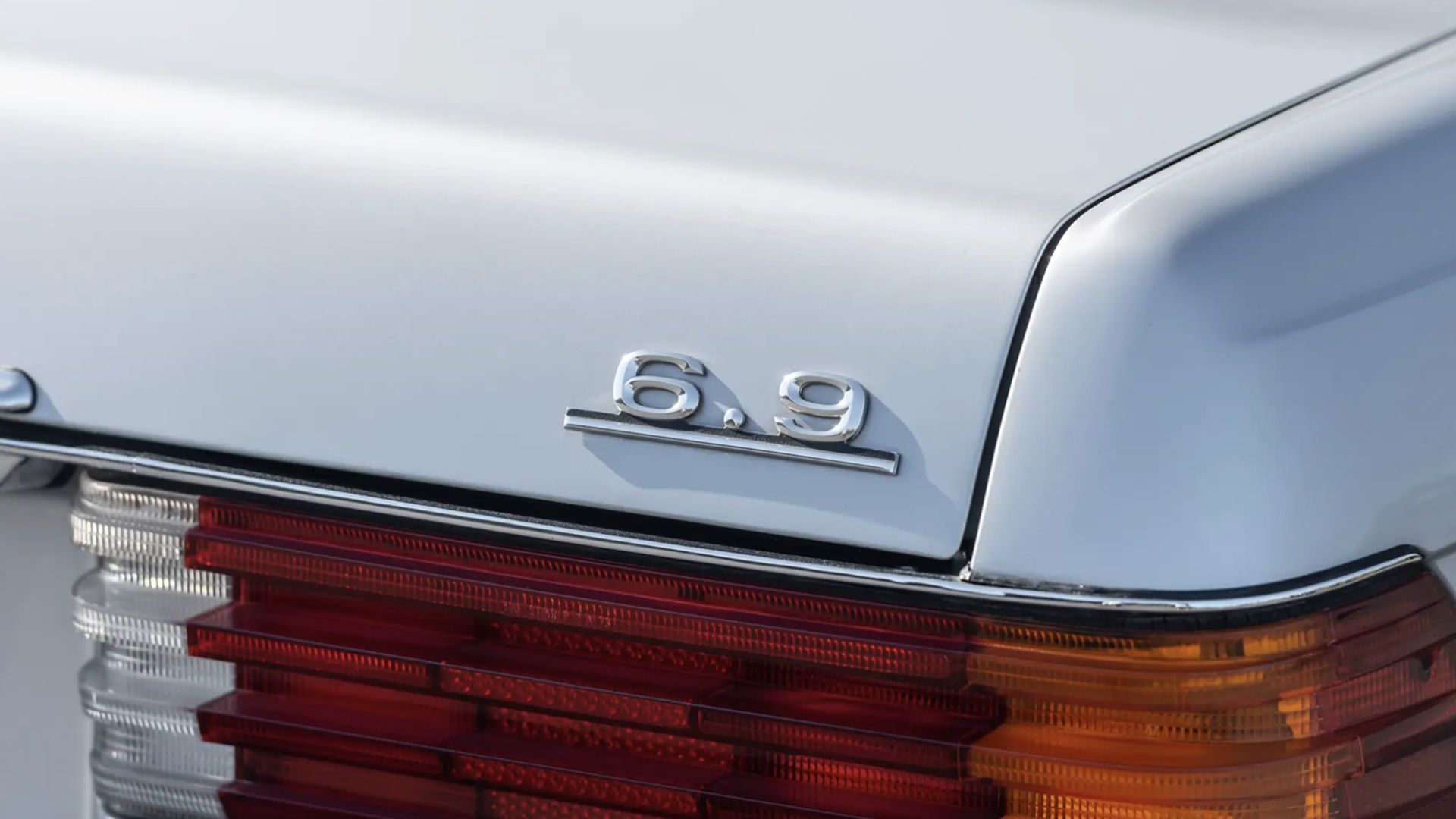
Feeling the 450 wasn’t quite powerful enough to retain its status as the flagship of Mercedes’ portfolio, a new variant called the 450 SEL 6.9 was released in 1975. It would be the performance version of the S-Class, and the 4.5-liter V8 was thrown in the skip in favor of a far bigger naturally aspirated V8 unit called the M100. It had an engine displacement of 6,834 cc – or 6.8 liters – but the Germans have a propensity for rounding up, so they called it a 6.9L.

Discussion
What does the Mercedes-Benz logo mean?
Everyone thinks the Mercedes-Benz tri-pointed star references an airplane propeller, but the official history of it according to Mercedes is to show the three areas it wanted to dominate: sea, air, and land. It was nearly a four-pointed star at one point (a trademark was filed but never used), but the tri-pointed star stuck, first being used from 1916-1926, and the outer ring with a wreath and the official “Mercedes” and “Benz” lettering was added in 1926 when Daimler and Benz merged into one entity. Since then, it’s stuck around relatively unchanged, with the simplified star in a ring being the most commonly used variant, often standing proud as a dash ornament on top of the wreath as a base.
It retained its spot as the most expensive S-Class around until 1980, when the W116 was replaced by the W126 S-Class. The M100 remains the largest engine to ever power a production S-Class.
The M100 Had Already Been Around The Block A Few Times
The M100 V8 was a bit of a beast, as it featured a heavy cast iron block and lighter aluminum cylinder heads. It first made its debut in 1963, when it powered the range-topping version of the 600 luxury sedan and the 300 SEL. The hand-built powerplant had a displacement of 6.3 liters in these models, though Mercedes increased its displacement to 6.8L for use in the W116 – the largest iteration of the M100 ever.
|
1975-1980 Mercedes-Benz 450 SEL 6.9 Specifications |
|
|---|---|
|
Engine |
6.8L NA V8 |
|
Drivetrain |
3-speed auto, RWD |
|
Power |
250-286 hp |
|
Torque |
360-403 lb-ft |
|
0-60 mph |
Approx 7.0 seconds |
|
Top Speed |
140 mph |
Ahead of its inclusion in the 450 SEL 6.9, the unit was bored out from 4.06 inches to 4.21 inches to increase displacement from 6.3 to 6.8 liters. The original 3.74-inch stroke was left untouched. The compression ratio was also decreased slightly from 9.0:1 to 8.8:1 in the 6.8-liter spec. This was to ensure it chucked out less in the way of emissions, given that governments around the world had started cutting down on huge and wasteful engines. The larger displacement meant that the power lost as a result of the restrictions could be recovered. In the European market, it punched out a solid 286 hp and 403 lb-ft of torque, but it was detuned locally to 250 hp and 360 lb-ft to meet US emissions legislation.

Related
Mercedes-Benz S-Class Sedan Generations: Everything You Need To Know In One Place
The luxury sedan by which others are measured still heads its class in perceived status, technological advancement, and hushed comfort.
Mercedes’ engineers even developed a dry-sump oil lubrication system for the M100, which consisted of a separate oil tank rather than having it sit in the sump below the engine like in a wet lubrication configuration, along with a huge oil capacity of 12.7 quarts. Aside from improving lubrication when the car is under higher g-forces, it also means the engine can be mounted lower in the vehicle. This helps improve its center of gravity, but also allowed Mercedes to retain the S-Class’ low hood line. The surplus of oil also meant that Mercedes could extend the service intervals, because the large volume of oil took longer to become contaminated, so the 6.9 could go 12,500 miles between oil changes.

Related
The Mercedes-Benz S-Class Is Turning 50 This Year
The W116 brought with it a host of technological advancements.
The M100 Carried The S-Class To Another Level
Despite the relative lack of outright grunt, Mercedes-Benz boasted that the US-market 450 SEL 6.9 could still hit 60 mph in a little over seven seconds, despite the big gaps between the gears of the old-fashioned three-speed automatic transmission. This is pretty quick even today, let alone for a road-going aircraft carrier in the late 1970s, especially if one considers that first gear was so tall, the car could complete its entire 0-60 sprint in that gear, despite a low redline of only 5,300 rpm.
Sports Car Pace Was Just One Of The 450 SEL 6.9’s Talents
Alongside the huge V8, the 450 SEL 6.9 also came as standard with an advanced active hydraulic suspension system. The setup was self-leveling, meaning the car would remain perfectly flat no matter how rough the road it was traversing, or how heavily it was loaded. This also improved its handling, as body roll was significantly reduced, and afforded the car a silky-smooth ride. A limited-slip differential was also used to keep the rear wheels under control, while disc brakes were used all round. Although Jensen is credited for first putting ABS brakes into a car in the ’60s, the 450 SEL 6.9 is generally known to be the first mass-production car to feature it as an option. Jensen’s ABS was fully mechanical, and was an adapted Dunlop Maxaret system usually seen on aircraft, while the 6.9 had electronic Bosch ABS.
It came with nearly every option under the sun too, with just four items remaining on the options list. Aside from the mechanical gear, the 450 SEL 6.9 was fully outfitted with leather upholstery and velour carpeting, while an advanced-for-the-time climate control system kept the cabin temperature comfortable at all times. Heated seats were one of the few options available, as was an electrically-operated sunroof.

Related
This Mercedes-Benz Has Saved Countless Lives Over The Last Fifty Years
The ESF 13 pioneered countless safety systems that are now commonplace in most cars.
The 450 SEL 6.9 was one of the most advanced vehicles of the period, boasting a plush cabin, class one engineering and one of the largest production V8s on sale, a unit that remains the largest ever fitted to a production S-Class.
Some Special S-Classes Had Even Larger Powerplants
This doesn’t mean other bespoke S-Classes didn’t feature larger units, though, with a special 1990s version coming with an even bigger V12 engine. You may have already heard of the Sultan of Brunei, a leader with riches that gearheads worldwide could only dream of. He has been known to have a unique collection of some of the most fascinating vehicles in the world, and in the 1990s he fancied a fleet of high-powered S-Class wagons.
|
1996 Mercedes-Benz S73 T Specifications |
|
|---|---|
|
Engine |
7.3L NA V12 |
|
Power |
565 hp |
|
Torque |
546 lb-ft |
|
0-60 mph |
N/A |
|
Top Speed |
N/A |
Mercedes elected to build a limited run of 18 examples featuring a 7.3-liter V12, the powerplant that would eventually be used in the Pagani Zonda C12 S supercar. With 565 hp on offer, the S73 T was never put into series production, with ten examples being shipped directly to the Sultan. The whereabouts of the other eight are currently unknown, though Mercedes may have a few stashed away in its secret holding facility.

Related
7 Times The Mercedes S-Class Blew Us Away
Adding luxury to space, grace, and pace since 1972, the S-Class is celebrating 50 years in 2022.
Aside from the huge engine, Mercedes’ engineers had to craft some custom bodywork for the rear of the vehicle, as it had never offered a wagon version of the S-Class before. It was also equipped with sports suspension, as well as a five-speed automatic transmission. With all examples currently hidden away, it may be some time until we find out everything there is to know about the S73 T unicorn.
Sources: Mercedes-Benz.