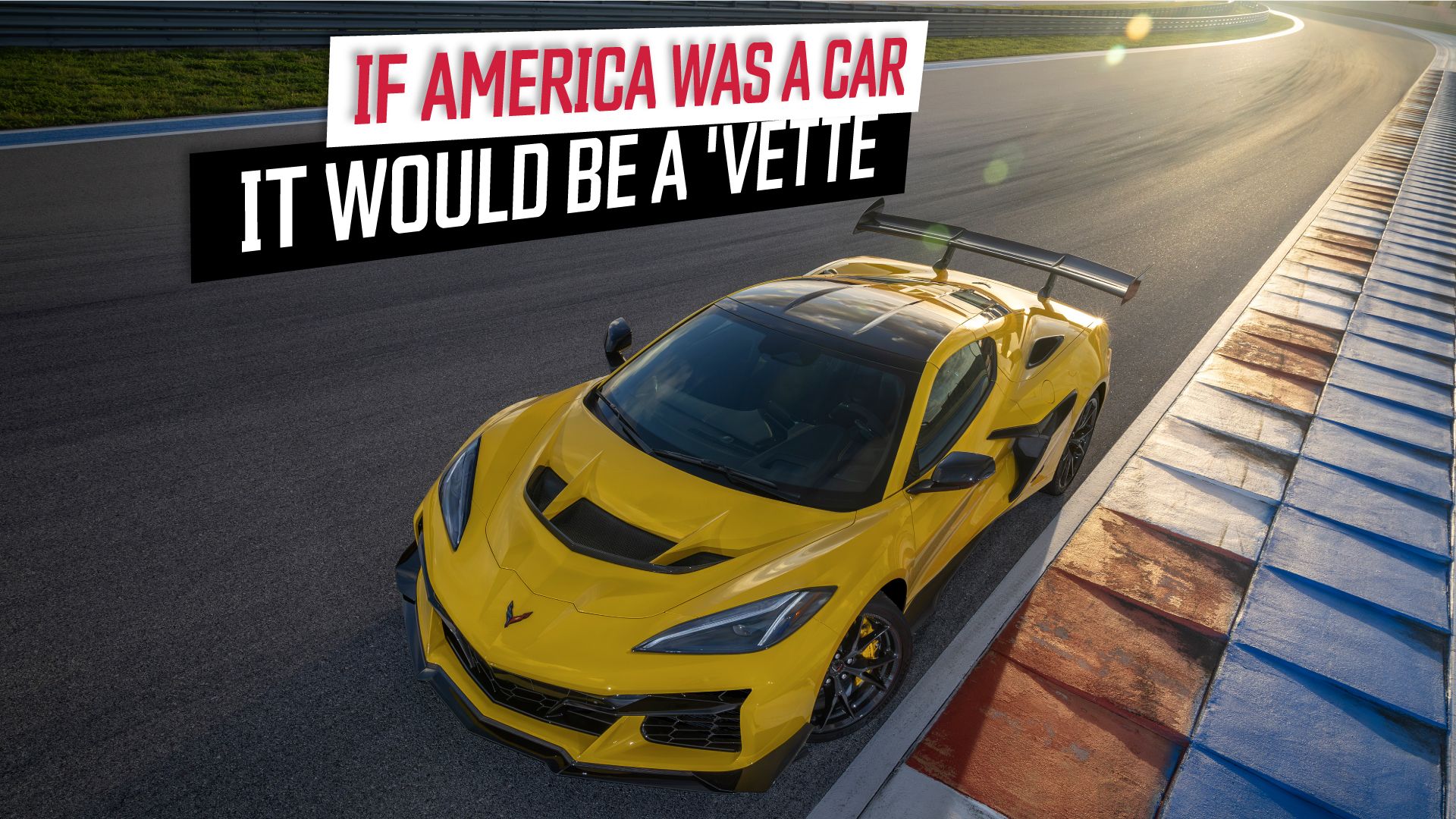
The Chevrolet Corvette Is The Automotive Equivalent Of America’s Fun-Loving Spirit

When it comes to American cultural icons, few are as revered as the Chevrolet Corvette. It’s been around for 71 years now, and even back when it was released in 1953, it was an instant hit. There have been competitors over the years, but none have even come close to touching on what the Corvette has been able to do, which is to shape American motoring culture as we know it. These days, the Corvette has come a very long way from its leaf-sprung, solid-axle roots. Today, the current Corvette is more supercar than a sports car.
Related
2025 Chevrolet Corvette ZR1 Brings A 1,064-HP Nuke To A Knife Fight
Chevrolet has turbocharged the Z06 engine to a stunning 1,064 horsepower with 828 lb-ft of torque. And that’s just the start.
However, it still retains its working-class roots where it matters most, such as price. Not to mention, it can still spark wonder and desire in the hearts of gearheads, children, and even passers-by without even trying.
Because the Corvette is such an important car, CarBuzz decided to pay homage to the icon. First, we’ll discover its origins and history, then delve into what it means to America as a whole. We’ll see exactly how, when, and what the Corvette has done to shape American car culture, and how it’s impacted the motoring world as a whole.
The following information was sourced directly from Chevrolet.com and CorvetteMuseum.org. Historical information and anecdotes were sourced from Chevrolet’s heritage website.
Where It All Started
C1 Corvette Quick Facts
- First introduced in 1953.
- Built using a revolutionary reinforced plastic body shell.
- The Corvette was nearly canceled after only two years.
As far as humble beginnings go, the Corvette’s is among the humblest out there. The Corvette began as the brainchild of Mr. Harley Earl, the head of automobile styling at General Motors throughout the early 1950s. Being a big fan of European sports cars, he’d been wanting to design one to be made by GM for some time. He’d finally reached his point of action when he realized just how many American GIs were bringing over European sports cars at the end of World War II. He saw a market and jumped at the opportunity.
After a hasty design phase that only lasted a few months, the Corvette was rushed into production in early 1953. At the time, the fiberglass-plastic body shell was only intended to be used on the first Corvette show model, after which assembly would be switched to a hardened steel body.

Related
Every C8 Chevrolet Corvette Model Ranked By Its Quarter-Mile Time
The Corvette is the pinnacle of Chevrolet performance, so let’s rank each current C8 generation model in terms of quarter-mile runs.
However, a man called Ellis James Premo, a body engineer for the Corvette commented on the decision to maintain production using a plastic body: “…at the time of the Waldorf (auto) Show, we were actually concentrating body-design-wise on a steel body utilizing Kirksite tooling for the projected production of 10,000 units during the 1954 model year. It was some time later that we decided to produce this quantity in reinforced plastic.”
The decision to keep the plastic body came after designers at Chevrolet noticed the public’s fascination with a plastic-bodied car. The reinforced plastic used to make the Corvette’s body wasn’t much more expensive than steel. However, the initial finish of the fiberglass body was extremely poor. Other issues included doors reportedly opening while the car was moving and water leaks were a constant issue. In total, roughly 300 Corvettes were produced in 1953, of which about 200 are thought to exist today.

Add CarBuzz to your Google News feed.
The Corvette Family Tree
After suffering dismal sales in 1953 and 1954, the Corvette was almost axed. Luckily, a few things occurred that helped secure the Corvette’s place in automotive history. For one, the piddly, 150-horsepower 235 CID “Blue Flame” straight-six seen in the 1953 and 1954 Corvettes was dropped following Chevrolet’s introduction of the 195-horse 265 CID small-block V8 in 1955. At this time, you could also swap the two-speed Powerglide transmission for a three-speed manual, upping the fun factor by quite a bit. However, the largest reason for Chevy to carry on with the Corvette was for competition’s sake, as Ford released their Thunderbird in 1955, another pleasure-oriented two-seater car.
Once the Corvette’s place in the automotive world was solidified, its popularity skyrocketed. The second generation ‘Vette, coined the C2, was introduced in 1963 with loads of improvements. Most notably, it ditched the solid-axle rear suspension setup from the C1 for an independent configuration, greatly improving handling and responsiveness.
2:16

Related
The History Of The Chevrolet Corvette Stingray
The standard C8 Corvette Stingray is one of the best performance bangs for your buck out there.
The C2 was also responsible for introducing the Stingray grade, arguably the most famous Corvette trim. Modernization was good for the Corvette. Come 1968, the C3 came to light, which transformed the Corvette into a more muscle-oriented car, rather than a fast, coastal road cruiser. A litany of V8s were offered, with the 435-horsepower, triple-carbed L71 427 CID big block V8 being the most powerful and first offered in 1968. In 1984, the C4 Corvette returned with a radically new shape, which would be seen until its discontinuation 12 years later. It also began to take cornering more seriously, attempting to leave behind the stereotypical “only good in a straight line” sentiment that plagued classic American muscle cars.
In 1997, the Corvette entered a more modern age with the introduction of the C5. Futuristic features were introduced with this generation, including a drive-by-wire throttle and variable steering. It was also the first Corvette to receive an LS engine, beginning with the 1997 model year. After eight years of the C5, it was time for a change, so Chevrolet released the C6 Corvette. Immediately, it was met with criticism because it was missing the iconic flip-up headlights. Regardless, the C6 was the first Corvette to see a significant amount of power, especially in the ZR1 model, which received 638 horses from a supercharged, 6.2-liter LS9 V8.

Related
Cars With Pop-Up Headlights: A Definitive Guide To The Legends
Is there anything cooler on the roads than pop-up headlights?
In 2014, Chevrolet unveiled their C7 Corvette, and the first one to use the Stingray name since 1976. Much like the C6, the C7 received its fair share of criticism, mainly centered around its then-reportedly “over-styled” rear end. Despite the criticism, it was well-received by the masses. The C7 offered two unique packages; the Atlantic and Pacific, among others. The Atlantic grade was meant to turn the Corvette to its luxury sports car roots, whereas the Pacific grade was a performance-oriented trim.

Related
Ranking Every Generation Chevrolet Corvette ZR1 By Top Speed
The ZR1 is the Corvette’s most powerful model, so let’s see how fast every generation can go.
Today, we’re currently in the midst of the Corvette’s eighth generation, the C8. When it was introduced in 2020, it was the most radical Corvette since its grandfather first hit the showroom floors in 1953. It now boasted a mid-mounted engine and was more track-ready than any other mass-market Corvette before it. The C8 is also the first Corvette to top 1,000 horsepower with the newly-unveiled C8 ZR1. On the flip-side, it’s also the first ‘Vette to introduce a hybrid version dubbed the E-Ray. Overall, the C8’s design and performance are meant to convey its more serious nature, taking styling cues from European supercars while still maintaining an affordable price and impressive abilities.
The Corvette’s Place In Our Hearts

It may seem like a simple enough answer, and it is. But there’s much more to the reasons why the Corvette holds a special place in America’s heart, and why it’s been such a monumental success, apart from things like being fast and cheap.
One of the shining aspects of the Corvette’s universal appeal is the joy it can bring to everyone in a relatively simple way. When you think of supercars like Ferraris or Lamborghinis, there’s no question they’re things of beauty and impressive performance. However, for 99 percent of us, a car like that is unattainable. Not many folks have the near-$430,000 to drop on a new Ferrari 812 GTS. However, the Corvette reminds us we don’t have to be Barons or oil moguls to achieve the quickness of a Ferrari. For just $68,300, the starting price of a 2024 ‘Vette, you can have a car that can get from 0-60 mph in 2.8 seconds, just one-tenth of a second slower than that 812 GTS. How could you not love that?

Related
10 Cars Powered By General Motors’ Most Reliable V8 Engine
GM and V8 engines are a match made in heaven, and one V8 has powered some mighty impressive machines.
Another key factor to consider in the Corvette’s ability to spark joy in just about anyone is it doesn’t take itself too seriously. Now, that doesn’t mean it’s a silly car for fooling around in. It’s far from that, especially these days. The C8 Corvette comes with things like Magnetic Selective Ride Control, an eight-speed dual-clutch automatic transmission, and aerodynamics honed in both wind tunnels and on racetracks. But, Chevrolet remembers that it’s a Corvette, and Corvettes are also made to cruise around the American countryside and sit on display at diner parking lot car shows, a place you’d never see a Ferrari or an old Maserati.
In short, we love the Corvette for loads of reasons, but it’s unmatched in its ability to capture the hearts of nearly anyone it’s exposed to, be it in terms of its looks, performance, or outlandish personality. It’s no wonder it can receive so much hate in some circles, yet still come back again and again to roaring applause and dreamy wonderment. It’s the perfect car to sum up America as a country and what we do best; have fun.
Sources:
ChevyExchange.com
,
CorvetteMuseum.org