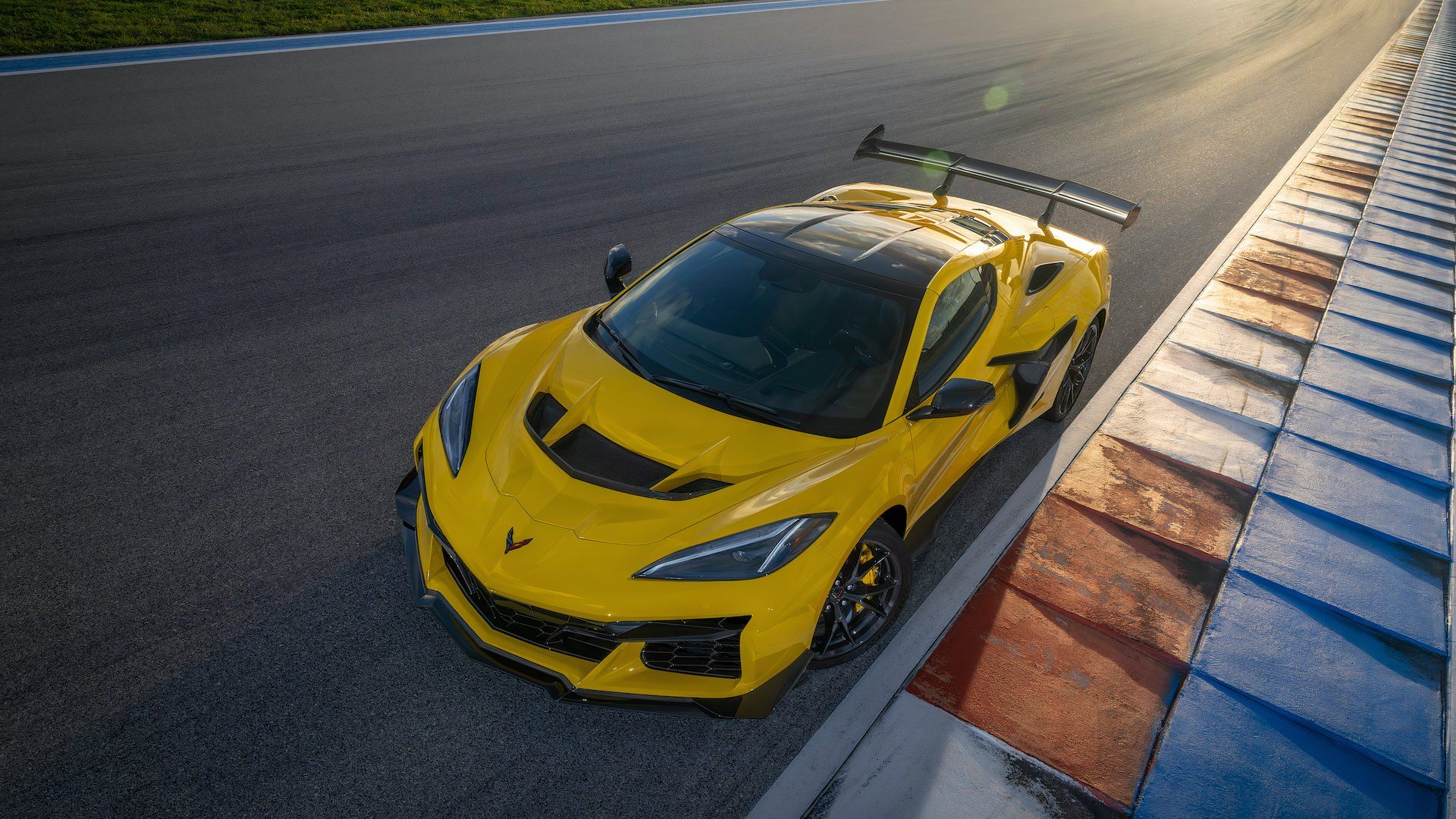
The Chevy Corvette ZR1’s Turbos Are Record-Setting Monsters

When the Chevrolet Corvette ZR1 was unveiled a few months ago, one metric stood out more than any other – the peak output of 1,064 horsepower. This was achieved, in part, by strapping a pair of turbochargers to the engine from the Corvette Z06, and since the LT6 in that car produces 670 hp, it’s no surprise to learn that the ZR1’s turbos are among the largest in the world. According to supplier BorgWarner, these are the “largest passenger car twin turbochargers in the market to be released to date.” With a 76mm compressor wheel, each turbo is as big as each of those on the Hennessey Venom F5.
Size Isn’t All That Matters
That compressor wheel is a forged and milled unit with a ported shroud. These help to prevent surge by allowing air from downstream of the compressor to recirculate upstream of the compressor. Surging is the disruption of airflow inside the turbocharger, and this can cause increased backpressure.
Add CarBuzz to your Google News feed.
This turbulence wastes energy and can cause unwanted vibrations and oscillations, as well as increased wear. With a ported shroud, higher boost pressures can be run at lower RPM and lighter throttle loads. A side effect of this feature is more turbo noise, but the key factor is greater reliability, something BorgWarner has learned a lot about as an NTT IndyCar Series supplier.
Electronic Boost Control
Each turbocharger features a compressor-mounted blade pass speed sensor, which allows accurate monitoring of the turbo speeds, allowing maximum utilization of the powertrain’s potential. Two boost pressure figures are cited: 20 and 24 psi. At normal operating temperatures and barometric pressure, the full output of 1,064 hp and 828 lb-ft of torque can be achieved at 20 psi. If air temperatures rise or air density falls (such as at higher altitudes), the turbos can spin to 24 psi, enabling the same mass air flow delivery rate.
This would not be possible with a mechanical wastegate actuator, which uses springs to determine how much boost is generated. All of this should mean loads of power with minimal turbo lag, but the engineers at Bowling Green aren’t done yet – the upcoming Corvette Zora will be even more powerful thanks to an electrification component.