The Fascinating Story Of Ford’s Failed McLaren F1 Rival

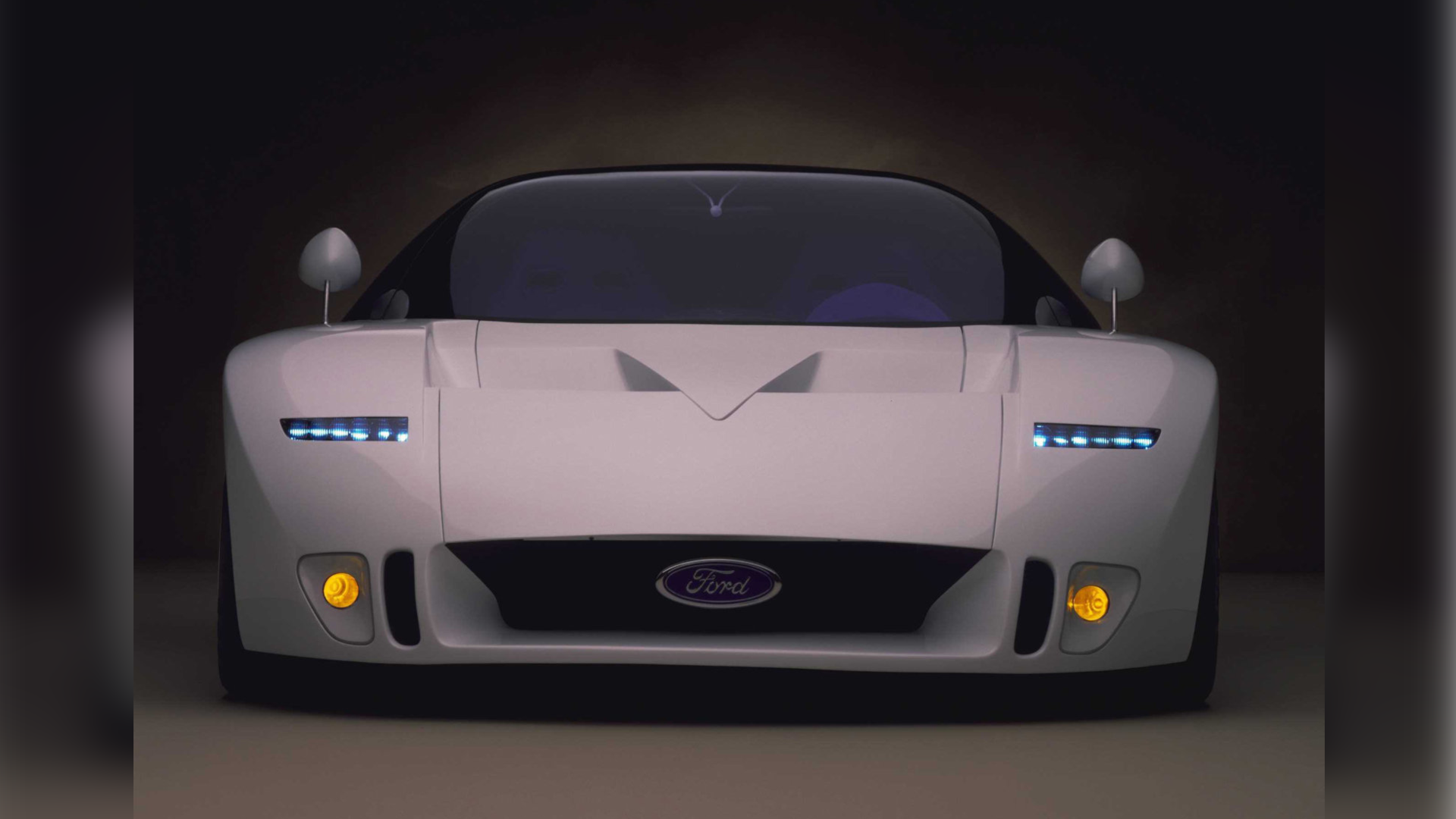
The Ford GT and its iconic predecessor, the GT40, are extremely well-known, with a firmly established place in automotive history. Thanks to their role in motorsport and engineering innovation, as well as striking design and pop-culture credentials, they have become all but household names. But there is one car that, although created to be part of the same family, never got to enjoy the same level of fame as its more illustrious brothers. The GT90, built in the mid-1990s as a one-off concept car that could have taken on acclaimed rivals such as the McLaren F1, never made it to production, and will never be a part of the legacy the GT family leaves behind. Let’s explore the history of this high-performance model that never was.
What Came Before: The GT40 And The GT70
The GT90 was originally intended as a kind of spiritual successor to the legendary GT40, built for endurance racing in the mid-1960s. While the GT40 has its early origins in England as part of a collaboration with iconic British racing car firm Lola, the project soon moved over to the States under the direction of legendary designer Carroll Shelby.
With a sleek, futuristic design, the GT40 was created with the primary aim of entering the 24 Hours of Le Mans, where Ferrari had enjoyed a long run of wins throughout the first half of the 1960s. In 1966, the hoped-for result finally arrived. A Mk II GT40, powered by a 7.0-liter V8 already used in the Galaxie, eventually succeeded in its aim of dethroning Ferrari at Le Mans with a 1-2-3 finish that secured Ford’s place in Le Mans history. This legendary feat would later be immortalized in the Ford V Ferrari movie in 2019.
There was also another, slightly less famous, model that influenced the GT90: the rare GT70 rally car, only six examples of which were ever built. The GT70 was a British-led project, created under the direction of automotive designer Len Bailey, who had at one time been the chief engineer of the GT40 project. While the initial models were powered by a 2.6-liter V6 borrowed from the Capri RS2600, later cars employed a variety of engines including two different Cosworth-built four-cylinder units.
Sadly, the GT70 did not enjoy the same racing success the GT40 had. Its short-lived rallying career was plagued by major issues with the engine, braking and suspension. Another car was involved in a collision during the 1971 Tour de France Automobile, prematurely ending its racing career. The sixth and last GT70 to be built became an innovative concept car thanks to the Ford Design Europe studio, with some help from design and coachbuilding firm Ghia, which had just been acquired by Ford.
Ford In The 90s: A Lull In Innovation
Throughout the first half of the 1990s, Ford was going through a slow period on the design and innovation front, with few new ideas and little in the way of exciting design developments. The “jelly bean” design era, which had started in the mid- to late-1980s, had reached its peak in the 90s with models like the Taurus, and was beginning to feel somewhat stale.
During this period, Japanese brands also began to establish a foothold in the American car market, building themselves a reputation for quality and reliability that would last to the present day. This was a contributing factor to Ford’s problem, and the company realized that a radical change in design was badly needed to revamp the lineup and offer something new to customers. Jack Telnack, then Vice President of Design, began to draw up a radical new design language that would turn around the company’s fortunes and spawn several iconic models.
A New Edge: Ford’s New Design Philosophy
Halfway through the decade, Ford began to take a new direction. The GT90 was an important part of the brand’s new design philosophy, dubbed the “New Edge.” It was the very first Ford vehicle to be built in this style, serving as a style blueprint that would go on to inspire several production models. The New Edge combined soft, rounded aerodynamic lines with sharp angles; after earning awards and praise from the press, it became a mainstay of Ford’s style for over a decade, eventually being replaced by the “Kinetic Design” style in 2006.
New Edge vehicles combined sweeping curves and straight lines to create a dynamic, energetic look. Some cars featured a trapezoidal grille that became one of Ford’s signature design elements, as well as the pointed headlights that made models such as the Focus instantly recognizable. The new design also had the additional effect of simplifying the production process. This was because the simplified lines made the panels easier to align, which made manufacturing quicker and easier.
The Nitty Gritty: The GT90’s Mechanical Side
The GT90 was equally impressive on the inside as it was on the outside. Power came from a custom-built 5.9-liter 90-degree V12 based on the Ford Modular engine series; while the Modular units were V8s and V10, the GT90’s engine was the V12 built by Ford since 1948. The already impressive engine was assisted by not two, not three, but four Garrett turbochargers. While in the development phase, the engine was installed in a Lincoln Town Car which was used as a test mule to fine-tune it. Power is sent to the rear wheels via a five-speed manual gearbox; the transmission was produced as the result of a collaborative effort between British companies FF Developments and Ricardo.
The GT90 also had another technological edge that made it stand out: the implementation of components derived from the aerospace industry. Due to the high temperature of the exhaust, the GT90’s body panels are at risk of melting if not protected adequately; Ford solved this problem by using ceramic tiles very similar to the kind used on the Space Shuttle to shield components from extreme heat. The 19-inch wheels wore custom tires, specially made by Goodyear for the GT90 project.
The interior was surprisingly human-friendly for a car of this type; rather than sporting a bare-bones, motorsport-inspired cabin, the GT90 was equipped with a ten-speaker sound system as well as an in-car phone and even air conditioning.
What Happened To The GT90?
| Engine | 5.9-liter, quad-turbocharged V12 |
|---|---|
| Power output | 720 hp |
| Torque | 660 lb/ft |
| 0-60 mph | 3.1 seconds |
| ¼ Mile | 10.9 seconds |
| Top Speed | 253 mph |
The GT90 made its debut at the Detroit Auto Show in 1995, ushering in the New Edge design and making an impression with aerospace-inspired tech elements. The initial hype associated with it was at odds with its later relative obscurity. The GT90 made an appearance on an episode of Top Gear which introduced it to worldwide television audiences. Jeremy Clarkson tested the GT90 as he could not fit in the GT40, but was initially happy to be given the opportunity to take it for a test drive; however, his opinion changed after he had driven it. The verdict on its handling and performance was far from good, with Clarkson stating it “had a top speed of 40” and “handled like it was in a cartoon”.
Between the poor feedback and high production costs, the GT90 did not get the go-ahead, and the prototype that had been showcased at Detroit would remain the only car to wear the GT90 badge. The next car to carry the GT name did not arrive until 2003, when the Ford GT made its debut to celebrate the company’s 100th anniversary. The GT90’s lifecycle being cut short, however, did not stop it from becoming an icon in the world of motorsport video games, with appearances in several prominent game franchises such as Need for Speed and Gran Turismo.
As for the real GT90, it showed up at high-profile automotive events a few times (including the Goodwood Festival of Speed in 2008), before being sold at auction in 2010. Although the auction did not succeed in finding it a new home, separate negotiations landed it a place in the Hajek Motorsports Museum in Oklahoma, where it arrived in 2012. By the time the GT90 arrived at the museum, it was in a fairly sad state of disrepair, with multiple issues including cracked windows (which required an $18,000 custom-built replacement) and a tank full of old fuel. After the necessary work had been completed and the GT90 restored to its former glory, it was finally ready to be put on display in the museum, where it still remains to this day.