The First Car With Dummy Exhaust Tips Will Shock You

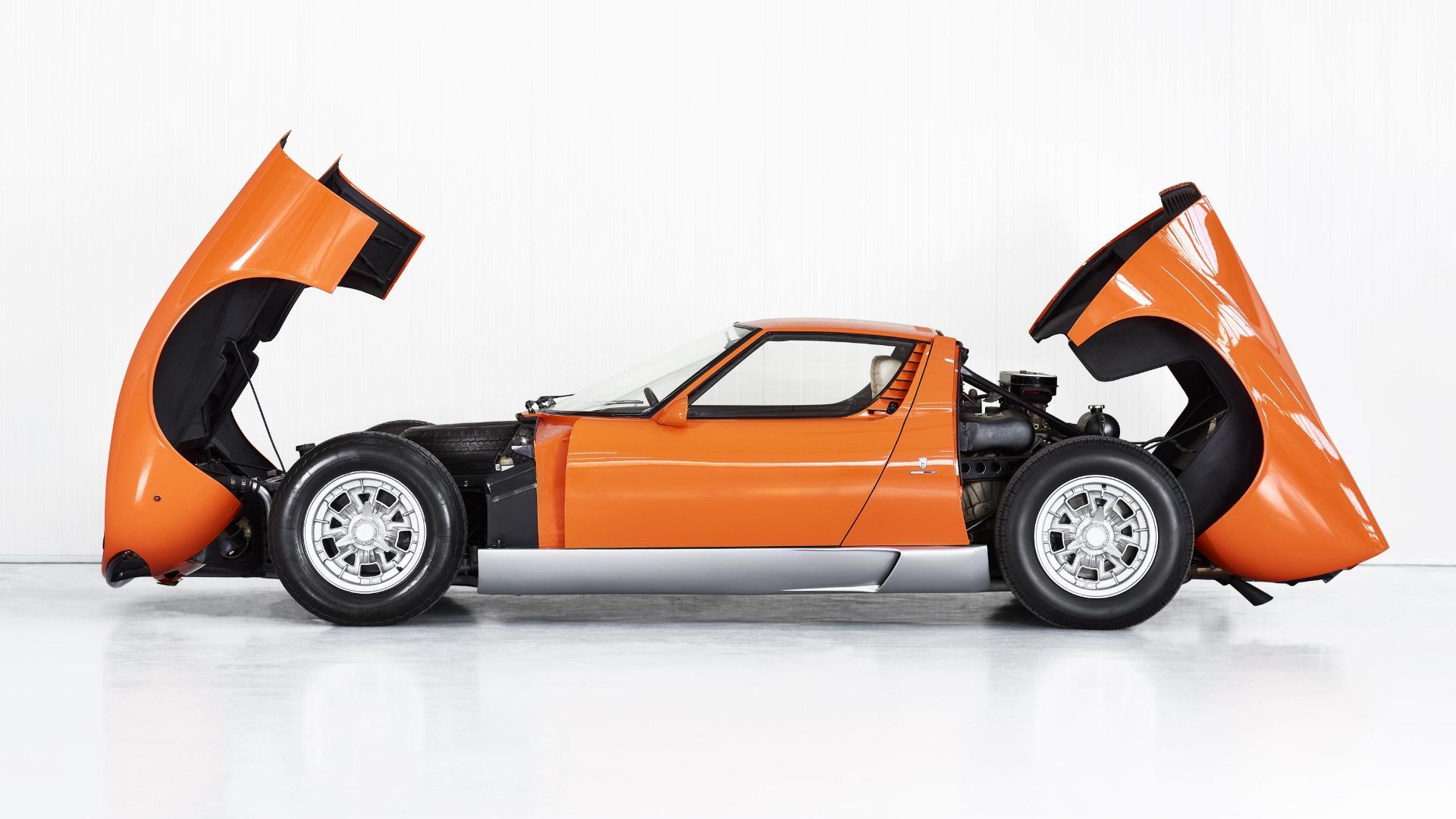
Lamborghini’s Miura was one of the groundbreaking supercars and, in its day, helped to establish a template for cutting-edge and high-performance car design. The Miura appeared at the 1966 Geneva Motor Show and immediately established a fan base, with its revolutionary mid-to-rear engine layout and striking looks. Yet this Lamborghini model also had an intriguing design that was to set tongues wagging, as its rear end sported a pair of dummy exhaust tips. Did these represent a design faux pas, or were they there for another reason altogether?
Lamborghini
Automobili Lamborghini was created in 1963 after its founder had a disagreement with Enzo Ferrari over the cost of servicing his cars, arguing that Ferrari was overcharging for off-the-shelf parts. Enzo didn’t respond amicably, so Ferruccio took matters into his own hands with the 350 GT. Lamborghini later introduced the Miura, widely regarded as the first true supercar and one of the prettiest ever made. These days, the brand’s identity is characterized by AWD drivetrains, outrageous special editions, and raucous engines. The 1,001-hp Revuelto is its current V12 flagship, while the Urus SUV is its bestseller.
- Founded
-
1963
- Founder
-
Ferruccio Lamborghini
- Headquarters
-
SantÁgata Bolognese
- Owned By
-
Audi
- Current CEO
-
Stephan Winkelmann
Some modern-day manufacturers fit faux exhaust tips and grilles to the rear of their cars, but Lamborghini chose to fit some to one of its earliest Miuras. What were the reasons for doing so and was the move controversial, or acceptable?
Ornamental Exhaust Tips Graced the Early Miuras
|
Lamborghini Miura P400 Specifications |
|
|
Engine |
3,929cc, V12, 60 degree, transverse, mid-engine |
|
Transmission |
5-speed manual |
|
Power |
350 hp @ 7,850 rpm |
|
Torque |
270 lb-ft @ 5,000 rpm |
|
0–60 mph |
6.7 seconds |
|
Drivetrain |
Rear-wheel-drive |
The earliest Lamborghini Miura models, specifically the Miura P400 (between 1966 and 1969), and the Miura P400S (between 1968 and 1971), had a pair of faux exhaust tips, which the company integrated into the rear panels. These were purely ornamental, and represented more of a channel than anything else, but they were nevertheless prominent features on the back of the car and gave the illusion of full exhaust outlets.
Designers hid the actual exhaust pipes from view completely, and they exited the engine beneath the vehicle. The engineers didn’t connect the pipes to the exhaust tips, and this certainly made it a lot easier or more practical for owners to open the car’s rear end and access the engine itself. So even though those exhaust tips were just an illusion, they certainly helped to add to the car’s dramatic aesthetic.
How Early Miura Design Came About
As with other models, the Miura was the brainchild of Ferruccio Lamborghini, the founder of the company that bore his name and an Italian entrepreneur whose passion in life was to usurp his rival Ferrari. He set about creating high-performance cars that could deliver unmatched performance alongside groundbreaking esthetics and, in doing so, he teamed up with engineers like Giampaolo Dallara.
Lamborghini named the Miura after a breed of Spanish fighting bull. Of course, the company’s motif is an angry bull, and his idea here was to craft a vehicle that was aggressive and beautiful at the same time as it produced raw power. The design itself came down to Marcelo Gandini, who worked for the Italian coachbuilder Bertone. Gandini was a master of design and not afraid to be futuristic or even radical at times. He shaped the car’s beautiful silhouette, underscored by sweeping curves and large, dramatic vents.

Related
Lamborghini Won’t Build You A Classic Miura Or Countach
It’s restoration shop is for restoration, only, no mods or continuations.
Both Lamborghini and Gandini knew that their buyers would love something stunning, sporty, and symmetrical. At that time, it wasn’t practical to extend the exhaust pipes themselves so that the actual exhaust, complete with decorative tip, emerged from the rear of the vehicle. Instead, they felt these “exhaust-like” tips would create the perfect illusion of muscularity and power.
Still, there were practical reasons for hiding the actual exhaust pipes beneath the car. This meant that engineers could position the pipes lower, which would help to keep excess heat and unwanted gases away from sensitive components. Additionally, they could protect the rear body from heat-related damage, especially as that bodywork was close to the engine layout, and designers didn’t have the luxury of lengthy piping to diffuse the heat.
Remember, the 1960s were different times and the automotive press was far more interested in Miura’s groundbreaking design, innovation, and speed, than minor distractions. They may have referred to the exhaust tips as ornamental, rather than complaining about any potential “deception.”
Lamborghini Moved on in the 1970s
Later models of the Lamborghini Miura featured an entirely fresh design, and only the early models – the P400 and the P400S – had the dummy exhaust tips. In 1971, Lamborghini came out with the Super Veloce (SV) and the false exhaust tips disappeared altogether. Instead, the functional exhaust pipes themselves were clearly visible at the rear. The SV had more straightforward styling cues and potential buyers were certainly happy with the results.
Why People Love to Modify Their Rear Ends
Lamborghini may have been one of the first manufacturers to include this type of visual illusion in pursuit of the perfect aesthetic. However, it certainly wasn’t the last, and you will find several high-performance and luxury vehicles today that offer either dummy vents, grilles, or exhaust tips, to enhance the visual appeal or balance of each vehicle. None of these design elements perform any mechanical function as such, but car buyers certainly like the look. After all, you only have to assess the scale of the aftermarket exhaust tip industry to see just how much people are willing to spend.

Related
Here’s What Happened To The Only Lamborghini Miura SVR Ever Built
The Miura SVR is the rarest-ever version of Lamborghini’s iconic supercar. Here is how it came to be and what became of it
It’s not unusual for people to customize the appearance of their cars for a variety of reasons. Sometimes they just want to reflect their personal style while at other times they may want to significantly improve the rear-end look of their vehicle. An exhaust tip could give the car a sportier or more aggressive look without any substantial modification and little wonder that there are so many options in the marketplace.
Today, you can choose exhaust tips made from stainless steel and chrome-plated steel. They may have heat-resistant finishes and be able to repel corrosion and certainly come in a variety of diverse styles. For example, you can choose products that have rolled or cut tips. Others may be super-lightweight and made from titanium or carbon fiber, while more outlandish versions can even feature illuminated or LED tips. Certainly, exhaust tips can help to protect the body and hold the end of an exhaust pipe in place, but they invariably add a cool look into the bargain.
Faux Exhaust Tips and Grilles in the Modern Era
Brands such as BMW, Mercedes-Benz, Audi, and Lexus may sometimes employ a decorative exhaust outlet or vent. You might have to look closely to see that these are merely stylistic rather than functional, but the inclusion of these parts may nevertheless highlight the lasting influence of cars like the Miura. Remember, Lamborghini established this practice decades ago, but there’s plenty of evidence of a carry over to modern times.

Related
This Supercar Had The Only Tranverse V12 In History
If you want your sports car to be different, why stop at a beautiful design?
Dummy Exhaust Tips Get the Conversation Flowing
If you strike up a conversation about this topic on an enthusiasts’ forum, you’re likely to find plenty of people on either side of the fence. Some see this as harmless design creativity, while others may be critical. The latter group may see dummy exhaust tips as an unnecessary design element or even as a deception. Yet others view it as simply an expression of artistic freedom and not something that should be an ethical consideration at all.
Don’t forget that in the era of electric vehicles, the dummy exhaust conversation hasn’t gone away completely. After all, manufacturers like Fiat are now giving the electric 500 Abarth a dummy exhaust noise. The company may not be adding a faux tip to go along with the artificial exhaust sound, but the practice certainly introduces another layer to the conversation.
The Miura’s Dummy Exhaust Tips Simply Add to Its Appeal

In the end, the dummy exhaust system on the Lamborghini Miura simply symbolizes an era where automotive styling was a blend of creativity and, to an extent, illusion. Dummy exhaust tips today can sometimes be controversial, but remember, the Miura was a pioneering supercar and broke ground in so many ways. Few people seemed to focus on something as innocent as a faux exhaust tip.
You could argue that automotive enthusiasts cherish the Miura today because of its design quirks and cutting-edge thinking, In that respect, the exhaust tips are all good.
Sources: Lamborghini