The History Of Ford’s V4 Engine

Over the course of automotive history, some engines, like the V8 and the inline-four, have gained popularity in production cars, being frequently used on a variety of models. Some engines, on the other hand, are less common, whether it’s because they have fallen out of favor due to mechanical issues or because they weren’t commercially viable.
The V4 is one engine that you’re unlikely to spot in the wild, even in the classic car world, unless you go out of your way to look for a car powered by one. While its history began around the same time as that of the car, with the first V4 being designed and built in 1898, it never became as popular as its inline-four counterpart, and over the next few decades only a handful of models have been built with a V4 under the hood.
One company that has designed not one, but two such engines is Ford. The first was the Taunus in the early ’60s, and then with the (unrelated) Essex a few years later. Let’s explore the history of the V4 engines built by Ford, and others like them across the automotive world.
The Taunus V4
The first V4 engine produced by Ford arrived in 1962. The Taunus, built by Ford of Germany in its Cologne plant. Four versions of the Taunus were created over the years, each with two differently-tuned sub-variants: a 1.2-liter producing either 40 or 45 hp, a 1.3-liter producing 50 or 53 hp, a 1.5-liter producing 55 or 65 hp, and a 1.7-liter producing 65 or 75 hp. The Taunus also served as the basis for a V6 engine called the Cologne V6, used in several models including the Capri, Ranger, and Mustang over the years.
The Taunus In Ford Cars
The Taunus was originally designed to power a new compact car aimed at the US market called the Cardinal. However, this project was later shelved, and the Cardinal design was employed by Ford in Germany for the new Ford Taunus, powered by the V4 engine of the same name. The Taunus V4 ended up being used in three other Ford models across Europe and the UK: the Consul, the Transit van, and the Capri.
Aside from the production cars, there was one other Ford which used the Taunus engine but remained a one-off concept: the Mustang I, one of the earliest ancestors of the legendary muscle car of the same name. Built in 1962, two years before the production Mustang hit the market, the Mustang I was an open two-seater with a design inspired by the world of motorsport: its sleek, aerodynamic aluminum bodywork bears little resemblance to what ended up becoming the Mustang.
The Taunus In Other Brands’ Cars

Ford’s V4 engine also powered some non-Ford vehicles over the years, including three Saab models and the Matra M530. The 96 was the first Saab model to be fitted with a Taunus V4 as a test; after Ford had conducted initial testing on a handful of cars, they were sold back to Saab with the engines in place, and Saab carried out its own testing in turn. Eventually, the company decided to make a deal with Ford and obtain the Taunus engine for three of its models: the 95, 96, and 97 (Sonett).

Related
Why Saab Failed To Capture American Hearts
Saab was one of the most innovative car manufacturers in business during the 20th century, but this is why it never conquered the US.
The M530, meanwhile, was a French sports car produced between 1967 and 1973 by small-scale French manufacturer Matra. A successor to the motorsport-oriented Djet, the M530 was instead aimed at drivers who simply wanted a more fun experience on the road: a voiture des copains (“car for friends”). It was equipped with the high-output version of the 1.7-liter Taunus, producing either 73 or 78 hp depending on the model variant.

Add CarBuzz to your Google News feed.
The Essex V4

Two years after the Taunus engine had made its debut, another V4 bearing the Ford name arrived on the market: the Essex was not related to the Taunus, but happened to share its layout. While it powered some British models, the Taunus had been primarily focused on the German market. The Essex came from Ford of Britain. This is also where its name’s origins lie: the Essex engine was built in Ford’s famous assembly plant in Dagenham, in the British county of Essex. Two versions of the Essex V4 were available: a 1.7-liter which produced 72 hp, and a 2.0-liter which produced 91 hp.

Related
How Ford Built The Most Powerful Version Of Its EcoBoost V6
Ford’s determination to create a high-powered V6 engine despite tightening global emissions laws
Work on its design started in 1961, with the goal of creating an engine versatile enough to be employed in commercial vehicles, passenger cars, and industrial applications alike. The project generated two different engines: one was the V4, the other the Essex V6. The development of the engine coincided with the birth of the Transit van; while, initially, Ford of Britain and Ford of Germany were developing two separate commercial vehicles (the British one was due to be called the V-series), eventually the projects were consolidated into what would become the Transit. The two divisions were, however, allowed to keep separate engines; Germany had already developed the Taunus, while England used the new Essex V4.
The Essex In Ford Cars

The Transit was not the only Ford vehicle to use the Essex engine; it showed up in several other models over the next few years. The Ford Corsair, a mid-size family car available as both a sedan and a wagon, was available with both of the Essex V4: the 1.7-liter unit was available from 1965 onwards, while the 2.0-liter version became available the following year. The inclusion of the V4 in the Corsair’s engine lineup turned out to be a disappointment for customers: its marketing tagline, “The car that is seen but not heard”, proved to be anything but true, as the engine was noisy and far from smooth.
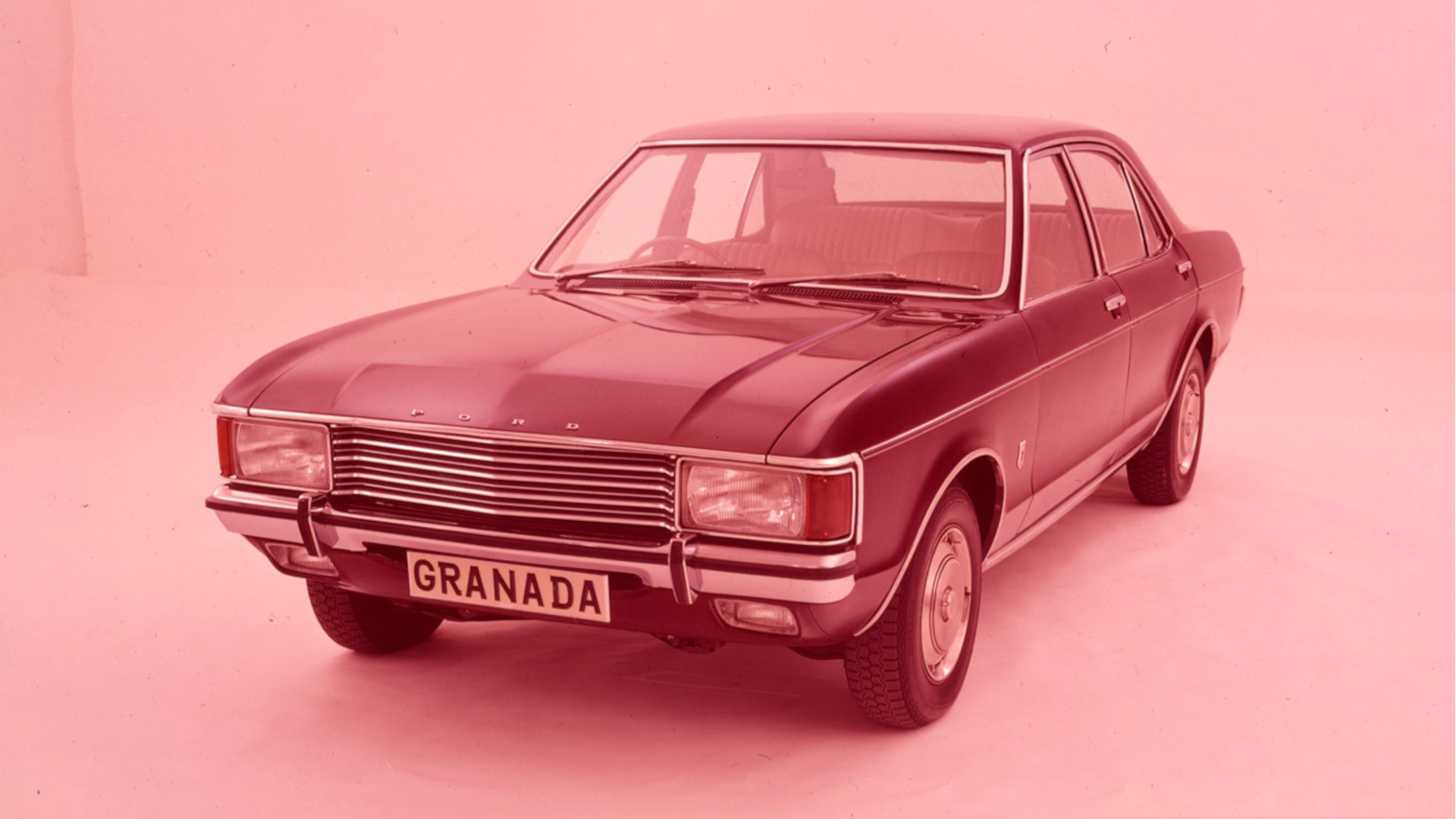
The Corsair’s replacement, the Granada, was also available with the 2.0-liter Essex; the Ford Consul, based on the Granada, offered both the 1.7-liter and 2.0-liter variants in its lineup. Other Ford models to offer an Essex V4 in the second half of the 1960s include the Zephyr Mk IV and the Capri 2000GT.
The Essex Outside Ford

The Essex was also used outside of Ford’s own models, although not quite as much as its Taunus counterpart. The only non-Ford car to be fitted with an Essex V4 was the limited-edition Marcos 2 Liter, a small sports car built by British manufacturer Marcos. Marcos had a complicated history of on-and-off financial troubles, until its eventual demise in 2007; its first brush with bankruptcy arrived in 1971, just after the 2 Liter had gone out of production. Estimates suggest that between 40 and 80 V4-powered Marcos 2 Liter cars have been built in total.

Related
Exploring Ford’s Forgotten V12 History
Ford is renowned for its V8 engines, but at some point in its history, V12s were a part of its lineup.
Other V4 Engines In Automotive History
The Taunus and Essex may have been the only V4 engines produced by Ford, but they were not the only ones to have been produced over the course of automotive history. Lancia produced a V4 engine between the 1920s and the 1970s, starting with the Lancia Lambda in 1922 and ending with the Fulvia in 1976. Around the same time, GM toyed with the idea of launching a V4-powered car, but ultimately the V4 project was scrapped in favor of a V6.
Jumping forward another half century, Porsche made use of the V4 layout for its 919 Evo hybrid racing car at Le Mans, between 2014 and 2017. The same car also shattered the overall Nürburgring lap time record in 2018, and is still the current record holder. Last year, CarBuzz heard rumors that Porsche may be testing a hybrid V4 engine, derived from the one used in the 919, for future use in a production model.
Sources:
Motorlegend
, Ford,
Marcos Heritage