The Last 2 SUVs Left In America With A Manual Transmission

For various reasons, the manual transmission is all but extinct in 2025. Just a few automakers are sticking it out with three pedals for the fans this year, including Subaru with the manual-equipped 2025 WRX which is a lot of fun but not intended for much serious off-road use. If you’re looking to do some four-wheeling while rowing your own gears as you explore new places and challenge yourself and your machine, then you’re a completely normal enthusiast driver who’s got a bit of thinking to do.
-

- Base Trim Engine
-
3.6L Pentastar V6 ICE
- Base Trim Transmission
-
6-speed manual
- Base Trim Drivetrain
-
Four-Wheel Drive
- Base Trim Horsepower
-
285 HP @6400 RPM
-
- Base Trim Engine
-
EcoBoost 2.3L ICE
- Base Trim Transmission
-
10-speed automatic
- Base Trim Drivetrain
-
Four-Wheel Drive
- Base Trim Horsepower
-
275 HP @5700 RPM
- Base Trim Torque
-
315 lb.-ft. @ 3400 RPM
- Base Trim Battery Type
-
Lead acid battery

The used market offers a decent selection of utility focused, AWD-equipped models, but shoppers set on something in a brand new SUV in 2025 with three pedals and four driven wheels have just two to consider: the Jeep Wrangler and the Ford Bronco.
This article was originally published in February 2025, but has been updated with the latest information available in June 2025. All information is sourced from the manufacturer.
2025 Jeep Wrangler and 2025 Ford Bronco
The Jeep Wrangler and Ford Bronco represent two extensive model ranges that cover a multitude of price ranges and configurations to suit a variety of needs and budgets. The Wrangler range opens the bidding at $32,690 for a two-door Sport model, with higher-end trim grades like the Willys, Sahara and Rubicon bringing pricing up to $52,050 for starters. More specialized models like the Rubicon X and Rubicon 392 carry stickers of $62,000 and $100,590, respectively, for the 2025 model year. Most models can be had in either two-door or four-door configurations.
Manual transmission fans can steer their attention towards the Toledo-built 2025 Wrangler with 3.6-liter Pentastar V6 engine, which is the only Wrangler grade to come with a six-speed manual. The Pentastar V6 is a highly proven and award-winning powerplant family, and one of the most mass-produced V6 engines on the road. It makes 285 horsepower on regular grade gas. The D478 manual six-speed transmission is sourced from top-tier Japanese supplier, Aisin, and comes from a relatively new gearbox family that first joined the Wrangler lineup with the introduction of the latest-generation machine in 2018 before being carried over to the Gladiator.
Elsewhere in the Wrangler lineup for 2025, look for four available 4×4 systems: Command-Trac, Rock-Trac Part Time, Rock-Trac Full Time, and Selec-Trac. This year, power locks and power windows become standard on all model grades, a new military olive drab-inspired paint color called ’41 is available, and Active Cabin Ventilation joins the feature list to better pre-ventilate the cabin via mobile app before drivers enter the vehicle.
|
Specifications |
|||
|---|---|---|---|
|
Model |
2025 Jeep Wrangler |
2025 Ford Bronco |
|
|
Engine |
Naturally aspirated 3.6-liter V6 |
2.3-liter turbocharged four-cylinder |
|
|
Horsepower |
285 hp |
275 hp |
|
|
Torque |
260 lb-ft |
315 lb-ft |
|
|
Transmission |
6-speed manual |
7-speed manual |
|
|
Drive |
4×4 |
4×4 |
|
|
Max Towing |
3,500 lbs |
3,500 lbs |
|
|
EPA Annual Fuel Cost (approx) |
$2,500 |
$2,500 |
|
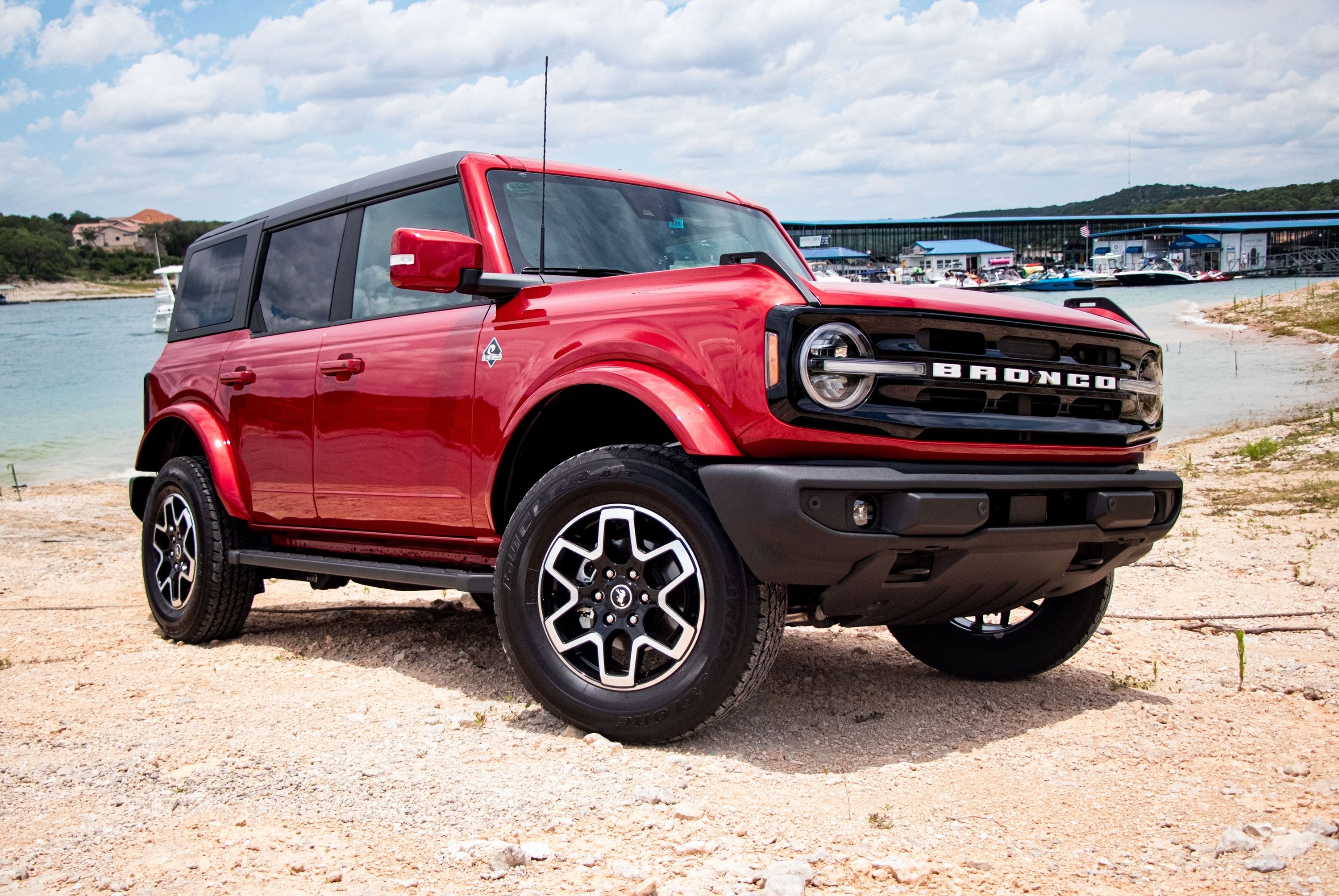
The Ford Bronco is the Jeep Wrangler’s main competitor, and it’s no wonder their spec sheets are so similar. The Bronco delivers similar power and more torque for the same EPA-provided fuel cost, matches the Wrangler’s towing capacity, and gives manual fanatics an extra gear to play with: seven in total versus the Wrangler’s six.
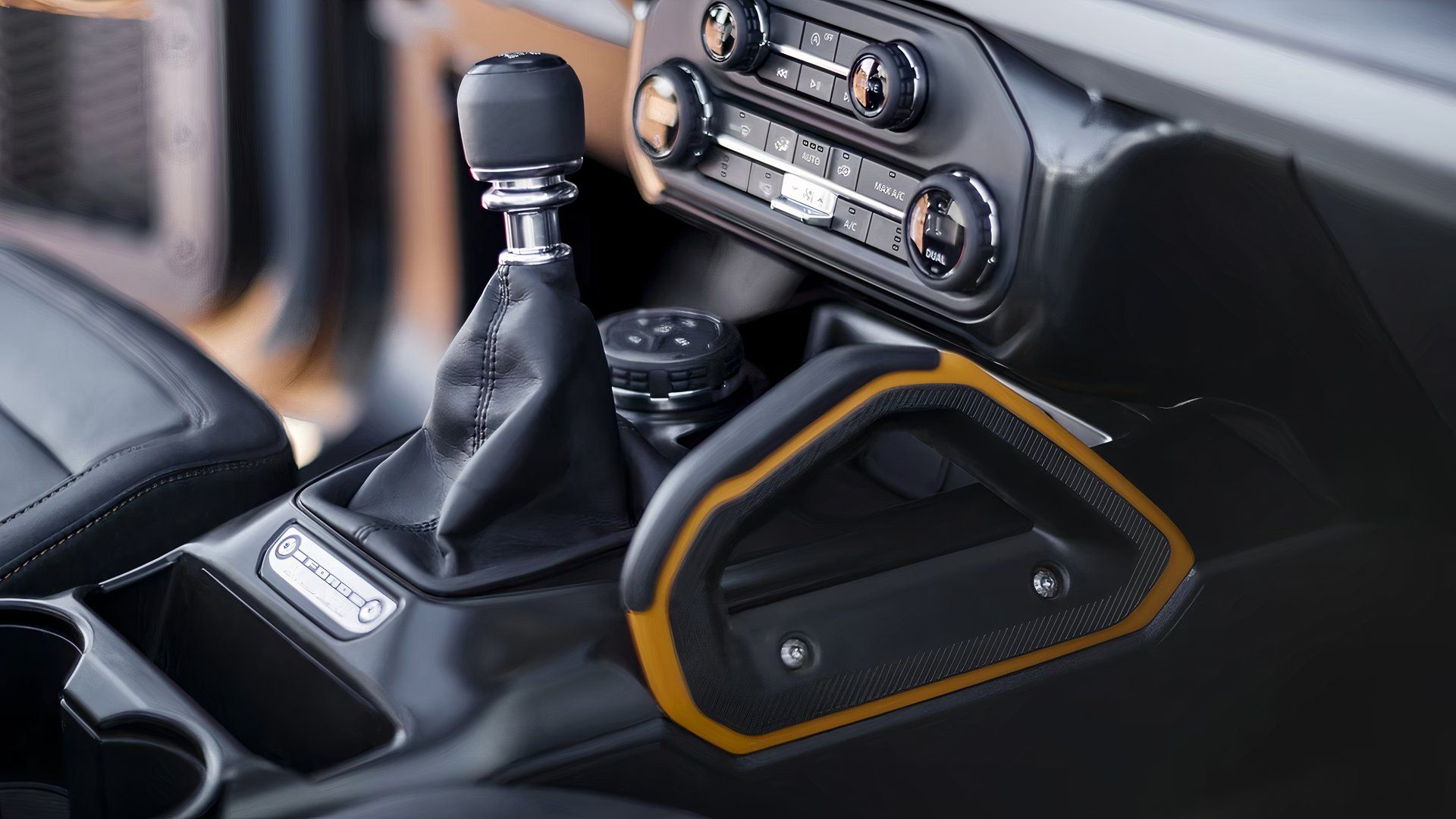
The Bronco’s 7-speed manual is a relatively new application designed for the latest Bronco generation when it launched for 2021, sourced from German manufacturer Getrag. You’ll find it teamed up exclusively with the 2.3-liter turbo four-cylinder engine. Other Bronco models run a larger 2.7-liter turbo V6 from the EcoBoost family, but it only comes with a 10-speed automatic bolted up.
The Bronco’s base model starts at $38,995 in a two-door configuration, with seven trim grades and special-edition models taking the ask towards $50,000 for the Heritage Edition or Badlands models. Specialized Stroppe Edition and Raptor variants of the Bronco push the ask up towards $80,000.
Elsewhere in the lineup for 2025, the Bronco gets a standard 12-inch digital gauge cluster on all models, sourced from the top-dog Bronco Raptor where this display made its debut. Now standard elsewhere across the line, it sports improved visuals and dedicated animations for each of the available G.O.A.T. modes, which encourage drivers to explore its capability in challenging situations. Nearby, there’s a 12-inch Sync 4 infotainment system, introduced as standard Bronco kit last year. Improvements to the air conditioner and premium stereo system help aid passenger comfort.

Related
Ford Bronco vs. Jeep Wrangler: Which Off-Roader Is King?
The 4×4 community in the USA is a passionate one, but which SUV – Ford Bronco or Jeep Wrangler – is the off-road king?
Manual Transmission Pros and Cons
Now that you know which Broncos and Wranglers come with which manual transmission choices, it’s time to dig into the pros and cons of owning a manual transmission. For years, one of the key disadvantages was fuel economy. Modern automatics in the optional 8- and 10-speed configurations available on the models in this comparison are making vehicles more fuel efficient than ever. In many modern applications, choosing the manual transmission means taking a notable hit to your fuel budget, and shifting your own gears instead of picking the automatic can easily cost you over a thousand dollars in extra fuel annually. That’s not the case with the Wrangler and Bronco, both of which turn in a fuel bill just $150 per year thirstier than their automatic counterparts.
Manual transmissions require more driver bandwidth to operate, which can be a pro or a con depending on who you ask and where they’re driving. Some drivers like the extra engagement and idea of working all four of their appendages while driving to feel a sense of maximum control. Having a clutch pedal to quickly connect and disconnect engine power from the driveline can be advantageous in certain situations, too.
Over the life of the vehicle, manual transmissions are widely held as easier to maintain, with some owners preferring to change a clutch every so often as opposed to an entire transmission. If you’ll often find yourself at a boat launch or tackling steep inclines or climbs, the manual transmission may be your preference as well. Though today’s automatic transmissions are more obedient and intelligent than ever, for some drivers there’s just no replacement for three pedals and a shift lever for that feeling of overall control.
If you’ll use your SUV for a lot of in-town driving or in commuter traffic, the automatic transmission option for either contender can make for a more convenient and relaxed experience without giving up much capability in an off-road setting. Still, the most enthusiastic drivers will likely choose the manual transmission option, knowing this might be their last chance to get one and keep a little piece of a special era of motoring history alive.

Related
Every Car Still Available With A Manual Gearbox In 2025
This might be your last chance to purchase a new vehicle with a manual transmission.
Which is Best For Off-Roading?
Is a manual or automatic transmission better for off-roading? That’s one of those questions that drums up some strong emotions, but the answer, ultimately, is that it depends.
Some off-roaders prefer the manual transmission because it tends to run cooler, is easier to fix and service if you break it, provides unmatched control over gear selection and power delivery to the ground, and even enables bump-starting which can allow the vehicle to be restarted even if the battery or starter motor dies. In some situations, being able to rock or jolt the vehicle using the clutch can provide an advantage as well.
If you’re the type of driver who cares more about feel, control, and connection more than gadgets and assists, then the manual gearbox is probably the right choice for you. Still, technical terrain can put plenty of wear on the clutch, and low-speed crawling without stalling is tricky with a manual for some drivers. There’s also a stalling risk on steep inclines with a manual, which can be hazardous.
An automatic transmission will use less driver bandwidth, eliminate the risk of stalling, and can even help cushion the driveline for a smoother experience, since the automatic transmission’s torque converter is a liquid-filled coupler that acts like a cushion. The latest advances in automatic gearbox technology are tied into the latest in transmission tech, allowing today’s off-road-ready automatics to be locked into a gear with a click or button press for crawling and climbing, and special modes modify throttle and shift points for specific settings so the driver doesn’t have to.
If you’re the sort of driver who wants to control everything at all times, then definitely go with the manual option. If you’d rather sit back and relax while the machine does the work for you, then either automatic will do you just fine, especially when tied into any of the advanced off-road assists and drive modes built into each of these worthy competitors.
Sources: EPA, Ford, Jeep