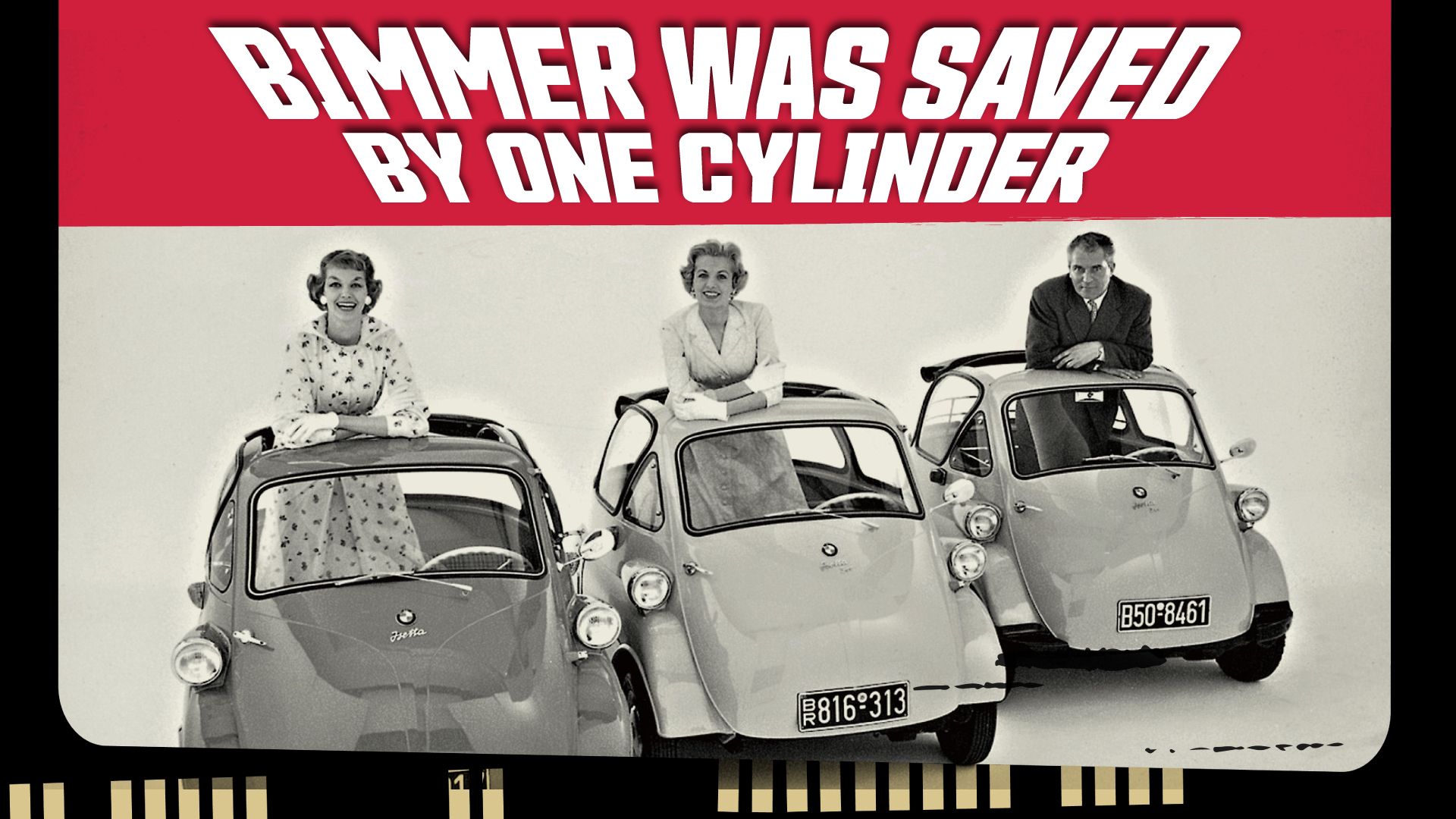
The Microcar That Saved BMW From Extinction

As German car companies continue to struggle in 2025 – though for entirely different reasons than the post-war period – the 70th anniversary of the car that rescued it from collapse is a poignant reminder of how soon necessity can turn into the mother of invention.
BMW
- Founded
-
1916
- Founder
-
Karl Rapp
- Headquarters
-
Munich, Germany
- Owned By
-
Publicly Traded
- Current CEO
-
Oliver Zipse
In the 1950s, BMW was reeling from the after-effects of World War II. It had successfully restarted production and the reselling of its motorcycles, yet on the automobile front – apart from 1951’s stately 501 sports sedan (that featured the world’s first light-alloy eight-cylinder engine), and owing to the Allied bombing of its Eisenach plant – the company did not have an affordable mass market option in its line-up.
In the four years that followed WWII, under Allied occupation, German companies were forbidden from producing automobiles. For a short while, BMW was forced to make household items instead. With the 501 an unprofitable pre-war relic, the Isetta epitomizes BMW’s fight for survival, even though by 1959 bankruptcy loomed so closely that Daimler nearly acquired the company.
At the 1954 Turin Auto Show, a company representative happened upon something the company called “a fully faired motorcycle” made by an Italian company called Isomoto. Against the success of the popular Volkswagen Beetle and Fiat 500, BMW knew it needed a budget-oriented equivalent to survive.
With a licensing deal slapped together that would see BMW take over the name and tooling of the “egg on wheels”, the Isetta was born and revealed to the world in March 1955.
The Isetta Handled Better Than You Think
The automotive alien that BMW labeled as “deliberately not intended to be a saloon car,” launched at a price of 2,550 DM ($607 at the time). It was a seemingly doorless capsule that, because of its dimunitive 92.5-inch length, could be parked nose-first against pavements to allow for the entire front section to open from the left side and allow egress from its two-passenger bench.
The design married the elimination of expenses with functionality. The egg shape maximized interior space from the least amount of metal used.
BMW reasoned that fewer doors saved on production costs. A single rear wheel would have further added to production economies of scale, yet fitting two so closely (20 inches) together eliminated the need for a differential as well as enhancing traction.
And finally, placing the engine ahead of the rear axle attained an ideal weight distribution.
For better access, the steering column moved outwards with the door so that only the floor-fixed pedals were obstacles to passengers entering.
BMW brought improvements to the original Italian concept, moving the headlights to the upper sides of the shell and fitting a new engine cover.
Naturally, a BMW could only be powered by one of its own, and called upon the services of its single-cylinder, 12 hp, 245 cm3 engine used in the R25/3 motorcycle. The ultra-low weight of 794 lbs (with a full tank) gave the Isetta a top speed of 53 mph and average fuel consumption of 80 mpg.
|
BMW Isetta 250 Standard |
|
|
Years made |
1955–1962 |
|
Number manufactured |
26,646 (total including other derivatives: 161,728) |
|
Engine |
246 cm3, single cylinder |
|
Power |
12 hp @ 5,800 r/min |
|
Torque |
10 lb-ft @ 4,500 r/min |
|
Transmission |
4-speed manual |
|
Dimensions (LWH) |
90 in x 54 in x 53 in |
|
Wheelbase |
59 in |
|
Front track |
47 in |
|
Rear track |
20 in |
Understandably, the motoring media were more than a little skeptical about the stability of a car whose rear track was more than half as narrow as the front.
There was only one way to silence the doubters: to go racing. BMW entered the Isetta into the 1954 Mille Miglia; averaging 43 mph over the 621-mile enduro – incredible considering that its top speed was just 10 mph faster.
You’d be right about thinking the secret to its speed could hardly be hidden in the oval oddity’s performance. Nope, it was in the front suspension, which moved with the steering, meaning that, along with a trapezoidal frame on to which the body was mounted, the former’s geometry remained unchanged even when the car tilted, providing for excellent stability in spite of a wheelbase barely longer than that of a tricycle.
Can I Buy A BMW Isetta Today?
Yes, you can. Given its price and positioning, the Isetta was never intended to be anything but a mass-market budget beater, and accordingly, prices have remained reasonably sensible.
For context, the Isetta was one of the cheapest cars you could buy back in the day. BMW says the average German worker at the time earned a salary of 90 DM per week, and the Isetta, at 2,550 DM, compared well against similar three- and four-wheeled microcar rivals such as the Messerschmitt KR200 cabin scooter (2,395 DM), the Heinkel Kabine (2,450 DM), Goggomobile T250 (2,947 DM) and the larger Volkswagen Beetle (4,600 DM).
Several auction sites list historical examples of the Isetta ranging from $20,000 to a somewhat extreme outlying $70,000; but really the sweet spot seems to be around $30,000.
Projects in differing states of completion can be had for anything from a few hundred to about $10,000.
BMW added a larger 300 cm3 (2,710 DM) to the Isetta lineup in 1956, that produced exactly one more horsepower than the original 250 version and had an unchanged top speed. Owing to nearly four more lb-ft on tap, drivability did, however improve, particularly on uphills.
The 600, a four-seater derivative, was produced between 1957 and 1960, but was met by a lukewarm response by the market.
Expansion of the 250 and the 300 models into overseas markets started in the same year, with versions designated as “Export”, “Overseas” and “USA”, for which 12,787 Isettas were ultimately designated.
What Killed The BMW Isetta?
As Germany’s so-called Economic Miracle rocketed the country out of the post-war financial doldrums towards becoming Europe’s pre-eminent economic powerhouse, the rising tide simultaneously lifted the country’s wages, size of families and living standards.
Overnight, the Isetta became inadequate to fulfill such needs, as the German public now demanded larger, more capable (and probably more dignified) private transport. By 1958, sales started to decline and BMW ended production in May 1962.
Apart from a few speed bumps such as the 1990s and 2000s recessions, along with Dieselgate and the Covid pandemic, German brands have gone on to enjoy significant growth since the 1980s.
Today, the world’s an entirely different place.
Against cooling market appreciation for EVs, tariff uncertainties, regulatory pressures and the onslaught of fully specced, cheaper Chinese imports, the future (again) looks a lot less certain for legacy car companies in and beyond Germany’s borders.
BMW won’t build another Isetta; for that there’s the 1 Series and Mini – not that they’ve ever been aimed at minimum wage earners.
Or, maybe the squeeze just isn’t tight enough yet. It’s unimaginable to see any of the German brands disappearing; yet with the world’s weirdness clock now well and truly in the red, BMW may well have to turn the clock back to 1955 to find inspiration for rescuing itself one more, or last, time.
Sources: BMW, Bring a Trailer, Classic.com