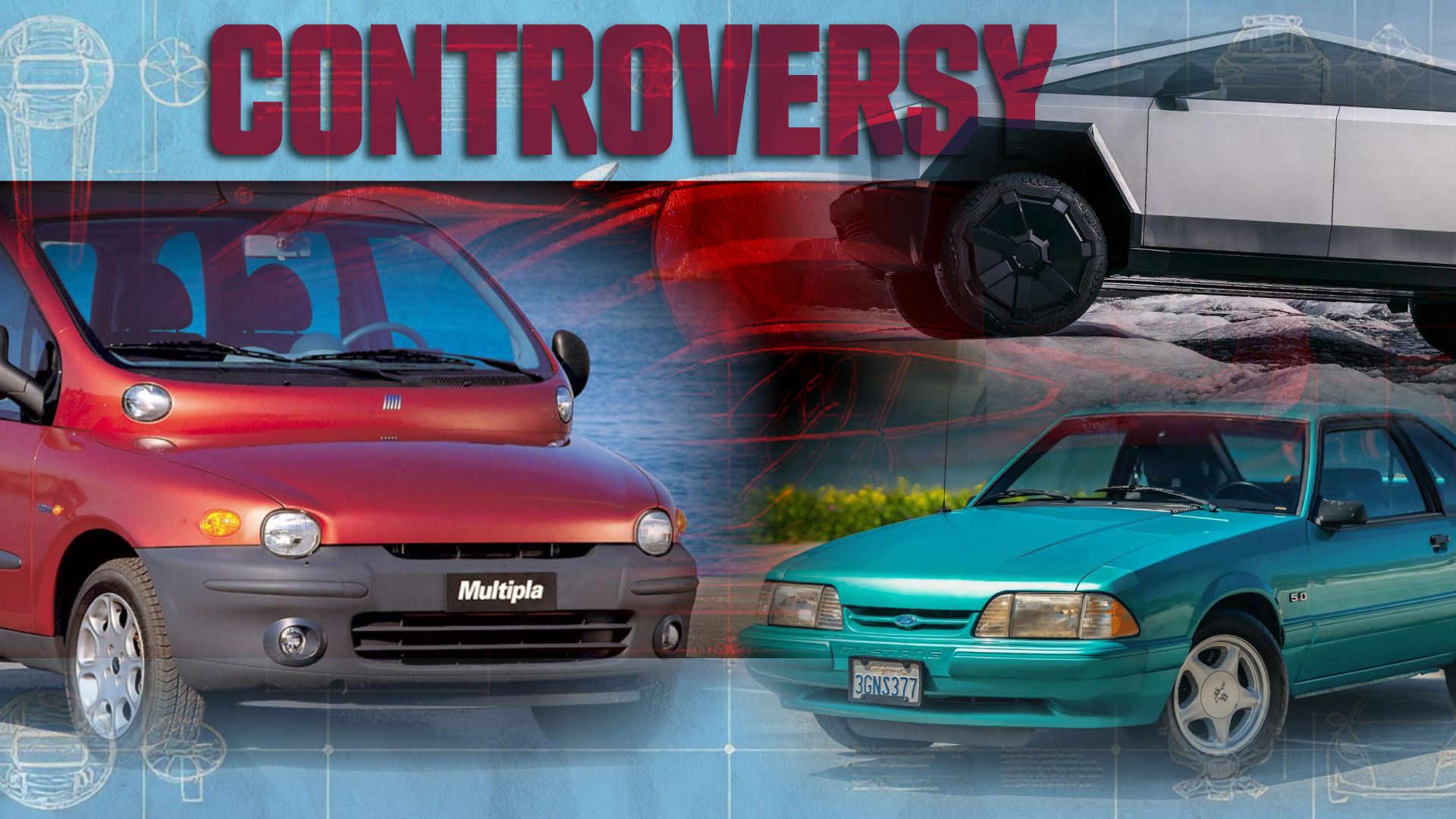
The Most Controversial Car Designs of All Time

Some cars are so popular and well-designed they manage to transcend the domain of automotive enthusiasts and become pop-culture icons, cementing their place in car history as examples of what to do when building a car. The Aston Martin DBS and Lexus LC made our list of the most beautiful modern cars of all time for a reason.
2022 Aston Martin DBS
- Base MSRP
-
$316,300
- Engine
-
5.2L Twin-Turbo V12 Gas
- Horsepower
-
715 hp
- Fuel Economy
-
14/22 MPG
Conversely, some models have attracted as much (if not more) negative attention as positive. From purists lamenting a carmaker’s departure from their traditional style (we’re looking at you, Ford Mustang fans), to designers themselves admitting a particular creation wasn’t their best, the world of cars is full of models that slightly missed the mark with the public. In this list, we have selected 10 cars that we think have generated the largest amount of controversy when they were first unveiled.
This list includes 10 car designs that we consider to be among the most controversial; although design and beauty (or the opposite thereof) are largely subjective, this list was derived in discussion with the experts at CarBuzz, taking into account design controversy at the time of launch (visual or mechanical design). Cars are listed in chronological order, from the oldest to the newest.
1
Chevrolet Corvair
Year Released: 1960
|
First-Gen Chevrolet Corvair Specs |
|
|---|---|
|
Engine |
2.3-2.7L flat-six |
|
Horsepower |
80-150 hp |
|
0-60 |
~15 seconds |
|
Top Speed |
~90 mph |
We’re starting off the list with the Chevrolet Corvair, a model that isn’t quite as well known as more famous Chevys like the Camaro, and far more polarizing. The aspect of the Corvair’s design that generated controversy was not only visual, but mechanical: its handling was widely criticized, most notably by consumer protection activist Ralph Nader who made an example of the Corvair in his 1965 book Unsafe At Any Speed.
However, there is evidence to suggest the Corvair may have been unfairly singled out: in 1972, a report by the NHTSA (which, ironically, the book’s release had helped create) was published revealing the Corvair had no greater potential for loss of control in emergency situations than other compact cars of the era.
2
Third-Generation “Fox-Body” Mustang
Year Released: 1979
|
1979 Ford Mustang Specs |
|
|---|---|
|
Engine |
2.3-liter turbocharged inline-four / 4.9-liter V8 |
|
Horsepower |
131 hp / 139 hp |
|
0-60 |
8.3 seconds |
|
Top Speed |
120 mph |
The third generation of the Ford Mustang, commonly referred to as the “Fox-Body” as it was built on the Fox platform, caused a great deal of controversy among Mustang fans when it was first released. The main reason for the uproar regarding its design was that it constituted a significant departure from the classic styling cues that had defined the Mustang up to that point.

Related
Fox Body Mustang: 10 Facts About The Longest-Running Ford Mustang Generation
How many of these cool facts did you already know about one of the most successful Mustangs ever produced?
The aggressive, muscle-car image that characterized the first two generations of the model had been replaced by a plainer, more subdued aesthetic, which to many symbolized a betrayal of what the Mustang was all about. That being said, the Fox-Body Mustang still managed to last 14 years on the market, only being replaced in 1993.
3
Mercedes-Benz A-Class (First Generation)
Year Released: 1997
|
First-Gen Mercedes-Benz A-Class Specs |
|
|---|---|
|
Engine |
1.4-2.1L inline-four |
|
Horsepower |
80-138 hp |
|
0-60 |
7.9-11.1 seconds |
|
Top Speed |
101-143 mph |
While the rounded, lump-like design of the first-gen A-Class may be a “love it or hate it” affair, what really caused a stir was its handling in emergency situations. The memorable incident that cemented the poor reputation of the first-gen A-Class was the “elk test” (also known as the “moose test”). This test is performed on new vehicles to determine their ability to safely swerve out of the way when facing a sudden, large obstacle, such as the titular moose.
In 1997, around the time the W168 A-Class was hitting the market, Swedish publication Teknikens Värld performed the test on the vehicle and flipped it over. While Mercedes-Benz initially attempted to deny the incident had happened and minimize the issue, the company then proceeded to recall all 2,600 cars sold to date, modifying their suspension and adding electronic stability control (ESC) to fix the problem with the original design.
4
Fiat Multipla
Year Released: 1998
|
Engine |
1.6-1.9L inline-four |
|---|---|
|
Horsepower |
91-113 hp |
|
0-60 |
7.5-12.6 seconds |
|
Top Speed |
~106 mph |
Mocked, parodied, and turned into an automotive meme, the Fiat Multipla is often mentioned on “world’s ugliest cars” lists (including several of CarBuzz’s own). Its design was described by the Daily Telegraph as “a psychotic cartoon duck”, thanks to its prominent front end and bulbous lines. A facelift arrived in 2004, removing the signature front end and replacing it with a more traditional design.

Related
15 Ugliest Cars Ever: Not All Cars Were Designed To Be Supermodels
Design is subjective, but not when it comes to these cars.
Despite the poor reception it got around the world, the Multipla managed to perform relatively well in its domestic market of Italy, perhaps because its compact-MPV nature made it possible to transport larger families in a country where narrow roads and small, scarce parking spaces are an everyday occurrence.
5
BMW E65 “Bangle” 7-Series
Year Released: 2001
|
Engine |
3.0-liter inline-six / 3.6-4.8L V8 / 6.0-liter V12 |
|---|---|
|
Horsepower |
228-439 hp |
|
0-60 |
5.5-8.1 seconds |
|
Top Speed |
146-193 mph |
The Bangle era of BMW design is characterized by controversy: several models created under designer Chris Bangle featured new design elements that BMW fans didn’t take to so well, at least at first. One such model is the 7 Series from that era, whose most hated feature at the time was the infamous “Bangle Butt” (a term coined by car enthusiasts and automotive media to describe the large, bulging trunk lid).
Rather than controversial, the Bangle era is perhaps best described as polarizing: while there are several BMW fans who find it aesthetically unappealing, there are equally as many people who love it, including some who warmed up to it over the years.
6
Porsche Cayenne (First Generation)
Year Released: 2003
|
2002 Porsche Cayenne Specs |
|
|---|---|
|
Engine |
4.5-liter V8 |
|
Horsepower |
335/444 hp |
|
0-60 |
5.5-6.9 seconds |
|
Top Speed |
150-165 mph |
While luxury SUVs are a large, lucrative part of the automotive market today, there was a time when the very concept would have sounded unusual to most people. The Porsche Cayenne played a substantial part in changing that when it landed on the market in 2003; however, while today it’s one of the best-selling Porsche models, it caused a stir when initially launched.
The very idea of a luxury crossover, which incorporated design cues already seen on Porsche sports cars and applied them to a large, 4WD family car, was received with skepticism by die-hard Porsche fans. However, in an era when even brands like Aston Martin, Lamborghini, Ferrari, and even Rolls-Royce have caved in and are selling SUVs, the criticism received by the Cayenne seems like a relic of a bygone age.
7
Jeep Cherokee (Fifth Generation, Pre-Facelift)
Year Released: 2014
|
Engine |
2.0-2.4L inline-four / 3.2-liter V6 |
|---|---|
|
Horsepower |
184-271 hp |
|
0-60 |
7.2-9.5 seconds |
|
Top Speed |
118 mph |
The fifth generation of the Jeep Cherokee, launched for the 2014 model year after a one-year hiatus, featured some design updates that did not get a warm welcome from the public. Its very narrow headlamps, and bizarrely-designed grille with narrow slits, got a mixed reception to say the least, with the most charitable descriptions calling the design unique and the least charitable calling it outright ugly.
Jeep itself heard the message and fixed things with a facelift in 2018. When the facelifted model was released, designer Brian Nielander told CarAdvice that he “would admit it needed change” (with regard to the outgoing Cherokee’s front-end style). It was a bold and controversial design choice, which to its credit did not result in poor sales, but was eventually replaced by a more traditional layout which remained until the model’s (temporary?) discontinuation in 2023.
8
BMW M3/M4 (Current Generation)
Year Released: 2020
|
M3 |
M4 |
|
|
Engine |
3.0-liter twin-turbo inline-six |
3.0-liter twin-turbo inline-six |
|
Horsepower |
473 hp |
473 hp |
|
0-60 |
4.1 seconds |
3.8 seconds |
|
Top Speed |
155-188 mph |
155-191 mph |
The current generations of the M3 and M4 (sixth for the M3, second for the M4) both include one feature that has not been received well by many BMW fans and car enthusiasts around the world. We are, of course, talking about their redesigned grille: more of a liver grille than a kidney grille, with its comically large proportions taking up a substantial part of the cars’ front end.
One of the main reasons behind this stylistic choice, which had already been introduced in a few other models, is BMW’s eagerness to appeal to a global audience, including the Chinese market where very large grilles are popular and considered a desirable feature. In Europe, however, where smaller grilles are generally preferred, the new M3 and M4 attracted a certain amount of controversy.
9
BMW XM
Year Released: 2023
|
Engine |
3.0-liter twin-turbo inline-six / 4.4-liter twin-turbo V8 |
|---|---|
|
Horsepower |
469-738 hp |
|
0-60 |
4.1 seconds |
|
Top Speed |
155 mph |
Not content with attracting negative attention with the M3 and M4’s grille design, BMW doubled down on the controversial designs with the introduction of the XM, a plug-in hybrid SUV that further emphasized its large grille with “nostril” style borders in bright finishes such as gold and red.

Related
Driven: 2023 BMW XM Excels At Luxury, But Disappoints As An M Car
It’s comfy, but there are several other BMWs you’d be better off buying.
The XM was, oddly, marketed as a BMW M halo car when first launched, with the company emphasizing its unique position as the first M car with a PHEV drivetrain. However, its polarizing design and sky-high price tag contributed to very poor sales, and BMW eventually decided to kill off the XM after the 2028 model year.
10
Tesla Cybertruck
Year Released: 2024
|
Engine |
One/two/three electric motors |
|---|---|
|
Horsepower |
315-845 hp |
|
0-60 |
2.6-6.5 seconds |
|
Top Speed |
112-130 mph |
The most recent entry on our list has caused an uproar not just for its visual design, but for an endless list of other reasons. From its dubious safety record, to its drawn-out release process, to its controversial creator, the Cybertruck has sparked discourse among car enthusiasts and the general population alike.
Its extreme, angular lines have contributed to the model being illegal in Europe, where it’s considered too big and sharp to meet pedestrian safety regulations. Over in the States, meanwhile, Cybertruck buyers have also experienced several technical issues during the first few weeks of ownership, and while not all of them have turned out to be genuine long-term problems, there are more than enough to steer clear.
Sources: BMW, Tesla, Chevrolet, Ford, Mercedes-Benz, Fiat, Porsche, Jeep, CarAdvice, The New York Times, Teknikens Värld, Daily Telegraph