
The Most Power-Dense Ford Engine Ever Produced

Which engine is more power-dense? Ford’s fifth-generation Coyote V8 used in the Mustang Dark Horse or the 1.6-liter turbocharged four-cylinder that once powered the Ford Fiesta ST? The answer is the Ford Fiesta ST’s four-pot. The reason is that the Dark Horse’s V8 produces 500 hp and has a displacement of 5.0 liters, meaning that it has a power density of 100 hp/liter. The Fiesta ST’s turbocharged 1.6-liter four-cylinder engine produces 197 hp, so it produces 123 hp/liter, meaning that this engine is more power-dense than the Coyote V8. We calculate the power density of an engine by dividing the total power generated by its displacement in liters.
An engine’s power density is a key aspect of its character as it typically denotes that an engine with a higher power density is more efficient at generating energy. Often, power-dense engines usually follow the “dynamite comes in small packages” dogma. An example is the GMA V12, which is the most power-dense V12 available in 2024, or the AMG ONE’s 1.6-liter V6, the most power-dense production car engine of all time.
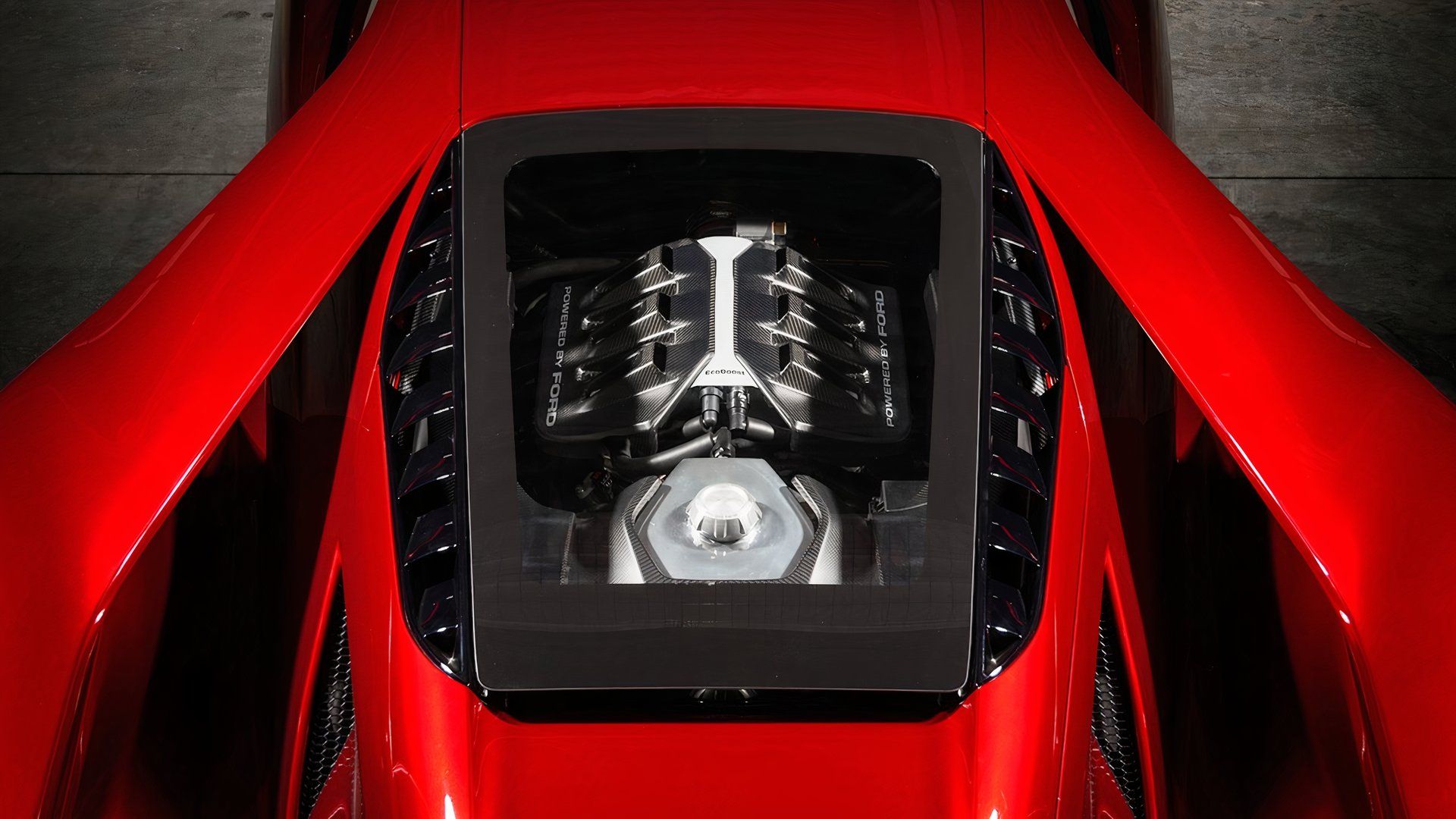
There are expectations, but for the most part, a smaller engine with a relatively high output will usually trump larger engines with equally large power figures. Within Ford’s stables, home to many power-laden Shelbys and the new Mustang GTD with their hulking power plants, it is the Ford GT’s 3.5-liter twin-turbocharged V6 that claims the title as the most power-dense Ford engine.
Powering Ford’s Supercar
|
Engine |
3.5-liter, twin-turbocharged, V6 |
|---|---|
|
Horsepower |
660 hp @ 6,250 rpm |
|
Torque |
550 lb-ft @ 5,900 rpm |
|
Hp/liter |
188.5 hp/liter |
|
Top speed |
216 mph |
The Ford GT has always stood as the sole supercar within the American automaker’s ranks. The first rendition of the Ford GT moniker was leagues above the rest of Ford’s range when it debuted. Power was sourced from a mid-mounted 5.4-liter, all-aluminum V8 equipped with an Eaton 2300 Lysholm screw-type supercharger. Based on the largest V8 in Ford’s modular engine family at the time, the supercharged V8 featured four valves per cylinder, a dry sump oil system, a forged crankshaft, H-beam connecting rods, and aluminum pistons. All in all, the first-generation Ford GT’s powerful engine burdened the rear wheels with 550 bhp and 500 lb-ft. It was one of the most potent products offered by Ford in the early 2000s, but production ceased in 2006. The second generation Ford GT debuted a decade after the production of the first-generation GT model stopped, powered by the 3.5-liter V6 EcoBoost engine we’re familiar with today.
The second-generation Ford GT’s power unit was a stark contrast from the one that motivated the founding model of the GT lineage. Instead of a burly 5.4-liter V8, the 2016 Ford GT employed an engine that featured less displacement and fewer cylinders but was, in all regards, more capable. This 3.5-liter V6 power unit wasn’t foreign to Ford’s lineup, nor exclusive to just the GT line. It shared components with the 2017 F-150’s V6 engine, such as the aluminum cylinder heads, aluminum engine block, and the sequential electronic direct and port injection fuel system. However, the applications of the two V6 engines were vastly different and, as such, Ford implemented larger turbochargers, an aluminum intake manifold, and several other components to accommodate the 2017 Ford GT V6’s more intense operating standard.
Similarly to the 2004 Ford GT’s V8, the EcoBoost engine featured four valves per cylinder but also employed Double Overhead Camshafts, Twin Independent Variable Camshaft timing, and roller-finger-roller rocker arms in its valve train. Pistons were cast aluminum and accompanied by machined forged steel connecting rods. The engine operated with a 9.0:1 compression ratio and was managed by Ford’s PCM system. The revisions to the V6 allowed the mid-engined supercar to possess 647 hp @ 6,250 rpm and 550 lb-ft @ 5,900 rpm. Side note, although there is no contest that the Ford GT is a supercar, it is not eligible to be considered an American supercar because it was built in Canada from the start to the end of its production.
In 2019, Ford announced that it would be revising the EcoBoost engine, as well as introducing a new special edition model dubbed the Ford GT Liquid Carbon. The EcoBoost gained 13 hp, resulting in the Ford GT’s total output rising to 660 hp.
Aside from the slight bump in power, Ford adjusted the torque band, making it broader, and revised the V6’s calibration. Mechanical upgrades were also introduced, including galley-cooled pistons and higher-energy ignition coils. Additionally, new buttress air ducts and larger intercoolers were employed to enhance the engine’s cooling and airflow. While not a direct upgrade to the engine’s performance, Ford would also offer an Akrapič titanium exhaust as standard for the GT.
The standard Ford GT was surpassed by the GT MK IV, a track-only offshoot of the GT characterized by its striking bodywork, improved aerodynamic capability, and the most powerful version of the EcoBoost engine ever. The specially tuned twin-turbocharged V6 in this model is purposed to generate more than 800 horsepower.
An All-Purpose Power Plant
The engine used in the 2017 Ford GT is Ford’s second-generation 3.5-liter V6 engine, codenamed “D35”. It was unveiled at the Detroit Auto Show in 2015 and is used in several of Ford’s vehicles, from its only supercar to full-size pick-up trucks like the F-150. Compared to the first generation version of the 3.5-liter turbocharged V6 engine type, the second generation featured different turbocharging architecture, a revised fuel injection system, a different chain-driven cam system utilizing two separate chains instead of one, a hollow camshaft, increased oil volume in the piston cooling jet.
The 3.5-liter V6 EcoBoost engine was used in four different variations of the Ford F-150 spanning from 2017 to 2021. In 2017, the F-150’s V6 output was 375 hp @ 5,000 rpm and 470 lb-ft @ 2,250 rpm – 3,500 rpm. Ford employed the EcoBoost engine in the 2017 F-150 Raptor, which generated a maximum of 450 ho @ 5,000 rpm and 510 lb-ft @ 3,500 rpm. This was the most powerful iteration of the EcoBoost engine with the F-150 subspecies. The 2017 Expedition was another model to utilize the EcoBoost engine and had the same output as the F-150 in 2017. The Expedition still employs the twin-turbocharged V6 in its latest models, with an output of 440 hp and 510 lb-ft in the High Output configuration.
Outside of Ford’s ranks, the Noble M500 also employed the 3.5-liter twin-turbocharged V6 and mated to a six-speed manual transmission. In this configuration, the V6 engine is coaxed to output 505 bhp and 550 lb-ft.
Add CarBuzz to your Google News feed.
Honorable Mentions
There have been and still are many engines that have a commendable engine power density. These are some of the honorable mentions.
Mustang GTD
|
Engine |
5.2-liter, supercharged, V8 |
|---|---|
|
Horsepower |
> 800 hp |
|
Torque |
TBC |
|
Hp/liter |
153.8 hp/liter |
The Mustang GTD is the current zenith of engineering and performance in Ford’s lineup. At its core, it features one of the most powerful and advanced engines ever employed in Ford’s road-going models, so much so that it’s more comparable to the marque’s GT3 race car than any other model currently available. The GT3 RS contender will debut sometime next year.
Shelby GT500
|
Engine |
5.2-liter, supercharged, V8 |
|---|---|
|
Horsepower |
760 hp @ 7,600 rpm |
|
Torque |
625 lb-ft @ 5,000 rpm |
|
Hp/liter |
146 hp/liter |
Road-legal GT3 cars aside (looking at you Mustang GTD), the Shelby GT500 has yet to be outdone by the newer S650 Mustang generation in terms of raw power. The Shelby GT500 still stands in a class of its own within Ford’s stables and offers one of the most visceral and guttural driving experiences, mainly because of the sonorous Predator V8 employed at its core.
Focus RS
|
Engine |
2.3-liter, turbocharged, four-cylinder |
|---|---|
|
Horsepower |
350 hp |
|
Torque |
350 lb-ft |
|
hp/liter |
152 hp/liter |
They don’t make them like they used to. Ford’s beloved Focus RS hot hatch, which was laid to rest in 2019, had one of the most power-dense engines ever. It is nearly on par with an engine that was taken from the GT500 and beaten with the “GO FASTER” stick. It entrenches the idea that sometimes dynamite does come in small packages.
Sources:
Ford
,
Ford Performance

