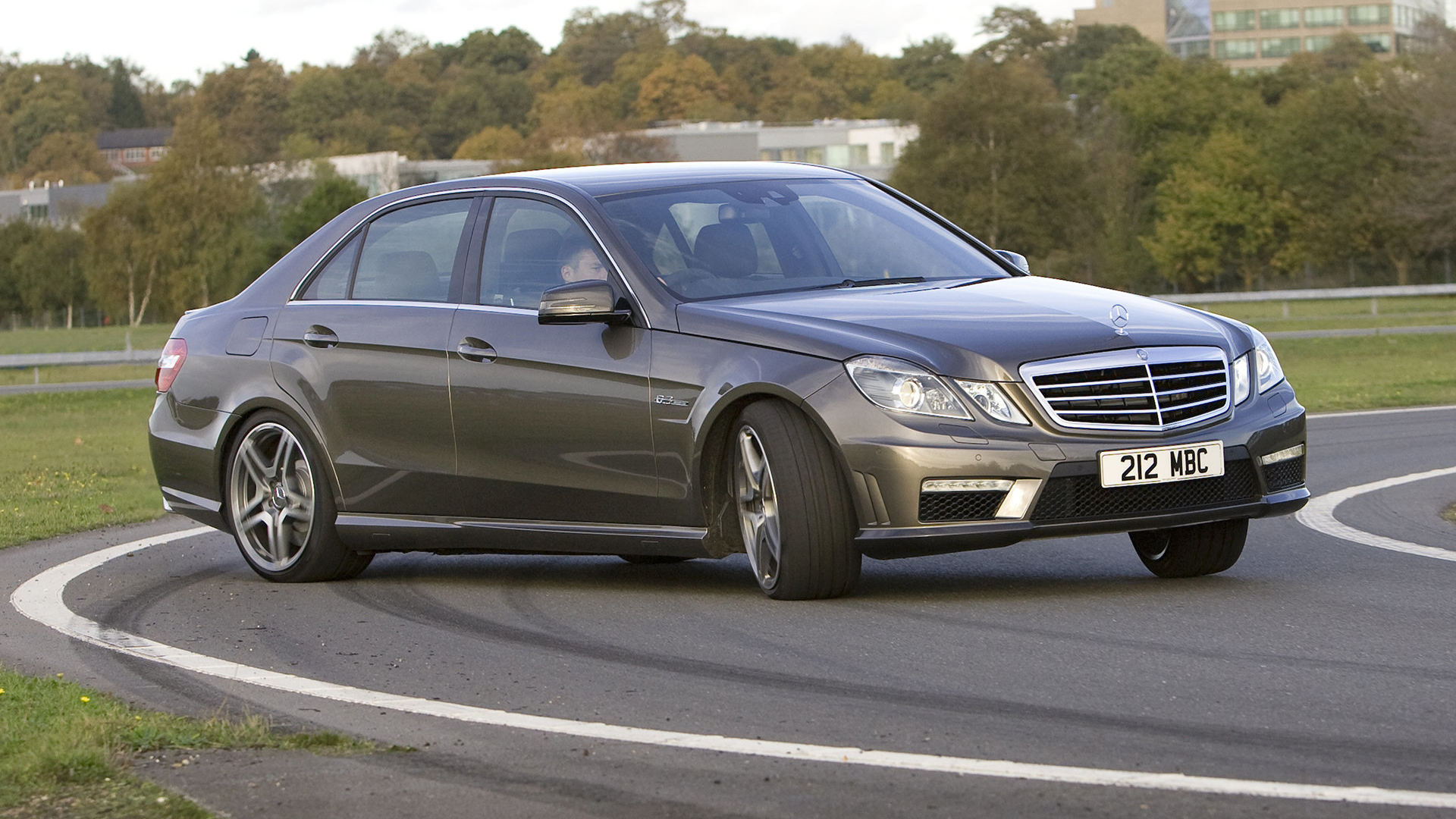
The Naturally Aspirated Mercedes E63 AMG Everyone Forgot About Is Super Cheap

The Mercedes-Benz E-Class has always been a luxury mid-size sedan, but not all E-Class models are created equal. While the majority of Mercedes-Benz’s E-Class sedans lean more toward comfort and luxury, the range-topping models are not only luxurious but undeniably hardcore, characterized by a longstanding partnership with powerful eight-cylinder engines.
We’ve seen many hardcore E-Class models, but one stands out as the last to feature Mercedes’ most memorable V8 engine. Unfortunately, it was also the E63 with the shortest lifespan.

- Base Trim Engine
-
6.2L V8 Gas
- Base Trim Transmission
-
7-Speed Automatic
- Base Trim Drivetrain
-
Rear-Wheel Drive
- Base Trim Horsepower
-
518 hp
- Base Trim Torque
-
465 lb-ft @ 5200 rpm
This article focuses on the W212 Mercedes-Benz E63 that was produced between 2009 and 2011.
The W212 Generation’s Shortest-Lived E63
Mercedes-Benz has produced the E-Class since 1953, and over time, it has become a mainstay of the luxury sedan segment. Since the 1950s, the established German automaker has introduced five generations of the E-Class, with some being more notable than others. One of the most notable generations is the W212 generation – which debuted in 2009 and, for many reasons, marked a significant turning point in the E-Class –particularly in its most hardcore offering within the model range: the E63.
The version of the E63 we’re discussing in this article is a unique variant. Mercedes-Benz’s W212 generation of the E-Class was split into two distinct versions, which their pre-facelift and post-facelift models can distinguish. When the W212 generation was unveiled, of the handful of pre-facelift E-Class models, the E63 was the most potent.

Related
Mercedes-AMG’s Final NA V8 Car Was A 500-HP Monster
The AMG C63 Edition 507 gave the M156 engine the best possible send-off, as the age of downsizing rapidly approached.
However, this version of the E63 was distinguished from the subsequent version by its engine. It was powered by Mercedes-Benz’s renowned M156 V8, which was designed by the same engineer responsible for the Porsche Carrera GT’s 5.7-liter V10 engine. However, it would be only two years before Mercedes-Benz introduced a face-lifted version of the E63 that not only saw a revision of the exterior design, but also a significant overhaul of its entire powertrain.
A Burly, Brawny, And Beautiful German Sedan
|
2009 Mercedes-Benz E63 |
|
|---|---|
|
Engine |
6.3-liter naturally aspirated V8 |
|
Power |
518 hp @ 6,800 rpm |
|
Torque |
465 lb-ft @ 5,200 rpm |
|
0-62 mph |
4.5 seconds |
|
Top speed |
155 mph |
As is the case with nearly every iteration of the E63 moniker, this short-lived example of the E63 was designed to blend day-to-day usability with tarmac-punishing performance. The latest iteration of the E-Class also scored an impressive rating during crash testing. In this offshoot of the hardcore E-Class, Mercedes-Benz employed the M156 naturally aspirated V8 engine, which was the same engine used by the original C63 and one of the coolest AMGs ever.
Compared to the previous model, this Mercedes-Benz E63 commanded 11 hp more while having better fuel economy. It was paired with a seven-speed automatic transmission that allowed the brutish German sedan to complete a sprint to 60 mph from a standstill in nearly the same time as the Mercedes-AMG C63, making it one of the quickest E-Class generations. Supporting this aggressively styled sedan was AMG’s Ride Control suspension system, which featured new spring struts at the front axle, AMG-specific air springs on the rear axle, a new electronically controlled damping system, a tubular stabilizer bar, new control arms, new wheel bearings, new elastokinematics, and a new subframe mounting.

Related
Mercedes-AMG’s First Supercar Is Reasonably Priced These Days
The Mercedes-Benz SLS AMG is a bargain by supercar pricing standards. What do you need to know about this gullwing special, and potential ownership?
A potent powertrain and a competent suspension system are defining features of the E63. Still, it also relied on a new power steering system that employed a speed-sensitive rack-and-pinion mechanism, which was more direct than the standard production model. This system was also assisted by a more rigid steering column, providing better steering precision and a more palpable sense of feeling connected to the road. These were just the mechanical components that enabled it to compete with some of the best in its segment.
Beyond these key aspects of the E63, the vehicle features powerful German elements, including lightweight 19-inch alloy wheels, an AMG rear axle locking differential, an AMG spoiler lip on the boot lid, and an AMG Performance steering wheel, among others.
Mercedes-Benz Ushers The E-Class Into Its Turbocharged Era
|
2012 Mercedes-Benz E63 |
|
|---|---|
|
Engine |
5.5-liter twin-turbocharged V8 |
|
Horsepower |
518 (550) hp @ 5,750 rpm |
|
Torque |
516 (590) lb-ft @ 2,000 rpm |
|
0-60 mph |
4.3 seconds |
|
Top speed |
155 (186) mph |
* Figures in brackets denote the Performance package
Two years after the W212 generation E63 debuted, Mercedes-Benz introduced a face-lifted version of the W212 E-Class, which included a new version of the E63. However, this wasn’t a mere revision of the E63’s styling, but an overhaul of its entire powertrain. Mercedes-Benz replaced the growling and snarling naturally aspirated M156 V8 engine with a twin-turbocharged M157 V8, which was smaller in size and displacement compared to the M156. However, with the aid of its two turbochargers, it was able to produce more power. Every E63 that followed would retain the twin-turbochargers.
The seven-speed MCT transmission was retained and continued to aid in overall fuel economy. Its suspension system was improved, while its front track was widened by 2.2 inches, and the front wheels utilized independent wheel carriers to increase negative camber. Additionally, Mercedes-Benz introduced new steel suspension struts. Compared to its forebear, the updated W212 generation E63 features a new electromechanical AMG speed-sensitive sports steering system. All in all, the updated E63 was a significantly better performance sedan than its pre-facelift counterpart. However, its soundtrack was not as visceral as that of the E63, powered by Mercedes-Benz’s iconic V8 engine.
A Bargain, If You Can Find One
As we’ve said, its looks and performance have aged like fine wine. Interested in owning a car that represents the pinnacle of Mercedes-Benz’s naturally aspirated V8 engines? Surprisingly, the pre-facelift W212-generation E63 is a bargain on the used market, if you can find one. According to Classic.com, the 2010 model year has an average selling price of $25,090, while the 2011 model year has an average selling price of $28,072, which is significantly lower than the cost of a fully loaded example of the current E-Class.
I owned one of these, and I can tell you that it’s definitely worth the money. There’s one thing to keep in mind, however. I made the mistake of buying a used performance sedan for cheap, without considering the upkeep. You lose a rear wheel, it’s $360. It was also expensive to service, not to mention the fuel costs. I would buy one again today, now that I have the disposable income to keep it in good condition. The important thing is to look beyond the cheap price, and take the expenses into account. – Gerhard Horn, Senior Editor
Last year, an example of the 2010 Mercedes-Benz E63 with 92,000 miles and in stock form sold for $16,750, while another with a similar specs list and fewer miles sold for $16,000. Earlier this year, an example of the 2011 Mercedes-Benz E63 in its original condition, with 82,000 miles, sold for $20,300. Meanwhile, another example of the same model year, featuring a handful of optional AMG features and 90,000 miles on its odometer, sold for roughly $20,800.
Sources: Mercedes-Benz, Classic.com, BringATrailer