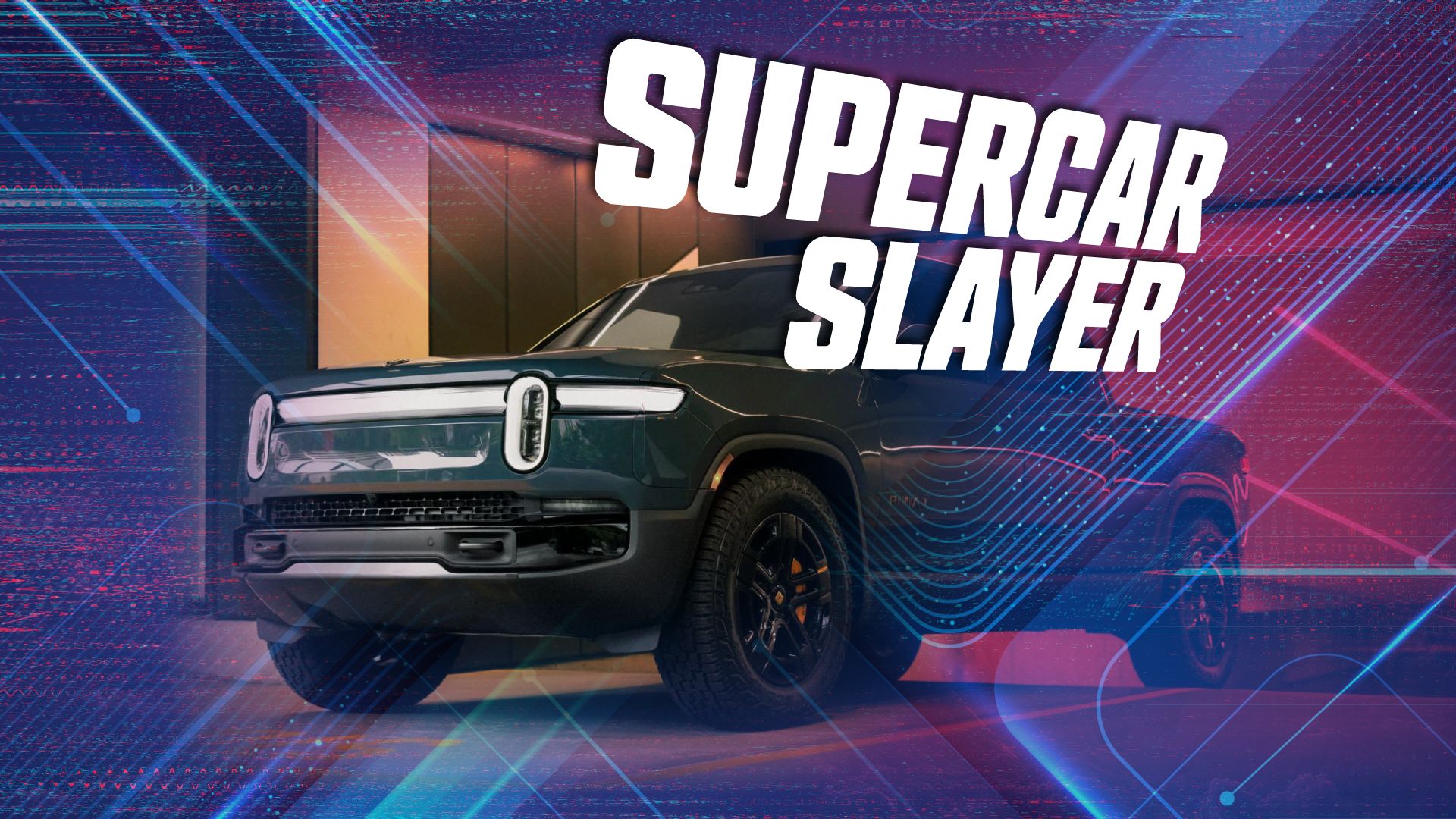
The Rivian R1T Quad Motor Can Outrun All 10 Of These Thoroughbred Supercars

There are several ways to achieve a sub-three-second sprint in a car. You could move the engine from the front to the back so that there’s more weight over the rear, making a standstill start smoother, as Chevy did when they developed the C8 Corvette. You could also send power to all four corners, like Audi had done with its late R8.
Or you could simply brute force your way to a sub-three-second sprint like Rivian has done with the 2026 Rivian R1T Quad Motor, which is capable of reaching 60 mph from a standstill in 2.5 seconds. This is not only an impressive acceleration figure on its own, but it’s even more impressive considering that this electric SUV tips the scales at 7,000 pounds, but can still beat a few thoroughbred supercars to 60 mph.
The 0-60 mph times for the included cars have been sourced from the manufacturer, and these cars have been arranged from the slowest to the quickest 0-60 mph times.

Related
2026 Rivian R1S & R1T Quad Motor Are Ready To Slay Supercars And Trails
With over 1,000 horsepower, these are the craziest Rivian models ever.
10
Audi R8 GT
0-60 mph: 3.4 seconds
|
Engine |
5.2-liter naturally aspirated V10 |
|---|---|
|
Horsepower |
602 hp @ 8,000 rpm |
|
Torque |
413 lb-ft @ 6,400 rpm |
|
Top speed |
199 mph |
The Audi R8 GT was the ultimate expression of Audi’s V10-powered supercar, which revived the philosophy of the daily supercar. Unlike other incarnations of the Audi R8, Audi ditched the all-wheel-drive configuration, directing approximately 600 horsepower exclusively to its rear axle. Still, even with its front legs cut off, so to speak, the Audi R8 GT is as capable as its AWD counterparts, commanding its 602 hp to propel its 3,550-pound frame to 60 mph in under three and a half seconds. That time is also partly due to the seven-speed transmission, which was new when the second-gen Audi R8 GT debuted.
Additionally, its Torque Rear mode, a first for the Audi R8, allowed for adjustable rear slippage. Beyond a new transmission and control system, the Audi R8 GT was also distinguished from the standard R8 by its lighter composition, 44 lbs lighter to be exact, a bespoke set of 20-inch lightweight forged wheels, and several exterior design elements.
9
Aston Martin Vanquish
0-60 mph: 3.3 seconds
|
Engine |
5.2-liter twin-turbocharged V12 |
|---|---|
|
Horsepower |
824 hp @ 6,5000 rpm |
|
Torque |
737 lb-ft @ 2,500–5,000 rpm |
|
Top speed |
214 mph |
We’ve only had three generations of the Aston Martin Vanquish, with the second generation bowing out in 2018, and we wouldn’t see an immediate follow-up. However, last year, Aston Martin resurrected the Vanquish name, more powerful and domineering than ever. The previous-generation Aston Martin Vanquish was nothing to scoff at, considering it was equipped with a nearly 6.0-liter V12 engine producing 550 hp.
Still, the third generation took it even further, relying on a slightly smaller but singularly wild twin-turbocharged engine hidden beneath the long, aggressive hood. Swan doors, a new front-mounted V12 engine, and a production cap of 1,000 units; the Aston Martin Vanquish is a striking supercar that, despite its lighter kerb weight, isn’t enough to outpace the Rivian R1T Quad, but we’d pick this over that any day.
8
Nissan R35 GT-R NISMO
0-60 mph: 2.9 seconds
|
Engine |
3.8-liter twin-turbocharged V6 |
|---|---|
|
Horsepower |
600 hp @ 6,800 rpm |
|
Torque |
481 lb-ft @ 3,600 rpm |
|
Top speed |
195 mph |
Mention the phrase “supercar killer” and many might have their minds bombarded by images of Nissan’s R35 GT-R. In its base form, the Nissan R35 GT-R is a force to be reckoned with, but the version of the R35 GT-R with the words “NISMO” on its rear is in a different league. Fettled by Nissan’s motorsports and performance department, the NISMO variant, which is the most powerful model NISMO has ever created, is a track-obsessed offshoot of the GT-R.
It gained more power, more body adhesive to improve rigidity, NISMO-tuned suspension including Bilstein dampers, a new mechanical front limited-slip differential, large carbon ceramic brakes, and all while weighing 68 pounds less than the standard GT-R. As far as track capability goes, it’s uncontested compared to other R35 GT-R variants. Still, its all-wheel-drive system and potent V6 engine are not enough to outpace the electric-motor-wielding Rivian R1T Quad.

Related
This Is How The Facelifted Tesla Model X Stacks Up Against The Rivian R1S
Both Tesla and Rivian have come out with updates for their flagship models, but do they disappoint or impress?
7
Maserati MC20
0-60 mph: 2.9 seconds
|
Engine |
3.0-liter twin-turbocharged V6 |
|---|---|
|
Horsepower |
631 hp @ 7,500 rpm |
|
Torque |
531 lb-ft @ 3,000 rpm |
|
Top speed |
201 mph |
Maserati had lost favor with many people in the automotive community, and the cars that they were producing weren’t inspiring any would-be customers to run to a dealership. However, Maserati’s second wind came in the form of the Maserati MC20; a V6-powered coupe touted as a super sports car, marking the first of its kind.
Compared to the comparatively mundane sedans and grand tourers that populated Maserati’s catalog at the time, the Maserati MC20 bucked the formula followed by those models. It was instead configured as a thrilling coupe using 631 hp to power its rear axle, culminating in a car that was not only lightweight but also undeniably thrilling. Its performance was another factor that differentiated it from Maserati’s other models, enabling it to contend with Ferrari’s entry-level models.
6
Ferrari 12Cilindri
0-60 mph: 2.9 seconds
|
Engine |
6.5-liter naturally aspirated V12 |
|---|---|
|
Horsepower |
825 hp @ 9,250 rpm |
|
Torque |
530 lb-ft @ 7,250 rpm |
|
Top speed |
211 mph |
The Ferrari 812, including all of its offshoots, was a striking and enticing grand tourer distinguished by its V12 soundtrack. However, the Ferrari 812 would be laid to rest in 2024, and carrying on its legacy is the Ferrari 12Cilindri, which followed a nearly identical formula, but with the benefit of leveraging Ferrari’s latest technology.
Like its predecessor, a 6.5-liter naturally aspirated V12 powers its rear wheels, retaining the ear-pleasing soundtrack, albeit in a car with dramatically different styling, yet a familiar shape. Active and passive aero elements are strategically placed across the Ferrari 12Cilindri’s body to enhance its performance capabilities and achieve a level of performance surpassing that of the Ferrari 812 Superfast.
5
Mercedes-AMG GT63 S E Performance
0-60 mph: 2.7 seconds
|
Engine |
4.0-liter twin-turbocharged hybrid V8 |
|---|---|
|
Horsepower |
805 hp @ 5,500–6,500 rpm |
|
Torque |
1,047 lb-ft @ 2,500–5,000 rpm |
|
Top speed |
199 mph |
The four-door version of the Mercedes-AMG GT63 S E-Performance debuted first, offering a glimpse of the potent hybrid powertrain configuration that would later underpin Mercedes-AMG’s most potent AMG GT derivative and further cement Mercedes-AMG’s position at the top of the performance hybrid segment.
Now, the Mercedes-AMG GT63 S E Performance has arrived, powered by a powertrain comprised of a powerful “handcrafted” V8 engine paired with a rear-mounted 150kW permanently synchronous electric motor. It’s 800 horsepower (and some change) is doled out to all four corners of the curvaceous coupe via the AMG Performance 4MATIC+ system, alongside the snappy nine-speed AMG SPEEDSHIFT transmission.
4
Lamborghini Temerario
0-60 mph: 2.7 seconds
|
Engine |
4.0-liter twin-turbocharged hybrid V8 |
|---|---|
|
Horsepower |
907 hp @ 9,000 rpm |
|
Torque |
538 lb-ft @ 4,000 rpm |
|
Top speed |
213 mph |
Lamborghini’s “baby Lambo” has returned, now called the Lamborghini Temerario, instead of the Lamborghini Huracán we’ve come to know, love, and mourn. Still, although its engine is missing two cylinders compared to the Hurucán, it’s the most powerful engine Lamborghini has ever used in a production series model, which works alongside three electric motors to achieve an all-wheel-drive configuration.
An eight-speed dual-clutch transmission accompanies that powerful eight-cylinder mill. Its chassis, aerodynamics, and overall performance are far greater than those of its predecessor. If hitting 60 mph as fast as possible is your only interest, though, you’d be better off hitching a ride in Rivian’s new offering.

Related
The Rise and Fall of Electric Supercars: Why Mercedes and Audi Failed
EV supercars a hard sell at the best of times, but that didn’t stop Mercedes and Audi from trying. Should they even have bothered?
3
McLaren W1
0-60 mph: 2.7 seconds
|
Engine |
4.0-liter twin-turbocharged hybrid V8 |
|---|---|
|
Horsepower |
1,258 hp |
|
Torque |
988 lb-ft |
|
Top speed |
217 mph |
McLaren shocked the world with the McLaren F1, which still holds a world record decades after its debut, and then achieved another massive feat by surpassing it, earning it a place in history as one of the first modern hypercars. Late last year, we were introduced to the third member of McLaren’s hypercar royal family, the McLaren W1.
It follows the same formula as the McLaren P1, featuring a twin-turbocharged V8 paired with a competent hybrid system, which affords the 3,084-pound hypercar a total output of 1,258 hp. This allows it to rocket to 60 mph from a standstill in nearly 2.5 seconds, despite its unbelievable power being fed exclusively to its rear axle.
2
Chevrolet Corvette Z06
0-60 mph: 2.6 seconds
|
Engine |
5.5-liter naturally aspirated V8 |
|---|---|
|
Horsepower |
670 hp @ 8,400 rpm |
|
Torque |
460 lb-ft @ 6,300 rpm |
|
Top speed |
189 mph |
Remember, at the start of this article, we mentioned that Chevy improved the Corvette’s 0-60 mph sprints by moving the engine rearwards and placing it over the rear axle. The Chevrolet Corvette Z06 not only benefited from that configuration change, but it also benefited from the fact that the engine, located over its rear axle, was a brand-new engine called the LT6.
This engine offers more power than its predecessor, and it also helps this incarnation of the Z06 achieve a seriously impressive 0-60 mph time. Considering that with less power and only a single axle, it still manages to outpace the all-wheel-drive Mercedes-AMG GT63 S E Performance.
1
Porsche 911 Turbo S
0-60 mph: 2.6 seconds
|
Engine |
3.8-liter twin-turbocharged flat-six |
|---|---|
|
Horsepower |
640 hp @ 7,200 rpm |
|
Torque |
590 lb-ft @ 2,500 rpm |
|
Top speed |
205 mph |
The Porsche 911 Turbo S is the undisputed king of straight-line sprints in Porsche’s ICE catalog. The reason for this position in the 911 hierarchy is the 3.8-liter twin-turbocharged flat-six engine, whose effort is compounded by the fact that its 640 hp is directed to both axles.
This allows the conservatively styled coupe, at least when considering the level of performance it commands, to accelerate from a standstill quicker than most cars you’d see on public roads, but still not enough to contend with an all-electric powertrain consisting of four powerful electric motors.
Sources: Porsche, McLaren, Ferrari, Chevrolet, Aston Martin, Lamborghini, Mercedes-AMG, Maserati, Nissan, Audi, Rivian