This Gadget Will Stop EV Haters From Complaining About Charging

Electric vehicle adoption has been slowly but steadily increasing in the United States, yet many shoppers are still resistant to change. They will cite range, cost, and infrastructure as reasons for their EV aversion, but at least one of those complaints is about to improve in a major way. Tesla’s Supercharger network is currently known as the gold standard for EV charging with over 7,000 stations and 65,000 connectors in the US alone. The Superchargers also excel in customer satisfaction because you simply pull up, plug in, and the car charges. No annoying payment systems or apps to deal with. It’s all handled by the car using your Tesla account.
For most of their existence, only Tesla vehicles could use Superchargers because they use a different charging port called NACS (North American Charging Standard), also known as SAE J3400, while every other EVs use CCS (Combined Charging System). Many automakers have announced they will switch from CCS to NACS and some (like Hyundai and Lucid) have already made the change.
Rivian
Rivian Automotive, Inc. is an American electric vehicle manufacturer launched in 2009 by R.J. Scaringe as Mainstream Motors before being renamed Avera Automotive and, later, Rivian in 2011. Despite initial plans to launch a sports car as its first product, Rivian changed focus to cater to the growing demand for adventure vehicles, launching the R1T and R1S in 2021 and 2022, respectively. As of the beginning of 2024, Rivian has sold a total of 82,572 EVs, with plans to grow this figure rapidly by launching new products like the R2 and R3.
- Founded
-
June 2009 (as Mainstream Motors)
- Founder
-
R.J. Scaringe
- Headquarters
-
Irvine, California, USA
- Owned By
-
Publicly Traded
- Current CEO
-
R.J. Scaringe
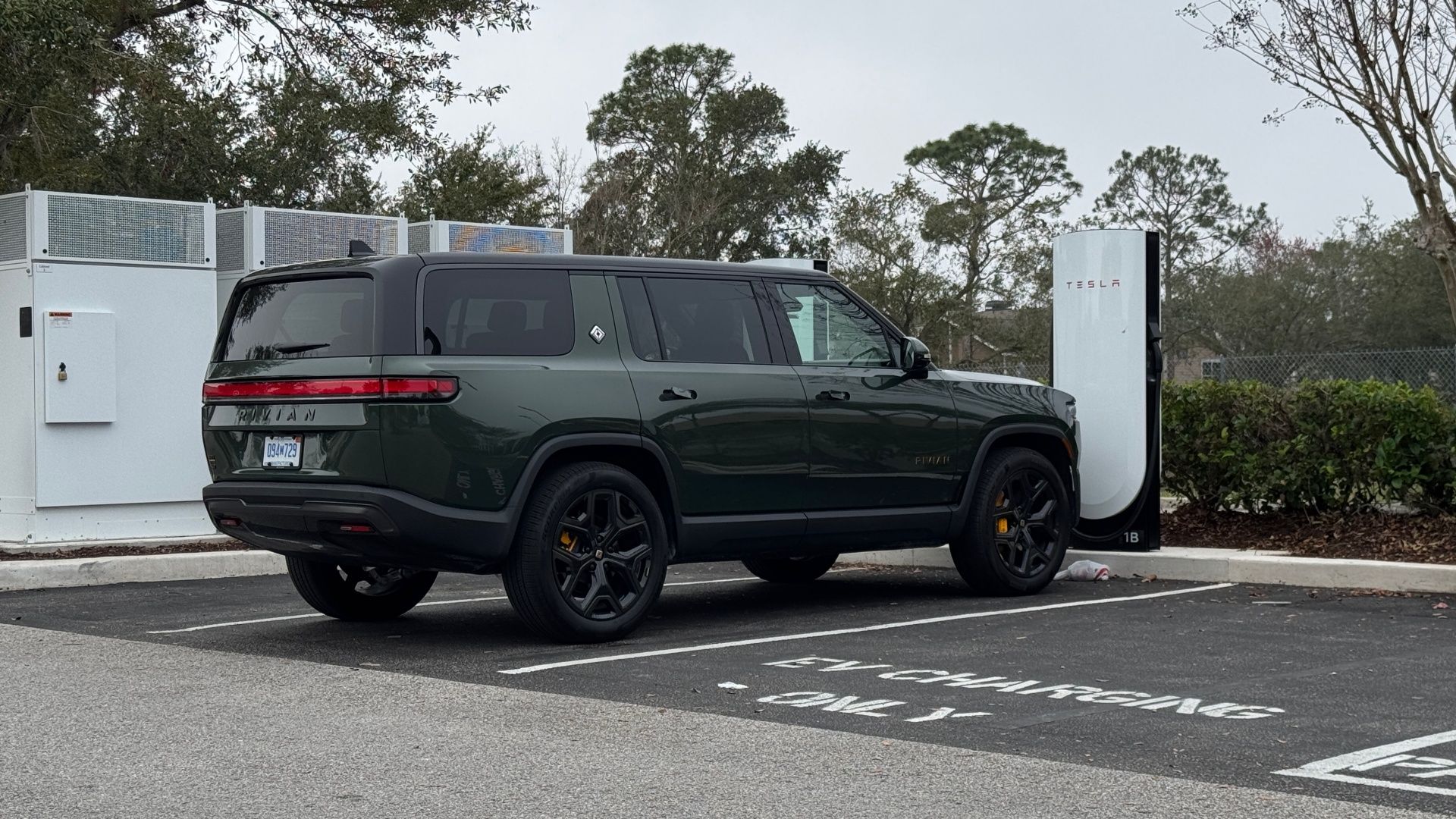
This will enable more vehicles to charge natively on Superchargers, but even if your EV doesn’t have an NACS connector, you can use an adapter. We wanted to find out how easy (or difficult) it is to charge at a Tesla station with a non-Tesla vehicle, so we borrowed a 2025 Rivian R1S and a NACS to CCS adapter from Lectron to find out.
This feature is compiled based on personal charging experience at a Tesla station with a Rivian R1S, and after in-depth discussion with Kyle Conner, owner and founder of OutOfSpec YouTube channel: Kye has likely driven more miles in EVs than anyone in North America, and this is his experience after extensive experience with public charging stations.
Which Brands Can Supercharge With An Adapter?
As of this writing, the following brands can use Tesla Supercharger stations with an adapter:
- Ford
- General Motors
- Lucid
- Mercedes-Benz
- Nissan
- Polestar
- Rivian
- Volvo
Other brands – including BMW, Genesis, Hyundai, Jaguar Land Rover, and Kia – will gain access soon. Some Tesla stations have a built-in adapter called the Magic Dock, which can be activated using the the Tesla app. In fact, “there are a handful of Magic Dock stations around the country that are open to any electric car,” Kyle Conner explained. “There were some issues with early [Volkswagen] E-Golfs, which I happened to own, and [Chevrolet] Sparks, but they fixed that.” These locations are scarce at the moment, but you can circumvent the need for them by bringing your own adapter. It’s worth noting that some companies, like GM, say you must use their certified adapter, not a third party one.

Related
Ford F-150 Lightning And Mustang Mach-E Owners Can Now Use Tesla’s Superchargers
The Blue Oval company is the first non-Tesla automaker to gain access to the Supercharger network.
“I think it’s so much better to have an approved adapter, because when something goes wrong, you can say, ‘hey, I was using the adapter you told me to use. You can’t say it was on me, right?'” Conner expressed. At this moment, there are only a handful of companies making OEM-approved adapters. In fact, the GM-recommended unit actually comes from Lectron, though GM officially says it works with “multiple suppliers” to source these adapters.

GM charges $225 for its adapter, while other automakers such as Ford and Hyundai sent out free units to their current owners with CCS ports. It’s great that some companies are stepping up with free adapters, though we spoke to two F-150 Lightning customers who just received theirs (in January 2025) after Ford announced the program in March 2024. Conner warned that not all of these adapters are created equally, and noted that the ones Hyundai and Kia are giving to their customers are limited to only 350 amps to save on costs.
When Will NACS Become The Standard?
Adapters make it possible for CCS vehicles to easily charge at NACS stations, but it requires drivers to keep this accessory in their vehicles at all times. Nearly every major automaker has announced that they will soon sell new EVs with the NACS port built-in, though the timeline for each brand is wildly different. The 2025 Hyundai Ioniq 5 and the Lucid Gravity are the first non-Tesla vehicles to be shipped with the smaller charge port.
However, just because an automaker sells one or more EVs with an NACS port, doesn’t mean CCS will go away overnight. Some vehicles currently on sale may not switch ports until a mid-cycle refresh or even a new generation. Having the correct port also doesn’t ensure your EV will charge at its peak speed on a Tesla station. Though Tesla claims to have a new “V4 Dispensers” that can output a higher voltage, Conner says they are still hooked up to the older V3 Cabinets on the inside.
“Tesla has no high-voltage Superchargers installed anywhere in the world, so they are capped at around 500 volts maximum… That means high voltage vehicles (like the Ioniq 5) have to deal with their own boosting strategy. Hyundai, Kia, and Genesis are switching to a higher boosting power, so they’re going from (depending on the model) between 50 and 100 kW to 120 to 140 kW, which is still much lower than their peak on a CCS station. You basically have to use a (NACS to CCS) adapter on an Electrify America station, and that kind of sucks. I think Ioniq 5 went NACS too early.”
– Kyle Conner, OutOfSpec Owner
Supercharging A Rivian
Rivian was one of the first brands to open access to Tesla’s Supercharger network (along with Ford), which is why we borrowed Tri-motor R1S SUV to test out the Lectron Tesla Supercharger (NACS) to CCS Adapter. This product is usually priced at $249 – a bit more than GM charges – but it is currently on sale for $184.99 with free shipping. Lectron’s adapter features three temperature sensors that monitor both the surface and terminals, a durable stainless steel latch, and an IP67 waterproof rating. It’s also rated for up to 1,000 volts and 500 amps.
Charging the R1S was remarkably easy. We arrived at the Supercharger Station, located at a Wawa gas station, plugged the adapter into the port, then plugged the charging cable into the other end. So long as you have a credit card on file in your Rivian account, the car will start charging with no other steps. This process is so painless, it’s easier than filling a car with gasoline, which requires a swipe of a credit card. Conner agrees that the Rivian charging process is remarkably easy, as is Ford’s, but there is still room for error.
“The main issue is the dealership. I’ve seen Ford dealerships not setting up their customers to access Plug & Charge at EA or Tesla,” he said. He also tells of a lady in Utah who had just bought a Ford Mustang Mach-E and was on her first road trip. The dealer said she could just Plug & Charge, but failed to set it up for her, and the credit card readers were broken – which understandably ended in disaster. Conner feels that the process needs to become automated for every automaker.
Warnings About Adapters
Kyle Conner is among the world’s leading experts at driving and charging EVs, and he has some advice for owners who plan to take long trips in their cars and who will need an adapter to do so.
His biggest warning comes in the form of spending up to get an OEM-certified adapter, and to treat it like a wear item.
“Adapters are dumb. That means the Supercharger and the car have no idea there is an adapter in the middle; there’s no communication logic between them. I am not recommending any non-automaker approved adapters…only because with millions of charging sessions that happen every day, there is bound to be an issue. We’ve seen EV fires without an adapter, so as soon as you add another connection point, the safety risk increases. They should be treated like a wear item; just replaced after a certain number of cycles when the pins start looking bad.”
– Kyle Conner, OutOfSpec Owner
Conner also warns that using your OEM’s app to activate a charging session could stick you with a higher electricity bill. “Most automakers recommend that you use their app to activate the Tesla Supercharger. You can activate the Supercharger using their app, but I don’t like that because Tesla allows you to subscribe and buy down your kWh rate to what Tesla owners pay. Some stations are cheap, but others aren’t. It would be nice to link your Tesla account on the back end. That’s something every automaker will have to come to an individual agreement with Tesla to do.”
Sources: OutOfSpec