UAW Voices Support For Trump’sNew 25% Tariffs On Imported Cars And Parts

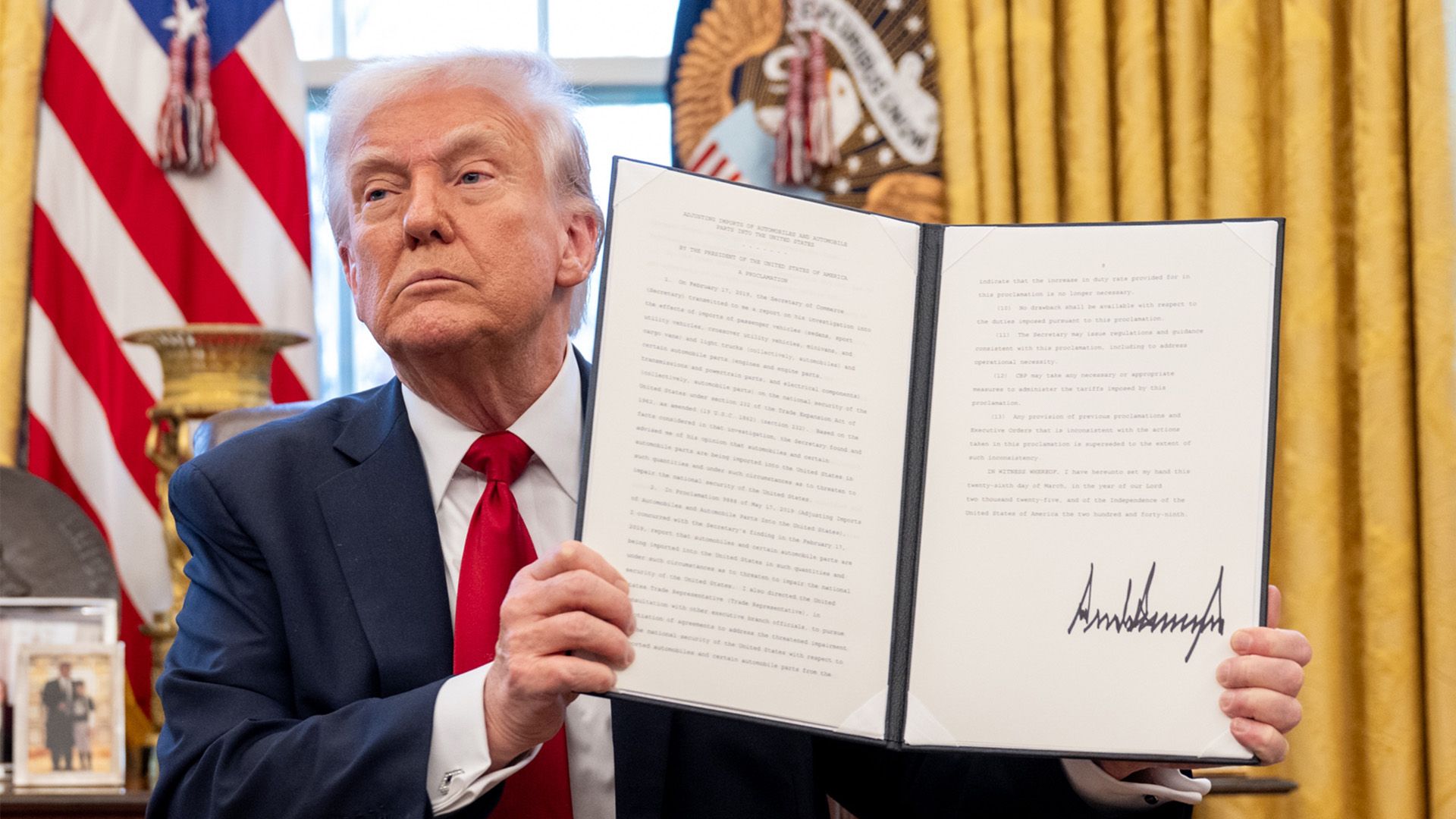
President Donald Trump has moved forward with his long-threatened 25 percent tariff on vehicles and parts imported from outside the United States. During an Oval Office signing ceremony Tuesday afternoon, President Trump claimed tariffs would push automakers to move more plants to the U.S. This comes as Honda recently announced it would build the next-generation Civic in Indiana instead of Mexico. As for the Detroit Big Three, they have publicly warned for weeks that immediate actions would be damaging to the American auto industry and raise prices, and analysts have cautioned that sales could drop. Cox Automotive estimated the tariffs could result in 700,000 fewer vehicles being sold in the U.S. in 2025.
2025 Honda Civic Sport Hybrid
- Base MSRP
-
$28,950
- Engine
-
2.0L I4 Hybrid
- Horsepower
-
200 hp
- Torque
-
232 lb-ft
- Fuel Economy
-
50 mpg
Big Three Pushed For Carveouts
In February, Ford CEO Jim Farley said, “a 25 percent tariff across the Mexico and Canada borders would blow a hole in the U.S. industry that we’ve never seen.” However, Farley said that when tariffs only on the U.S.’s neighboring countries were being discussed, as he claimed it would give “free rein to South Korean, Japanese, and European companies” that are now facing the same issue. The Big Three did push for exemptions to the tariffs, as many of their vehicles are made up of parts that come from other countries.

Related
Automakers That Will Be Impacted By President Trump’s Tariff Against Mexico And Canada
With impending 25% tariffs against goods manufactured in the USA’s neighboring states, these are the automakers that would be most impacted.
Ford Executive Chair Bill Ford was planning to travel to Washington, D.C., for talks with members of the White House, and GM CEO Mary Barra was having similar remote meetings. Part of the problem has been trying to communicate the complexity of the auto industry to the new administration, according to Detroit Free Press. The convoluted modern vehicle supply chain proved challenging for automakers to explain to the incoming administration. Furthermore, the auto industry has expressed that relocating production facilities to the U.S. would take years and cost billions of dollars, with consumers potentially bearing the cost on tariffs in the near term and on those relocation costs in the future.
There May Be Some Exemptions For American Cars
Per White House principal deputy press secretary Harrison Fields, “key automobile parts,” which include engines, powertrains, and electrical components, that fall under the U.S.-Mexico-Canada agreement are “tariff-free.” It is unclear now how long that will last and if that applies to whole vehicles that are USMCA-compliant.
Expensive Border Crossings
It is also possible that parts face tariffs multiple times, raising the price for vehicles, regardless of the country of assembly, by 20 percent. That is according to Sam Abuelsamid, vice president of Market Research at Telemetry Insights, speaking to the Free Press. If the average price of a new car is $50,000, after tariffs, that exact vehicle could cost $60,000 or beyond.
“Actually, it’ll probably be worse than that. Supply chains are complicated and there are a number of components that cross borders a number of times.”
That’s because each time a part crosses a border, it’ll be subject to a tariff. For example, some automakers import specific components from suppliers in Japan, such as Takata or Denso. Those components get shipped to the U.S. (passing a tariff on the way) to be attached to vehicle parts that then get shipped to Mexico for final assembly. Once that’s done, the completed vehicle comes to the U.S. and gets hit with yet another tariff.

Related
Why The Dodge Charger EV Deserves The Muscle Car Title
Feel free to light up the comments section.
Autoworkers Union Supports The Tariffs
While the impact of the new changes appear to be costly for both automakers and consumers, one group is supporting the move. In a statement by United Auto Workers President Shawn Fain it reads in part, “We applaud the Trump administration for stepping up to end the free trade disaster that has devastated working-class communities for decades. Ending the race to the bottom in the auto industry starts with fixing our broken trade deals, and the Trump administration has made history with today’s actions.”

Fain also said, “These tariffs are a major step in the right direction for autoworkers and blue-collar communities across the country, and it is now on the automakers, from the Big Three to Volkswagen and beyond, to bring back good union jobs to the U.S.”
“You’re going to see prices coming down. We’re already setting records for new plants.”
In the release sent to CarBuzz, the UAW went on to state that it believes the tariffs will bring “thousands of good-paying blue-collar auto jobs” to communities across the country by adding additional shifts or lines in existing union auto plants in Michigan, Kentucky, Kansas, Tenesee, and Ohio.
According to the executive order, the tariffs would take effect on April 2. President Trump has referred to it as “liberation day” and promised to also impose new reciprocal tariffs on goods from other countries.