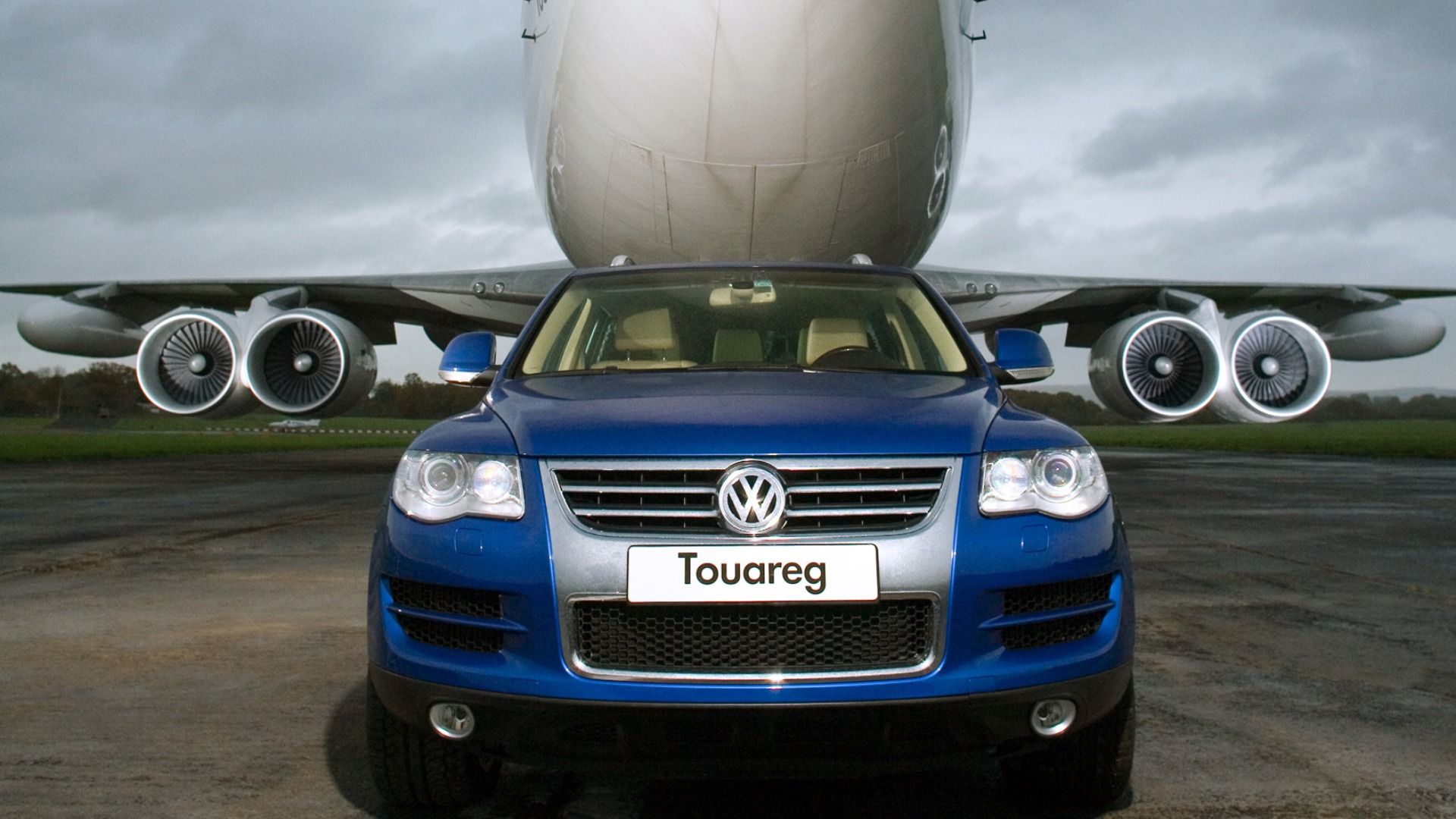
VW Touareg, Chevy C/K Truck & More

Throughout automotive history, car companies have frequently used extreme, mind-blowing stunts to publicize their vehicle’s capabilities. Think of the famous Volvo ad with Jean-Claude van Damme doing the splits between two trucks, which showcased the stability of Volvo’s commercial vehicles. Another automotive metric that lends itself well to visually impressive feats is towing capacity: the ability to pull very large and heavy objects can produce eye-catching visuals, ideal when you’re trying to draw attention to your SUV or pickup truck.
Some automakers have taken this to the extreme. Volkswagen’s plane-pulling Touareg stunt, where a diesel-powered version of the SUV towed a Boeing 747, is perhaps the most famous example of this; however, VW was not the first nor only company to have this idea. Several other companies, such as Chevrolet, did the very same thing before and after the Touareg. Let’s take a look at four of the most well-known examples of a car towing a passenger airplane.
Other Trims
This article focuses on four cars that have been known to tow passenger airplanes in widely publicized feats.
The Volkswagen Touareg And Its Incredible Accomplishment
|
Volkswagen Touareg Diesel V10 Specs |
|
|
Engine |
5.0-liter V10 turbodiesel |
|
Power |
310 hp |
|
Torque |
553 lb-ft |
|
0-60 mph |
~7 seconds |
|
Top Speed |
140 mph |
In 2006, Volkswagen’s Touareg SUV performed an amazing stunt on British motoring television series Fifth Gear. A blue Touareg successfully towed a Boeing 747 aircraft, weighing in at around 155 tons, at the Dunsfold Aerodrome in south-west England. An initial trial was carried out in Germany, but logistical issues led Volkswagen to conduct the final stunt through its UK division instead.
The Touareg in question was the version equipped with a 5.0-liter turbocharged diesel V10, which produced 309 hp and 553 lb-ft of torque. It was paired with a six-speed automatic transmission. This model had a turbulent history on the US market because of clashes against emissions regulations. It was briefly available in the States during the 2004 model year, was then taken off the market, and reintroduced two years later. This time, the V10 Touareg lasted three years, before being killed off for good in 2009. The V10 was replaced by another turbodiesel engine, a V6.
Although the car was mostly stock, a few changes were made to make this stunt possible. A large amount of ballast was added, bringing the total combined weight of car and driver (test driver Uwe Krieghoff was behind the wheel) to around 15,500 lbs. An adapted towing bracket was fitted to the Touareg’s stock towbar. The axle ratio was modified as well, a change that turned out to be unnecessary.
The bodywork was also changed, with some body panels being swapped out so the car could resemble an updated version of the model which was about to be released. The aircraft itself had undergone some modifications, too: the engines and original braking system had previously been removed for the filming of a movie. The seats, toilets and landing gear were, however, still in place.
Before The Touareg: The Chevy C/K Pickup Truck
The Touareg’s stunt may have been one of the most widely publicized in recent car history, but it wasn’t the first one of its kind. Going back a few decades to the early 70s, a similar feat was accomplished by Chevrolet, when a 1972 ¾-ton Chevy pickup truck managed to tow another Boeing 747. The plane, borrowed from American Airlines, weighed approximately 460,000 lbs, or 230 tons.
The truck was a K20 model, from the last year of the Chevy C/K Series’ second generation. It was equipped with a 5.7-liter V8 that produced 175 hp, paired with a three-speed Turbo-Hydramatic automatic transmission. Footage of the truck towing the airplane was used in an ad campaign. Although the emphasis on towing capacity and ruggedness is still a part of pickup trucks’ marketing strategies today, this was even more relevant in the 70s, when trucks were largely seen as utilitarian workhorse vehicles rather than the family daily drivers they are frequently used as today.
The second-gen model had first been introduced in 1967. In 1971, however, it underwent some major changes. The front fascia was redesigned, with an “egg-crate” grille and the reintroduction of the Chevrolet bow-tie logo (which had been absent in previous model years). The interior was also revamped, with more features being made available such as an AM/FM radio. The 1972 model had an updated door design, as well as a new rear-view mirror. This generation was referred to as “Action Line”, and was replaced in 1973 by the third-gen “Rounded Line” models.
Other Cars That Have Towed Planes: The Porsche Cayenne…
In more recent years, a few other cars have also pulled off a similar accomplishment to the Touareg and the Chevy pickup. One of them was the Porsche Cayenne, which in 2017 was the center of a Porsche publicity stunt organized in collaboration with Air France. At Paris’ Charles de Gaulle Airport, a Porsche Cayenne S Diesel successfully towed a passenger plane: this time, not a Boeing, but an Airbus A380. The plane was towed for 42 meters, with Porsche GB technician Richard Payne behind the wheel. This accomplishment allowed Porsche to set a Guinness World Record for “Heaviest aircraft pull by a production car”.
“It did it – I’m so relieved! We don’t usually go this far to test the limits of our cars but I think today we got pretty close […] I could tell that it was working hard but the Cayenne didn’t complain and just got on with it.
My mirrors were quite full of Airbus, which was interesting. Our cars can go a bit beyond what our customers might expect – they’re designed to be tough. But even so, what the Cayenne did today was remarkable.” – Richard Payne, Porsche technician
The star of the show was equipped with a 4.1-liter diesel V8, which produced 385 hp and 627 lb-ft of torque. It was almost entirely stock, with just a single additional feature to help it along on its journey: a special towing attachment, which sat on the car’s regular tow bar. In order to prove a point about the capabilities of gas-powered engines as well as diesel ones, Porsche repeated the stunt soon afterwards, this time using a Cayenne Turbo S. This car was equipped with a 4.8-liter gas V8, which produced 560 hp and 590 lb-ft of torque. Both vehicles were later driven from Paris to London, showing that their condition and drivability had not been affected by their extraordinary towing feat.
…And The Tesla Model X
Over the past decade or so, the automotive world has been keen to explore the towing and hauling capabilities of electric vehicles. As EV tech made strides forward, one car stood out for achieving a similar feat to the Cayenne and Touareg: the Model X, Tesla’s falcon-winged SUV. In 2018, a Model X P100D successfully towed a Boeing 787 Dreamliner for around 300 meters (roughly a fifth of a mile) at Avalon Airport in Melbourne, Australia.
Even though the plane was not quite loaded to its maximum take-off weight (560,000 lbs), it was still heavy enough for the Tesla to gain a Guinness World Record of “heaviest tow by a production electric passenger vehicle”. The official towing capacity of the Model X is 5,112 lbs, while the weight of the aircraft, unloaded and with minimal fuel on board, is 286,600 lbs.
This publicity stunt did not just showcase the Model X’s capabilities, it also served the purpose of highlighting the relationship between Tesla and Qantas, Australia’s national airline. At the time the plane-towing stunt was performed, the airline had installed Tesla chargers at four airports across Australia.
Sources: Volkswagen, Chevrolet, Porsche, Tesla