Which Is The Best Porsche 911?

Quick Links
There are very few certainties in this world, but one maxim that has remained true for decades is that the Porsche 911 is the default choice for those looking for a class-leading sports car that can do it all. The updated Porsche 992.2 Carrera T is arguably the pick of the ‘entry-level’ 911s, offering impressive performance, plenty of customizability, and that daily usability that has differentiated the 911 from most of its rivals over the years.
It is also the only way to get behind the wheel of a manual transmission 911, apart from the far pricier GT3 models. But if you like the old-school stick shift, and have around $150,000 to spare, then a whole world of desirable classic 911s are there for the taking. We decided to see whether the latest is always the greatest, and compared the 2025 Carrera T to some of our favorite classic 911s.
We used the base MSRP of the 2025 Porsche Carrera T Manual coupe and convertible as a baseline for our classic 911 comparison. We compared new and old models on several factors to see how they stacked up. All data is from reputable sources.
The Porsche 911 Carrera T
|
2025 Porsche 911 Carrera T Manual |
|
|
Engine |
3.0-liter twin-turbo flat-six |
|
Power |
388 hp |
|
Torque |
331 lb-ft |
|
0-60mph |
4.3 seconds |
|
Base MSRP |
$143,700 |
A base-spec 911 has always been one of the best ways to experience this evergreen sports car. Devoid of excessive electronic aids, hard suspensions, and without the massive power outputs of the range-toppers, a base model has always been able to hit the sweetspot between daily usability and driving thrills. While the latest Carrera T isn’t strictly a base model, it is fitted with the bare minimum of options, all designed to maximize the driving experience. The most important of which is a manual shifter.
Water-cooled engines, turbocharging of nearly every model, and PDK transmissions across the board have been things that Porsche fans regularly griped about, but it is the demise of the manual transmission that upset driving fans the most. The 991.1 generation GT3 was offered without a manual option at all, a mistake soon rectified when the 991.2 arrived.
The bread-and-butter 911 models also started to go PDK-only, but a manual was generally available as an option somewhere in the range. Currently, the Carrera T is the only model offered with a manual transmission, apart from the GT3, which is more of a road-legal track car than a daily driver. The Carrera T uses the base model’s 388 hp engine, but adds driver-centric options like Porsche Torque Vectoring, the Sports Chrono Pack, and the Porsche active suspension management (PASM) system. This all pushes it within $8,000 of the 473-hp PDK-equipped Carrera S, but if straight-line speed is all you’re after, then this is not the car for you.
The 992.2 Carrera T (now also available as a Convertible) is all about driving enjoyment, and that is what the 911 has always been about. So, if Porsche is taking one step back to go two steps forward, let’s see whether stepping all the way back to the 1990s and 2000s nets an even better result.
The Classic Options
While a base 2025 911 Carrera T will set you back $143,700 before any taxes, and the convertible is an even steeper $157,400, we have set our sights on classic Porsches closer to the $100,000 to $120,000 mark. That’s because while the new 911 comes with a service plan and the expectation of years of trouble-free motoring, an older car is unlikely to be as reliable or cheap to maintain. That extra $30,000 to $50,000 should be more than enough to keep your classic Porsche serviced and repaired for the foreseeable future. We have stuck to manual transmission cars across the board. If all these Porsche model names are making your head buzz, or you want a quick refresher, read our comprehensive guide here first.
Porsche Carrera 997 2004-2013
The 997-generation 911 was a great sales success for Porsche. It built on the strong foundation of the 996, the first water-cooled 911, and featured a less controversial exterior design and a better quality interior. Early Carreras can dip as low as $25,000, but our budget allows us to cherry-pick from the updated 997.2 models, including the Turbos. A manual transmission Turbo is still a very rapid car, will handle the school run without a problem, and is even quicker than the 2025 Carrera T. What’s not to like?
|
Our Choice |
997.2 Turbo |
|
Engine |
3.8-liter twin-turbo flat-six |
|
Power |
493 hp |
|
Torque |
457 lb-ft |
|
0-60 mph |
3.5 seconds |
|
Average Values |
$120,000 |
|
Average Mileages |
20,000 – 45,000 miles |
Porsche Carrera 993 1994-1998
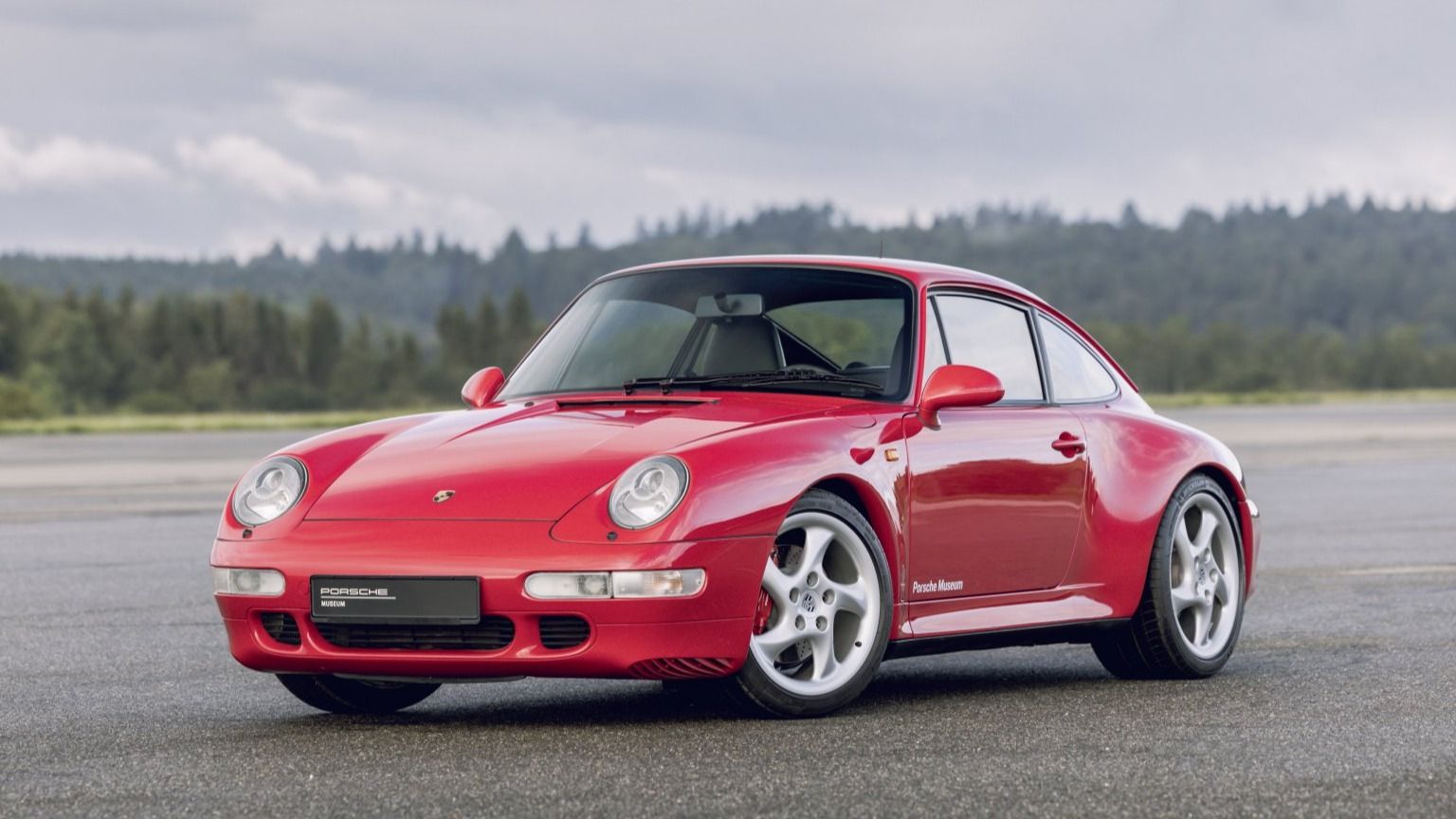
The last water-cooled 911 and the one that most people feel was the pinnacle of the range before the new era arrived. Values have certainly climbed steadily for these cars in recent years, with the average price across all models now at $141,294. That’s a bit above our budget, but the rare and highly collectible models like the GT2 and RS skew the average somewhat, and there are plenty of great regular Carreras out there for well below that figure. These cars are still modern enough to feel quick, and while they aren’t great for long distances, a 993 is a solid investment that will have you up early on weekend mornings just to go for a drive.
|
Our Choice |
993 Carrera |
|
Engine |
3.6-liter flat-six |
|
Power |
268 – 281 hp |
|
Torque |
243 lb-ft |
|
0-60 mph |
5.2 seconds est |
|
Average Values |
$100,000 |
|
Average Mileages |
40,000 – 10,000 miles |
Porsche Carrera 964
The 964 was in the shadow of the 993 for years, but it offers its own charms, and seeing as so many end up as the base for a restomod, they are becoming rarer too. The retro ’80s looks bridge the gap between the earlier models and the smoothed-off 993, and average values for the 964 overall are now at $198,899. This figure is a bit misleading, though, as million-dollar restomods by companies like Singer are also included.
Regular 964s, as Porsche intended, are far more accessible, with a high-mileage Carrera 4 Convertible averaging $40,000. Low-mileage Carrera coupes are double that figure, while the fantastic Carrera RS America is closer to $140,000. We would stick to a regular 964 Carrera coupe and keep some cash aside for servicing and maintenance. It may no longer be the last word in speed and handling, but the 964 range is still great to drive, and can be pressed into daily use if required.
|
Our Choice |
964 Carrera |
|
Engine |
3.6-liter flat-six |
|
Power |
247 hp |
|
Torque |
229 lb-ft |
|
0-60 mph |
5.5 seconds est |
|
Average Values |
$80,000-$100,000 |
|
Average Mileages |
100,000 miles |
New Vs Classic
Daily Drivability
The modern Carrera T wins this hands down. It offers smartphone connectivity, a far superior HVAC system, and is more comfortable and spacious inside. One area where the older 964 and 993 score some points is in their more pliant ride quality. The 997 splits the difference and is actually great to drive in any situation. Just add a bluetooth connector, or better yet, one of Porsche’s updated infotainment head units.
Investment Potential
Oldies for the win here. Every 911 eventually stops depreciating and heads up in value, but as it stands the new model will still lose a lot more value in the coming years than the older cars. If preserving wealth is high up on your list of priorities, you’ll either need to keep your 2025 Carrera T for a very long time, or opt for a classic.
Performance
The Carrera T may be the least powerful model in the 911 range, but it is still very quick, and handles superbly. The 1990s cars aren’t slow, but a mid-5.0-second 0-60 mph time is only a little quicker than a Golf GTI or Toyota GR86. The 997 Turbo is still rapid enough to easily embarrass a modern Carrera or Carrera T, but it doesn’t quite have the same cornering capabilities.
Running Costs
Old cars require more maintenance, and Porsche parts aren’t cheap. The new Carrera T comes with a service plan and shouldn’t require any unplanned repairs for years. So, the new car wins here, but remember, what you save in maintenance costs, you lose in new car depreciation.
Cool Factor
This depends on personal preferences, but for us, there is something special about seeing a classic 911 drive by. Those familiar lines and that chuntering flat-six sound put a smile on our dials every time. Then again, the current 911 looks absolutely stunning, too.
No Wrong Answers
Porsche 911s never become old cars; they just morph into desirable classics. The evolutionary nature of Porsche’s design approach means that there is a common thread that runs through every model, regardless of its age, but there is no denying the technological prowess of the latest models.
Classic 911s are sure to continue going up in value, and deliver an intoxicating hit of driving fun, but they are less suitable for daily driving duties and will require regular maintenance to perform at their best. The 2025 Carrera T, meanwhile, captures the spirit of the old models and injects the experience with a dose of cutting-edge tech. So, which is best? For once, there are no wrong answers here.
Sources: Porsche, Classic, AutoTempest