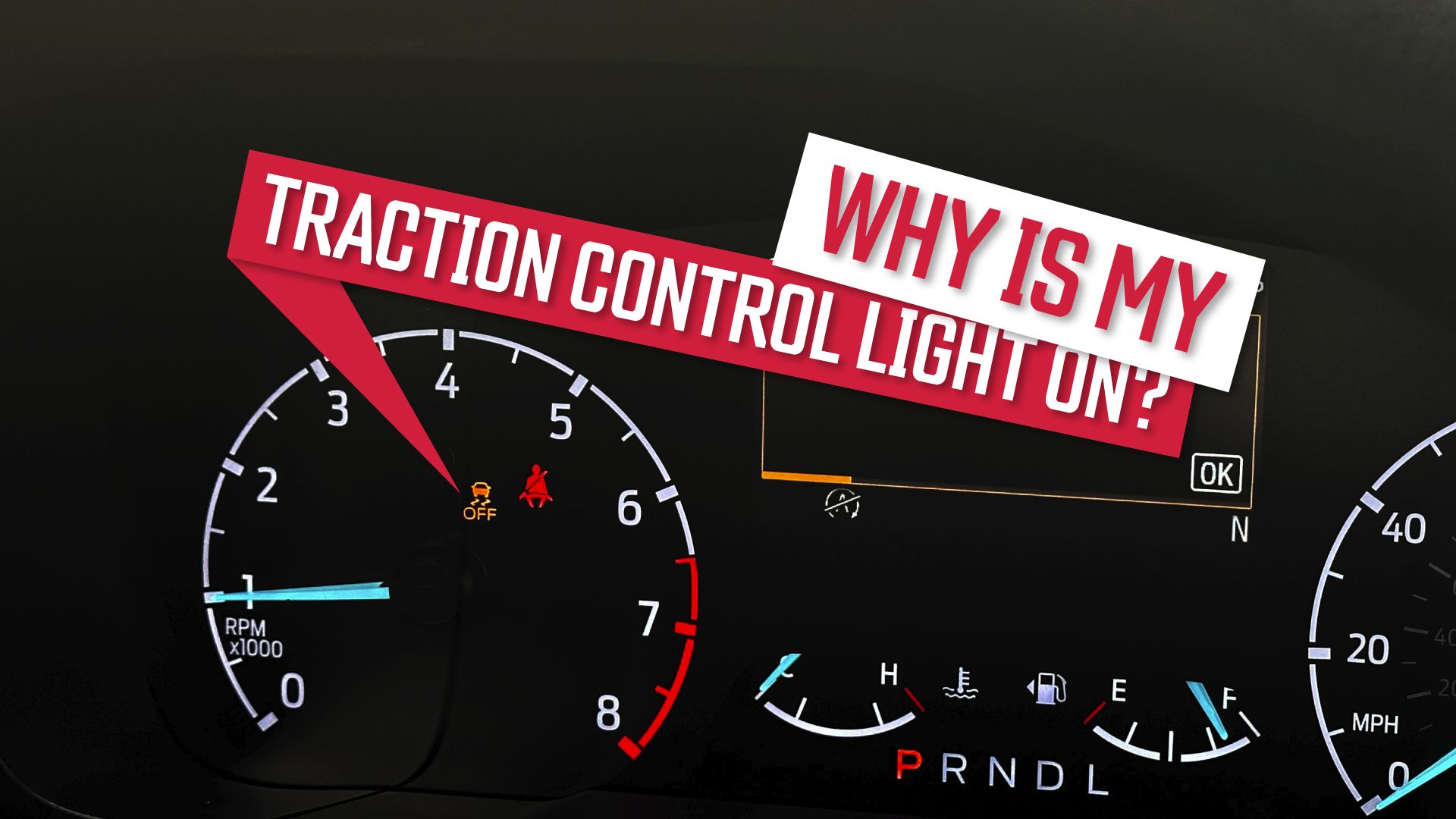
Why Is It Staying On?

The modern vehicle has well over a dozen warning indicator lights. These lights are designed to alert of what systems are engaged, which systems are disengaged, and when a system has logged a fault code. Anti-lock brakes (ABS), stability control (VSC), brake assist (BA), tire pressure monitoring (TPMS), downhill assist control (DAC), and traction control (TCS) are only a few of the electronic systems that improve the safety and effectiveness of our vehicles. The traction control light going on is reported by many drivers, but it does not always indicate a fault with the system. In this article, we’ll cover the ins and outs of the traction control system, including how much it costs to fix if something goes wrong.
What Is Traction Control On A Car?
Traction control is a system designed to prevent both the loss of traction and to help regain traction when a wheel ‘slips’. Slip occurs when one wheel’s speed is faster than the other wheels. This happens when the wheel loses traction.

Traction control works in conjunction with ABS as it uses the ABS module and wheel speed sensors. Each wheel has a speed sensor that reports the wheel’s speed back to the control module. When a wheel begins to slip, the control module will modulate the brake to slow the wheel down. By slowing the wheel down, it allows it to regain traction.

When Should The Traction Control System Be Active?
Traction control is automatically active and ready when starting the vehicle, as long as there isn’t an active fault code. For the vast majority of the time, you’ll want traction control to remain activated as it improves the safety of the vehicle. Traction control will activate on loose terrain such as gravel and dirt, wet or slick surfaces such as during rain or snow, and whenever wheel slip is detected, such as during heavy acceleration or excessive cornering speeds. There are only three scenarios where you may want to consider disabling traction control.

Add CarBuzz to your Google News feed.
Spare Tire Installed
Temporary spare tires have a smaller diameter than normal tires. This can cause the traction control system to prematurely activate or improperly activate, due to the difference in rotational speed that can be detected by the control module. In simple terms, there’s no way for the module to know a spare tire has been placed on the vehicle. Therefore, once the speed difference is noticed, the module will believe the tire is slipping.

Faulty Traction Control System
Traction control system faults will typically disengage the traction control system, preventing it from operating. However, some faults related to the wheel speed sensor may not always lead to a fault code being set, and the traction control system will remain active. In these scenarios, the traction control system can prevent your vehicle from accelerating as it should, creating a potential safety hazard.

On The Track
For those who are interested in taking their Porsche 911 or Honda Civic Type R to a racetrack, you may want to disable traction control for a faster lap time or for drifting. Traction control will quickly apply the brakes to slow a spinning wheel, which is a good thing, unless you want it to spin or the excessive spin isn’t affecting the control of your vehicle. Additionally, traction control will prevent you from doing a burnout. Burnouts are used in drag racing to preheat the tires so they gain better traction. If you plan on making a few passes down the drag strip, you may want to disable traction control.
Why Is The Traction Control Light On?
So, what does it mean if the service traction control light illuminates? The traction control light will illuminate when the system is disabled, being activated, or when there’s a fault code present. Why is my traction control light staying on? Generally, the traction control light will flash or blink when it’s activated and remain solid when it’s disabled or a fault code is present. The following causes of an illuminated traction control light are commonly reported:
- Faulty wheel speed sensors
- Improper tire sizes
- Incorrect tire pressure
- Faulty brake module

Traction Control Vs. Stability Control Vs. ABS
Traction control is designed to prevent wheel slip (excessive wheel speed), whereas ABS is designed to prevent lock-up (reduced wheel speed). Stability control utilizes the ABS, TCS, yaw rate sensors, and steering angle sensor to provide the driver with more assistance. Stability control is designed to redirect the vehicle’s path of travel when it detects excessive oversteer.
How Much Does It Cost To Fix A Faulty Traction Control System?
The vast majority of traction control faults are related to faulty wheel speed sensors, improper tire sizes, and improper tire pressure. RepairPal estimates a cost between $200 and $300 for a wheel speed sensor replacement. A faulty brake module can be a costly repair needed to restore the operation of the traction control system. RepairPal estimates a brake module replacement will cost you as much as $1,000. However, we’ve seen parts alone cost $900 to $1,200. Additionally, some traction control faults are remedied by software updates. These are usually covered under warranty or warranty enhancements.
Traction control is a very important safety system on your vehicle. By maintaining the grip between the tires and the road, your vehicle will stop, accelerate, and handle more effectively. Although your vehicle will remain operable, if the TC light on your car is illuminated, we recommend seeking repairs sooner rather than later.