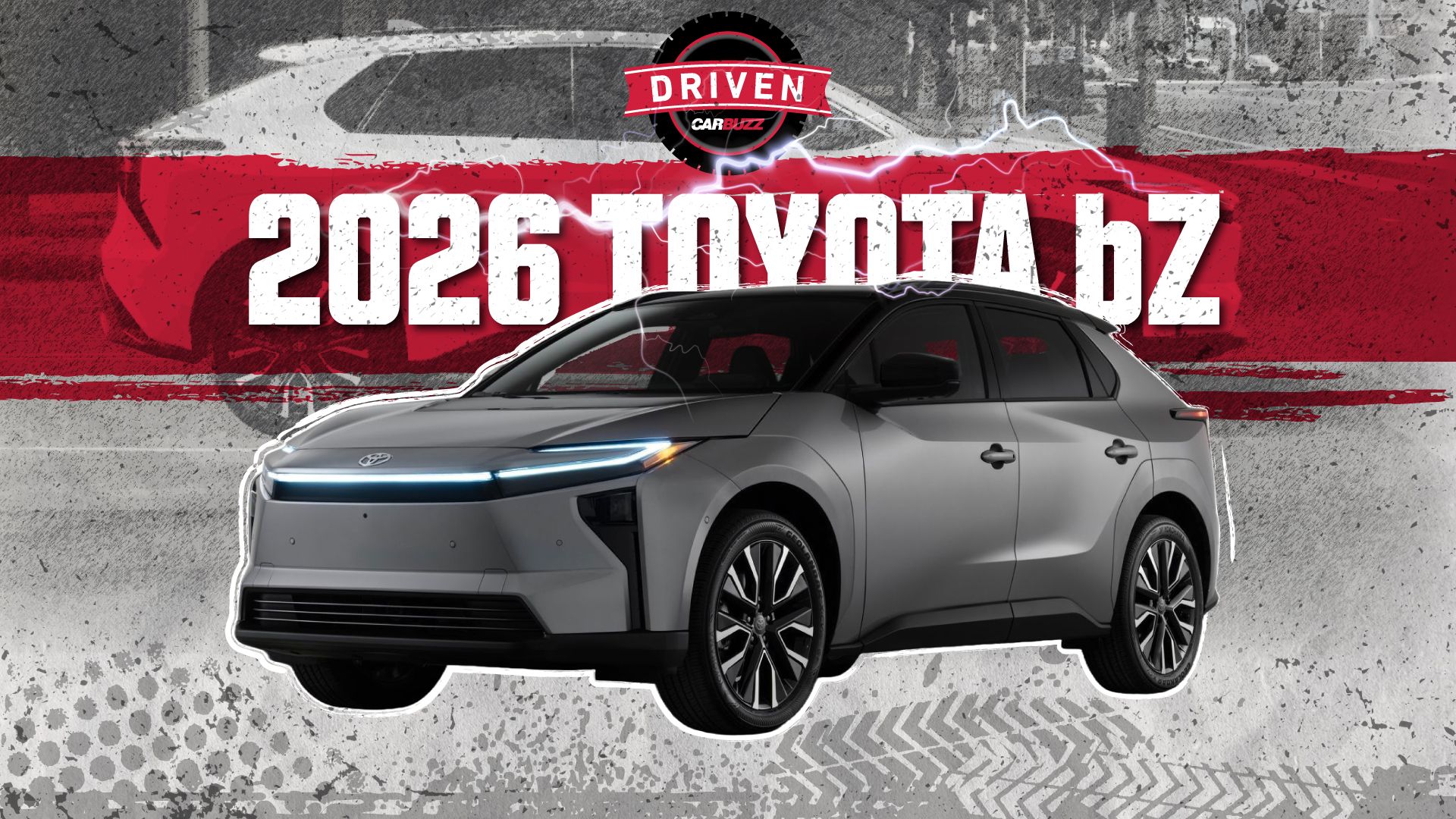
2026 Toyota bZ First Drive Review: New Name, New Groove

Toyota launched the bZ4X electric crossover to timid applause. When it launched back in 2022, it didn’t have world-beating specs, an interesting design, or even a compelling name. It also wasn’t overly exciting to drive. A total rethink was in order. Enter the 2026 Toyota bZ, a refreshed version of the bZ4X that debuted three years ago. While far from an all-new model, the bZ makes some notable improvements over its predecessor, including a new, more streamlined name.
- Base Trim Engine
-
Electric
- Base Trim Transmission
-
Single-speed Automatic
- Base Trim Drivetrain
-
Front-Wheel Drive
- Base Trim Horsepower
-
168 hp
- Available with over 300 miles of range
- Huge power bump on dual-motor model
- Improved interior and exterior
- Still looks a bit generic
- Charging speeds are slow
- How much does it cost?
bZ stands for “Beyond Zero,” and this vehicle still acts as part of Toyota’s electrified lineup that will soon add a larger model called the bZ Woodland and a smaller crossover that will revive the CH-R name. These new models show that Toyota has dropped its previous EV naming scheme, where each model would have the letter bZ followed by numbers to denote size. Can a name change, bigger batteries, and other small improvements turn the bZ into a more compelling EV option? CarBuzz took a quick spin in the updated car to find out.

Related
Is the 2026 Toyota bZ finally a proper Tesla Model Y rival?
The original bZ4X was a bit underwhelming. It had a poor range, was a bit underpowered, cost over $40k, and even had a stupid name. The 2026 bZ is an improvement in every way, most notably the range, which is now up to 314 miles. Would you buy one over the Ford Mustang Mach-E or Tesla Model Y?
First Drive events provide our initial impressions of a vehicle in a restricted environment under certain time constraints. Keep an eye on CarBuzz for our comprehensive Test Drive review which will follow soon.
What’s Changed For 2026?
Toyota changed a lot for the 2026 model year, including the name, though most of these are what we’d consider “minor.” Updated headlights form an upward swoop with a full-width light bar running across the front end. The main part of the headlight is now housed separately lower on the bumper. Customers complained about the bZ4X’s contrast fenders, so several colors on the new bZ now have body-colored panels.
Inside, there is a new 14-inch touchscreen standard, a nice increase over the outgoing 12.3-inch screen. It functions the same as the outgoing screen, meaning it’s simple to use and features wireless Apple CarPlay and Android Auto. That screen is tied to a six-speaker audio system on the XLE or an available nine-speaker JBL system on the Limited. The center console has been completely redesigned, ditching the bZ4X’s closed cubby in favor of an open shelf with two available wireless phone chargers. A fabric/Softex interior is available on the base XLE model, while the upper trim Limited gets a full Softex interior with heated and ventilated front seats. 64-color ambient lighting has been added to improve the vibes at night.
Powertrain & Driving: Competitive At Last
|
Strengths |
Weaknesses |
|---|---|
|
|
|
The bZ makes some major improvements over the bZ4X, including longer range, more power, and a new small battery version that should come with a cheaper price tag. Toyota’s range estimates vary depending on trim and battery size, with the XLE FWD Plus expected to cover the most ground, 314 miles (manufacturer estimate). For reference, the outgoing bZ4X could only travel 252 miles. We sampled the new XLE FWD variant with the smaller battery and a Limited AWD.
2026 Toyota bZ Motor/Battery Options
|
|||||
|
XLE FWD |
XLE FWD Plus |
Limited FWD |
XLE AWD |
Limited AWD |
|
|---|---|---|---|---|---|
|
Battery |
57.7 kWh |
74.7 kWh |
|||
|
Power |
168 hp |
221 hp |
221 hp |
338 hp |
338 hp |
|
0-60 |
8.0 seconds |
8.0 seconds |
8.0 seconds |
4.9 seconds |
4.9 seconds |
|
Range |
236 miles |
314 miles |
299 miles |
288 miles |
236 miles |
The outgoing bZ4X offered pretty lackluster performance – which was impressive if you’ve only driven Toyota four-cylinder cars – but par for the course if you’ve ever been in an EV. This updated bZ is far more impressive. We first jumped into the XLE FWD, the least powerful model with just 168 horsepower. It can outmatch Toyota’s acceleration estimate, hitting 60 mph in a respectable 7.38 seconds, chirping its front tires in the process. The Limited AWD delivers more thrilling acceleration with 338 hp, reaching 60 in 4.5 seconds in our testing. Neither powertrain delivers immediate thrust off-the-line, each requiring a brief build-up after you pin the throttle. Toyota clearly didn’t develop these with racing starts in mind. It’s still nice to see a 20 hp improvement on FWD models and a 124 hp bump on the AWD model.

Related
Toyota’s Newest Crossover Is Just As Quick As The GR Corolla
The new bZ: an electric crossover with hot hatch performance.
Aside from the superior acceleration, Toyota didn’t change much about how the bZ drives. It’s quiet, competent, and familiar, like a Toyota should be. We wish Toyota offered a full one-pedal driving mode instead of the bZ’s strong regeneration mode that doesn’t fully bring the car to a stop. It’s all part of Toyota’s approach to making EVs that don’t feel too foreign to existing owners.

The bZ’s 150 kW peak charging speed is still unimpressive by modern standards, but thanks to an improved charging curve and battery preconditioning, Toyota says you can get from 10-80% charge in around 30 minutes. That’s also due in part to the bZ’s battery, which is small compared to rivals. A standard NACS connector means bZ owners can now pull up to a Tesla Supercharger and Plug & Charge without an adapter. Home charging is quicker too, with a new 11 kW onboard charger that replaces the old seven kW one.
Verdict & Pricing: Pending Pricing
Toyota has not released pricing for the 2026 bZ, so it’s difficult to render a full verdict without that information. The current 2025 bZ4X starts at $37,070, while the Limited costs $41,800. Adding the dual-motor setup with AWD currently costs $2,080. We expect these improvements to come at a slight price increase, but the new smaller battery model should undercut the cheapest bZ4X. If Toyota could price it around $35,000 before incentives, this could be a great starter EV for buyers on a budget. A fully-loaded Limited AWD should still approach $50,000 with options, but at least now it packs competitive power.
We would have liked to see Toyota bring larger batteries for more impressive range, getting all trim levels near or above the 300-mile mark. It would have also made them better road trip vehicles with quicker DC charge speeds, though the improved charge curve, faster AC speeds, and standard NACS port are nice upgrades. Toyota still doesn’t have a “class-leading” EV, but it now has a more compelling option that doesn’t feel like it was developed as an afterthought. So long as you aren’t trying to be on the cutting edge of EV technology, the bZ is a vehicle that’s worth considering.