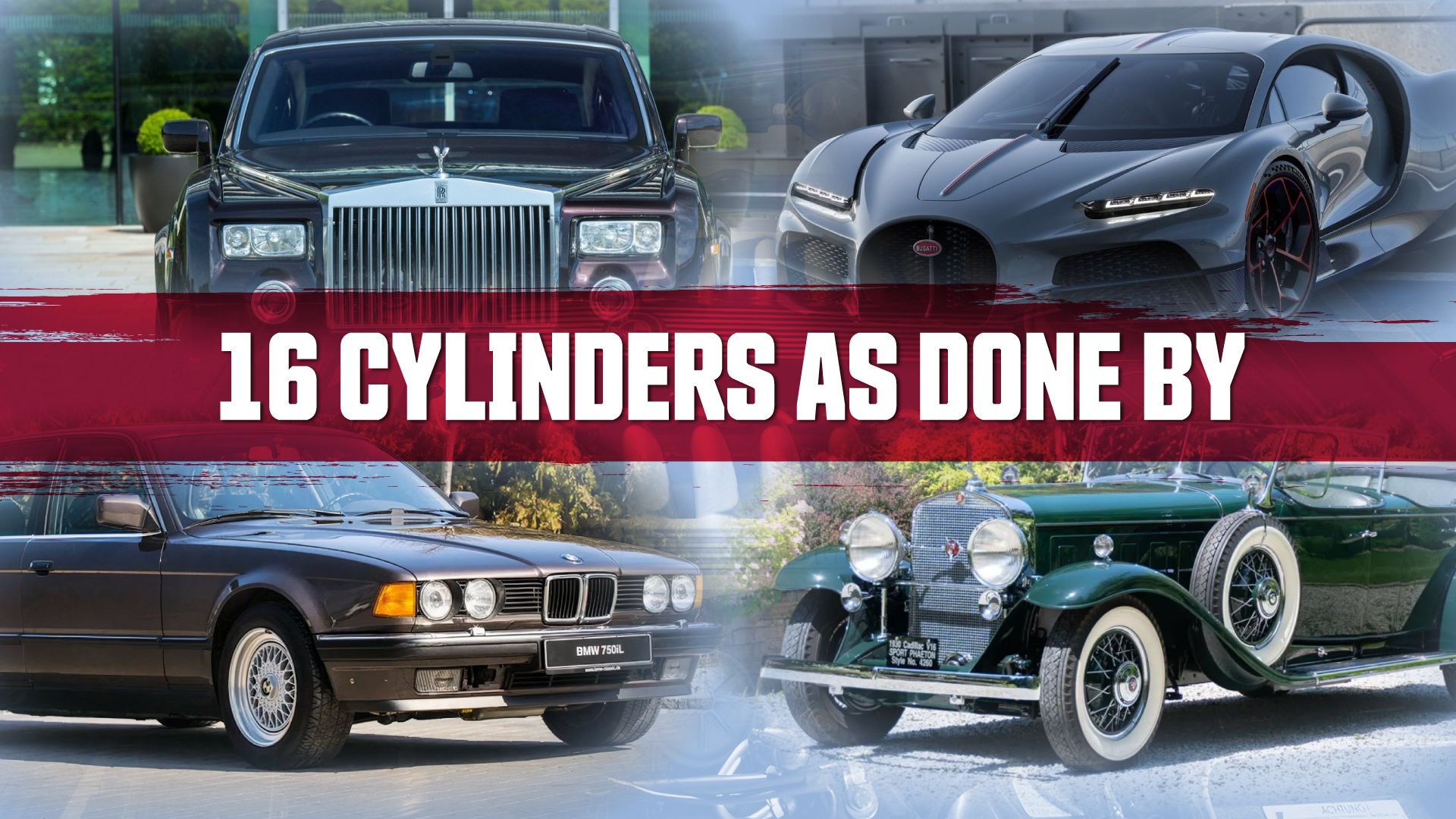
The V16 Engine By Four Auto Giants

There are all sorts of engine layouts in the automotive world, some more common than others. While you’re likely to have driven a car with an inline-four or a V8 at some point, a car powered by something like a V12 or an inline five is a far rarer beast. Other layouts, like the straight-eight, were more common in the distant past but were eventually phased out over the decades.
Cadillac
- Founded
-
1902
- Founder
-
Henry Leland
- Headquarters
-
Warren, Michigan
- Owned By
-
General Motors
- Current CEO
-
Johan de Nysschen
In this article we are focusing on one extremely rare type of engine: the V16, which, as suggested by its name, arranges two banks of eight cylinders in a V-shaped layout. Only a handful of cars across history have sported one of these engines under their hood. Let’s take a look at its history through the lens of four major automakers who, at some point across the decades, have used a V16: Cadillac, BMW, Rolls-Royce, and Bugatti.
This feature focuses on four brands that have used the V16 engine over the decades, whether in a concept car or a production model.
The Early Days: Cadillac
Like many elements of engineering innovation that later ended up being used in the automotive world, the V16 engine started out in the world of aircraft: the first vehicle powered by a V16 engine was the Antoinette VII, an experimental plane built in France in 1909. 21 years later, the first V16-powered car arrived, on the other side of the Atlantic: the Cadillac V-16. This model was introduced in 1930, and remained in production for ten years until World War II began to affect sales, leading to its discontinuation. The V-16’s first generation lasted until 1937, while the second was introduced in 1938 and lasted until the model’s demise.

Related
Jay Leno Drives Cadillac’s V16-Powered Bugatti Chiron
“This is the car that really put Cadillac on the map.”
The engine that powered the V-16 was initially built with a displacement of 7.4 liters; however, this was later reduced to 7.0 liters when the “Series 90” second-generation model arrived. This version was, however, more powerful than its predecessor; the first-gen Cadillac V16 produced 165 hp, while the second produced 185 hp. Interestingly, this would not be the last time Cadillac built a car with a V16 engine; the most recent example is a one-off concept called the Cadillac Sixteen, which was introduced in 2003 but never became a production model.
A Very Powerful Goldfish: BMW
|
BMW “Goldfisch” Specs |
|
|---|---|
|
Engine |
6.7L NA V16 |
|
Horsepower |
408 hp |
|
Torque |
461 lb-ft |
|
0-60 mph |
6 seconds |
|
Top Speed |
175 mph |
Another automaker that briefly dabbled in the world of V16 engines was BMW; although the company never made a production model with this engine, there was one interesting concept car that sported one under the hood. During the lifespan of the 7 Series’ second E32 generation, between 1986 and 1994, one car was used as a test mule for a V16 engine configuration: this unique creation went by several names, such as the SevenSeven and the 767, but the nickname that eventually stuck with car enthusiasts was the “Goldfisch”.
The brainchild of Dr. Karlheinz Lange, the “Goldfisch” was powered by a naturally aspirated 6.7-liter V16 curated by engineer Adolf Fischer; this engine was based on an existing BMW V12, the M70. It was, however, much larger (the M70’s displacement being “only” 5.0 liters) and 12 inches longer, thanks to its four additional cylinders.

Related
The Only BMW Powered By A V16 Engine
Back in the ’80s, when BMW didn’t keep its engineers on a short leash, a V16-powered 7 Series BMW was born.
A revised cooling system and new fiberglass air intakes completed the picture, keeping the Goldfisch’s engine cool; the end result was a car more powerful than anything else in the 7 Series range of the time, with a power output of 408 hp. The BMW V16 engine was also briefly trialed in the Bentley Mulsanne; however, this experiment never resulted in a production vehicle.
The Goldfisch was tested extensively to establish its performance capabilities, achieving a 0-60 time of six seconds and a top speed of 175 mph. BMW, however, ultimately decided not to turn the project into a production model, wanting to avoid starting an engine arms race among manufacturers. The car remained a one-off and was eventually relocated to the BMW Classic Collection in Munich, where it still resides today.
Johnny English Reborn: Rolls-Royce
This British ultra-luxury marque never built a production model powered by a V16; however, there were a handful of one-off cars in its history equipped with this engine layout. The 100 EX and 101 EX concept cars (EX stood for “experimental models”), were built in 2004 and 2006 respectively; both were showcased at the Geneva Motor Show. The 100 EX gets the first half of its name from the occasion it was built to celebrate: 2004 was the 100th anniversary of the meeting between businessman Charles Rolls and engineer Sir Henry Royce, which led to the formation of the company.
Two years later, a follow-up concept car arrived: the 101 EX, a grand tourer coupe which shared its chassis with the 2003 Phantom; however, the 101 EX was 9.5 inches shorter than the Phantom. Both the 100 EX and the 101 EX were powered by a 9.0-liter V16 engine, paired with a six-speed automatic transmission. A few years before these two concept cars were built, Rolls-Royce had briefly toyed with the idea of installing a V16 in the Phantom VII, which was launched in 2003. Four V16-powered prototypes were built; however, the V16 was eventually replaced by a V12 for the production model.

Related
The Rolls-Royce Phantom VII Nearly Had A 9.0-liter V16 Engine
The V16 is a rarity in the automotive world, though one very nearly appeared in the Rolls-Royce Phantom.
In 2011, the movie Johnny English Reborn (the second installment in the Johnny English series) was released, featuring yet another Rolls-Royce powered by a V16 engine: this was a one-off version of the Phantom, created specifically for the movie. Legend has it that British actor Rowan Atkinson, who stars in the movie as the titular protagonist and is a dedicated car enthusiast, visited the Rolls-Royce factory while the car was being prepared. Being aware of the existence of a V16 engine produced by the firm, he then asked the company to fit it in the Phantom, and the rest is history.
A Work Of Art: Bugatti
|
Bugatti Tourbillon Specs |
|
|---|---|
|
Engine |
8.3L NA V16 + 3 electric motors |
|
Horsepower |
1,775 hp (combined) | 986 (ICE only) |
|
Torque |
1,464 lb-ft (combined) |
|
0-60 mph |
2.0 seconds |
|
Top Speed |
276 mph (limited) |
Last of all, we have one model that did get a production run, however limited and highly exclusive: the Bugatti Tourbillon, a work of art on wheels introduced to the world through an online live stream in the summer of 2024. The Tourbillon stands out in Bugatti’s lineup for one major reason: it is the first model produced by the company in over two decades to not be powered by a W16 engine, opting instead for an 8.3-liter, naturally aspirated V16. The Tourbillon’s engine is paired with three electric motors as part of a hybrid powertrain, which produces a combined power output of an eye-watering 1,775 hp. The engine itself produces 986 hp on its own.

Related
Every Hypercar Gunning For The 300-MPH Crown
And before you ask, no, Bugatti didn’t do it with a production-spec Chiron.
While Bugatti is known for its engine-building expertise, the unit powering the Tourbillon was not produced by the French automaker itself, but rather developed by British engineering firm Cosworth. Bugatti needed something to replace the epic quad-turbo W16 that had powered legendary models like the Veyron and the Chiron; it turned to Cosworth’s expertise to create something that could deliver not just similar levels of power, but an emotional driving experience. The result was the first production V16 engine in 84 years. The brand also published a mini-documentary on YouTube called “A 16-Cylinder Heart”, which explains the design process that went into the new V16, and breaks it down to capture every detail.
The engine is not the only impressive part of the Tourbillon: its suspension was developed in collaboration with Divergent Technologies, the parent company of Czinger (the American manufacturer best known for the 21C hypercar. The Tourbillon’s chassis is a carbon composite monocoque, which was built using 3D printing technology.
Sources: Cadillac, BMW, Rolls-Royce, Bugatti