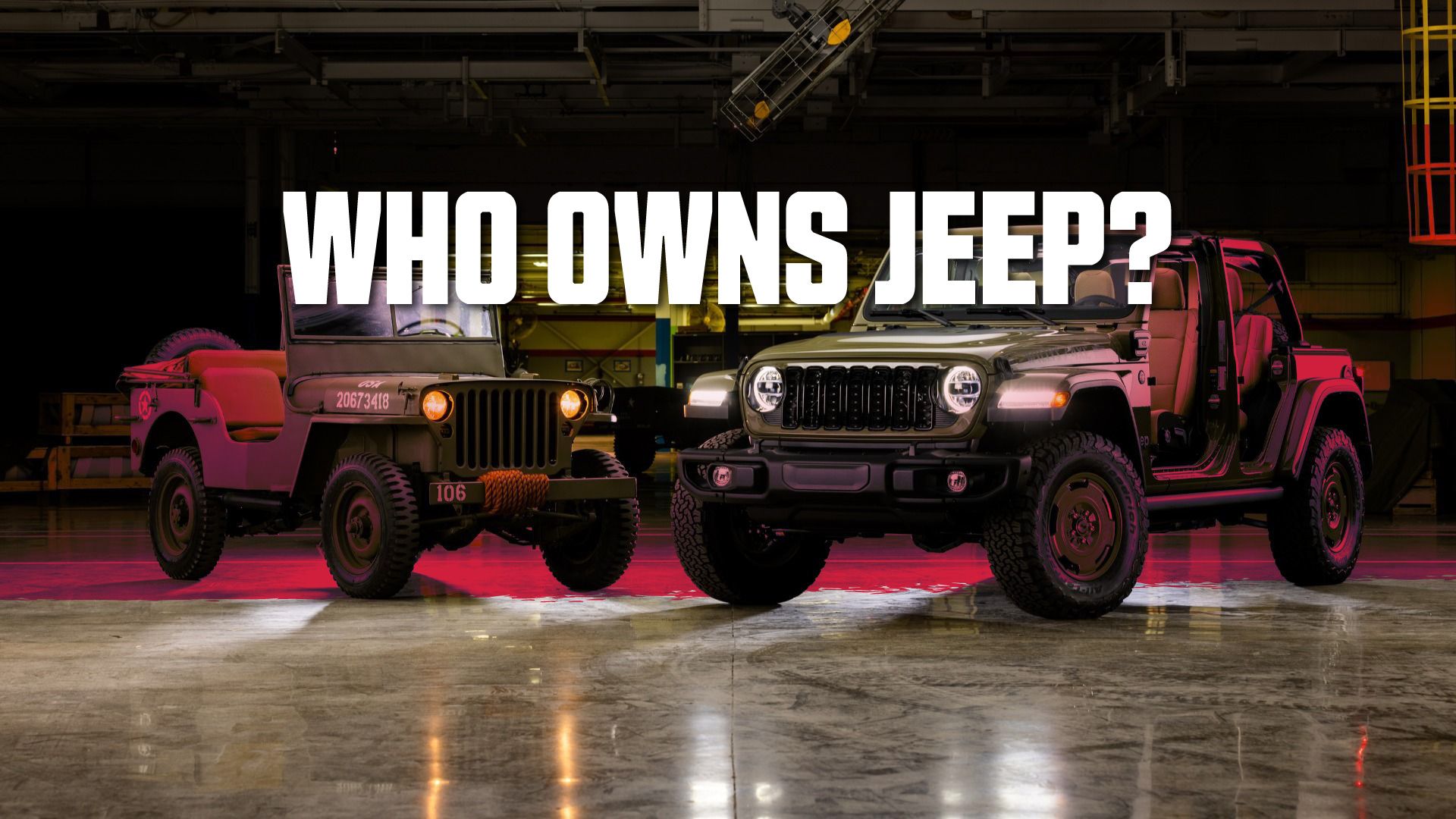
A History Of Its Ownership Post WW2

Jeep’s history is an endearing one, ranging from the WWII-inspired 1940s WIllys, all the way through to the off-road champion that is the current Jeep Wrangler. It is a captivating story born out of war and one that is steeped in passion. However, there is a lot to unpack behind the seven-slot grille. It’s a history marked by questions like ‘who owns Jeep?’, butting heads at boardroom level, and sales and marketing strategies aimed at dominating the global car scene – albeit with varying degrees of success.
Jeep
- Founded
-
1943
- Founder
-
Willys-Overland Motors
- Headquarters
-
Toledo, Ohio
- Owned By
-
Stellantis
- Current CEO
-
Antonio Filosa
Despite the struggles and challenges that clouded its many owners, Jeep managed to remain relevant in a sea of constant change. And throughout its eight decades of existence, it still stands tall as a proudly American carmaker with global ambitions. Even as changes are rung in, it remains true to its off-road roots.
This article explores Jeep’s ownership history post World War II. All information was gathered from the official Stellantis/Jeep websites, as well as credible news sources.
The Immediate History Behind Jeep Today
It is perhaps a bit unorthodox to begin Jeep’s ownership history with its most recent owner, but this American automaker’s current endeavors are just as important as the road it has traveled these last 80 years. And the current story has its roots in 2009, following the global financial crisis in 2008. In ‘09, Chrysler, Jeep’s primary owner at the time, filed for bankruptcy amidst financial losses and the devastating impact the crisis was having on the brand. For many automakers, it was one of the toughest times in their history, and some had to close their doors. Permanently.
Jeep was unfortunately just collateral of this crisis because Chrysler’s demise would, in all likelihood, mean its demise, too. Luckily, a helping hand was extended from across the pond as Fiat, which was led by the late Sergio Marchionne at the time, saw value in the ailing American brand. However, it wasn’t so much about Chrysler, but rather Jeep and the untapped potential for it to become a truly global player.
Fiat began its tenure with Chrysler with a 20% stake in 2009, and by 2014, the two automotive giants merged to form Fiat Chrysler Automobiles (FCA). Again, Jeep, at the mercy of its owners, was on the receiving end of renewed promises. Only this time, they held up. There were new investments, new platforms, and new goals and targets to turn Jeep’s fortunes around. Suddenly, under Marchionne’s stewardship, Jeep became a brand worth keeping an eye on as products such as the compact Renegade, midsize Compass, and more luxurious Grand Cherokee began rolling off production lines.
Jeep’s Production Facilities: USA & Abroad
As part of the FCA shakeup, the Jeep plants for the new generation of vehicles were not just located in the USA as before, but also in other parts of the world. So if you were wondering where Jeeps are made, these are the production facilities:
USA:
- Toledo Assembly Complex in Toledo, Ohio
- Jefferson North Assembly Plant in Detroit, Michigan
- Mack Avenue Assembly Plant in Detroit, MI
- Warren Truck Assembly Plant in Warren, MI
- Belvidere Assembly Plant in Belvidere, Illinois
International:
- Brampton Assembly in Ontario, Canada
- Toluca Car Assembly in Mexico
- Goiana Assembly Compex in Pernambuco, Brazil
- Cordoba Assembly Plant in Santa Isabel, Argentina
- Melfi Assembly Plant in Southern Italy
- GAC FCA Assembly Pants in China
- Ranjangaon Joint Venture Plant in Pune, India
Enter 2021 & Stellantis
2021 brought with it another major shift in Jeep’s history as FCA merged with the PSA Group to form Stellantis. Suddenly, Jeep was a part of the world’s fourth-largest automaker based on volume, and it benefited from new-age synergies and an accelerated adoption of electrification. Jeep now has the Compass 4xe, Wrangler 4xe, and Grand Cherokee 4xe in its portfolio, which are plug-in hybrid models powered by a 2.0-liter turbocharged gas engine paired with an electric battery for a total system output of 375 horsepower and 470 lb-feet of torque.
The Wagoneer S is an all-electric Jeep (yes, an EV Jeep), with more EVs, like the Recon, on the horizon. Under the watchful eye of new parent company Stellantis, who still makes Jeep vehicles, the brand aims to introduce four new EVs to the USA in 2025, with 50% of annual North American sales to be 50% EVs.

Related
What Every Brand Under The Stellantis Umbrella Is Supposed To Do
Since the merger of FiatChrysler with France’s Peugeot-led PSA group, a new conglomerate of brands have been established. We’ll dissect them for you.
Jeep’s New Life Post World War II (1945–1970)
Okay, now that Jeep’s current status is taken care of, let’s dial it (way) back and track its ownership since 1945.
When World War II ended, Willys-Overland Motors found itself in somewhat of a pickle. For years, it produced the Willys MB – the original Jeep – but life post-war could either be deemed a mess or seen as an opportunity. Willys took the latter approach and grabbed the chance to make the MB commercially available. In July of 1945, the CJ-2A (Civilian Jeep) went on sale, setting off a rich and storied history for the ‘CJ’ series. The CJ-3A and CJ-3B followed in 1949 and 1953, respectively, and the Willys Wagon in 1946, the Willys Truck in 1947, and the Jeepster in 1948.
Come 1953, Kaiser Motors acquired Willys-Overland, which was followed by a rebranding to Kaiser-Jeep Corporation in 1963. The CJ-5 was the first vehicle to come from the new ownership in 1955, but the biggest stamp came in 1962 when the Jeep Wagoneer made landfall. It was, in every sense of the word, the first 4×4 SUV and came equipped with an independent front suspension, an automatic transmission, and luxury trimmings. Kaiser also introduced the Gladiator pickup – the forebear of the Gladiator we have on our roads today.

Related
The First Civilian Jeeps Are Surprisingly Affordable
Whatever you think you’d spend on a 1946 Civilian Jeep, it’s less than that.
The Pawn In Taking On The Big Three (1970–1987)
By the end of the 1960s, Jeep had caught just about every investor’s eye, including American Motors Corporation (AMC), which acquired it from Kaiser-Jeep in 1970 for about $75 million. It was a big-boy move by AMC; this for a company nowhere near the size, strength, or production capacity of the big three (Ford, Chrysler, General Motors). Still, AMC came to play, as it recognized the potential in Jeep’s unique identity. The CJ-7 was introduced in 1976 and was especially well-liked by off-roaders and those keen on the open road. The C7 was a masterstroke because it was a big step in AMC positioning the brand as a leisure and lifestyle offering.
AMC played it smart by also evolving the Wagoneer, and it launched the Grand Wagoneer in 1984 as an even plusher version of the model. Other notable products that came from the AMC tenure were the Cherokee (SJ) in 1974 and the Cherokee (XJ) in 1984. However, the XJ Cherokee, with its two doors, was lighter and nimbler than any Jeep before it, and it struck a chord with buyers like never before.
Despite the product offensives, AMC’s finances were not looking too great, leading to Renault stepping in to relieve some of the financial burden in 1979. With the French company’s assistance and the XJ Cherokee selling in strong numbers, AMC avoided financial ruin in the 1980s and managed to do just enough to convince Chrysler (in 1987) to purchase its entire operations.
Chrysler’s purchase was with the intent of gaining control of Jeep.
Jeep, Chrysler, And Its German Affiliation (1987–2007)
When Chrysler bought AMC in 1987, it was to the tune of just over $1.5 billion. And as we already mentioned, it was motivated by the allure of owning the Jeep brand. By this time, Jeep was established not just as a capable off-roading marque, but also as a name that had massive potential to become an even bigger commercial success. One of the first – and perhaps biggest – changes was dropping the CJ and replacing it with the Wrangler in 1987. It was a better all-round vehicle, so the move made sense.
The Cherokee remained in play, but was joined by the Grand Cherokee in 1992. And how was it introduced? By being driven through a glass window at the Detroit Auto Show! Talk about making a bold statement. By 1998, Jeep was the core of Chrysler’s operations, and it caught the attention of German automaker Daimler-Benz, which brokered a $38-billion deal with Chrysler marketed as a “merger of equals”. Sadly, it wasn’t the dream partnership Chrysler envisioned and Jeep, like the other brands in the Chrysler stable, was forced to operate under a multinational structure.
Even though the two controlling companies butted heads in the boardroom, Jeep kept its side of things clean and the staff put their heads down. Sadly, it wasn’t enough, and by 2007, Daimler had sold its interests in Chrysler to Cerberus Capital Management. Though the latter paid $7.4 bn for 80.1%, Daimler settled Chrysler’s debt to help sweeten the deal. To better understand the situation, Garel Rhys, professor of motor industry economics at Cardiff University in Wales, told NBC News at the time of the sale:
“Daimler actually paid a dowry to unload Chrysler – it took a $700 million hit on its balance sheet. That speaks volumes about the future they saw for Chrysler under their stewardship.”
– Garel Rhys, Professor of Motor Industry Economics, Cardiff University
Of course, what followed was the 2008 global financial crisis, Fiat’s takeover of Chrysler in 2009, the Fiat-Chrysler merger in 2014, and the advent of Stellantis in 2021.

Related
Jeep CJ-7 Overview: Design, Specs, And An Ultra-Rare Special Edition
Explore the Jeep CJ-7’s rugged history, from iconic design and performance to rare special editions like the legendary Jamboree Commemorative Edition.
Is Jeep Keeping Its Head Above Water?
All the while, Jeep managed to keep its head above water. For 80 years, since 1945, the American car brand fought tooth and nail for its survival. Yes, its custodians over the years did all they could to turn the acquisition into a profitable affair, but success never really followed. Whether biting off too much or not having enough financial resources, something always hindered Jeep.
Under Stellantis, the new Jeep owner, the marque is looking strong, with Q1 2025’s sales highlighting the following:
- Jeep U.S. retail sales increased 2% year over year
- Jeep Compass posted a 15% total U.S. sales increase in Q1 YoY
- Jeep Grand Cherokee posted a 14% retail gain YoY
- Total 4xe (Wrangler 4xe, Grand Cherokee 4xe) total U.S. sales increased 150% month over month (March 2025 over February 2025)
Other Q1 successes:
|
Jeep sales: March Over February 2025 |
|
|---|---|
|
Model |
Month Over Month |
|
Wrangler |
69% |
|
Wrangler 4xe |
229% |
|
Grand Cherokee |
31% |
|
Grand Cherokee 4xe |
42% |
|
Gladiator |
8% |
|
Compass |
24% |
|
Wagoneer |
44% |
|
Wagoneer S |
21% |
Sources: Jeep, Stellantis North America