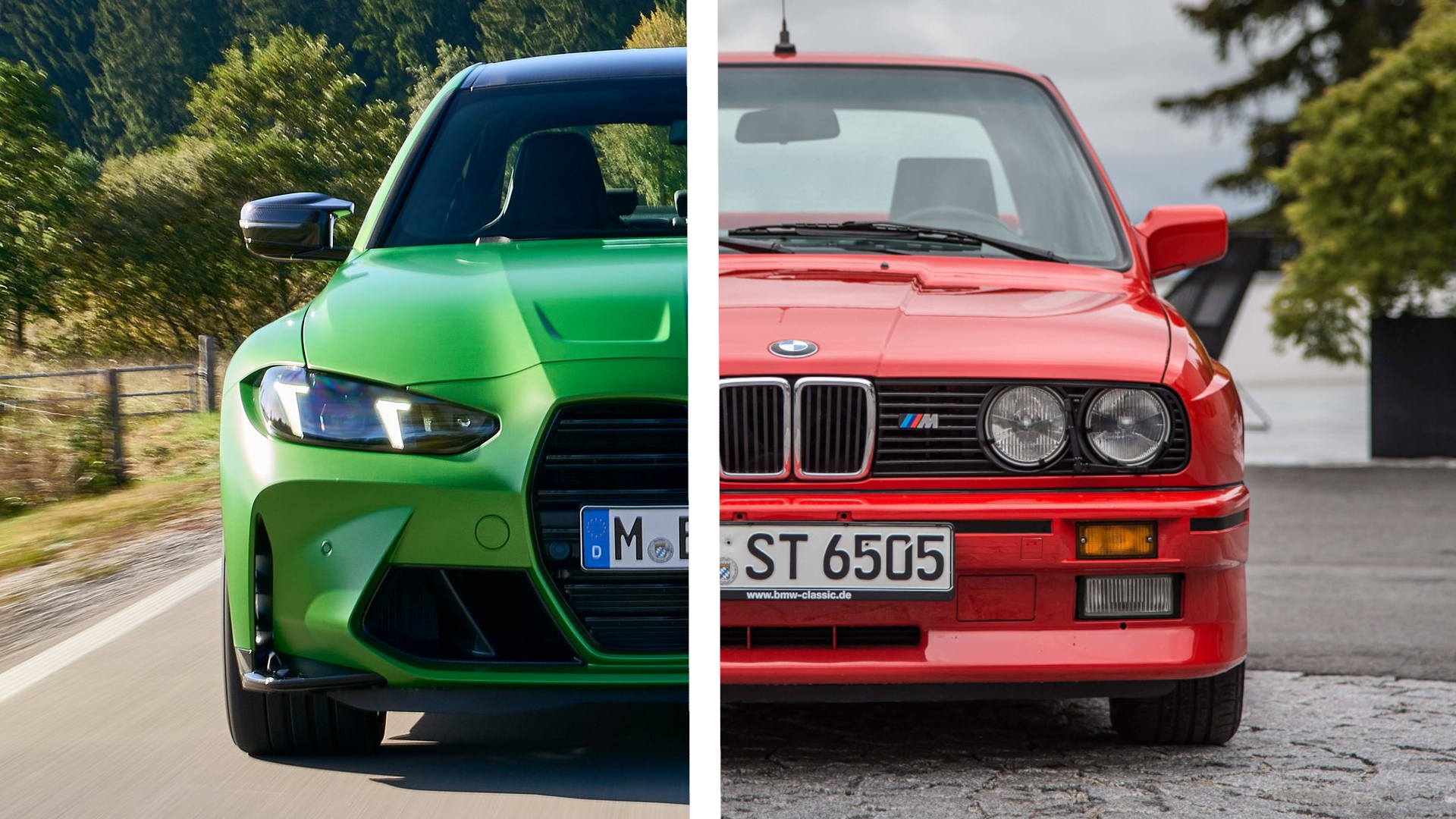
Each Generation BMW M3 Ranked By Acceleration And Quarter-Mile Times

The M3 nameplate is one of the longest-standing in BMW’s history and is one of the most prolific high-performance model ranges to come from the Bavarian automaker’s factories. Six iterations of the M3 badge exist, each introducing a new level of performance and leveraging the firm’s knowledge gained from its exploits in motorsports.
Related
The First BMW M Car Wasn’t The M1
If you thought you knew, chances are you didn’t – this is actually the first true M car.
The founding member of the M3 lineage was born out of motorsports and has since become an iconic brand within the automotive world and one of BMW’s most sought-after offerings across every generation. Here’s each generation ranked by their 0-60 mph acceleration figures and 1/4-mile times.
Each generation is ranked based on 0-60 mph acceleration and 1/4-mile times, arranged from slowest to quickest.
6 BMW E30 M3
0-60 mph: 6.1-6.7 seconds; quarter mile: 15.2-16 seconds
The M3 lineage began in 1986 with the introduction of the BMW E30 M3, the only model in the model line’s history to be a homologation vehicle. BMW needed to produce and sell at least 5,000 road-legal examples of its racing car within a year for the vehicle to be homologated for racing, which in the E30 M3’s case was to compete in the Group A racing series. BMW engineers gave the E30 M3 the best components available in the BMW racing parts bin.
|
Engine |
2.3-2.5L naturally aspirated I4 |
|---|---|
|
Horsepower |
192-235 hp |
|
Torque |
177-181 lb-ft |
|
Top speed |
146-154 mph |
|
Curb weight |
2,568-2,998 lbs |
One of the E30 M3’s most enticing features was the athletic four-cylinder engine, which BMW designated the “S14.” The level of power it commanded was a bragging point of BMW’s E30 M3’s four-cylinder engine. The S14 engine was based on the two-liter four-cylinder used in the 3 Series at the time, which for the E30 M3 was heavily revised. After the engineers at BMW finished developing the S14 engine, it was renowned for being lightweight, durable, and having a high specific torque output.

Related
Audi vs. BMW: Which Luxury German Car Is Right For You?
We compare two of Germany’s most prominent automakers.
The displacement had increased from 2.0 to 2.3 liters and featured a new four-valve cylinder head, a piece of tech already employed in the BMW M1 supercar’s M88/3 inline six-cylinder engine, of which the S14 was two-thirds. The E30 M3’s performance was rapid for the era. The power-to-weight ratio of the original was 13.5 lbs/hp, and aside from an impressive sprint time, it would muster nearly 200 hp without the regulated catalytic converter. Five years after its debut, the BMW E30 Evolution would debut with a 220 hp 2.5-liter four-cylinder, which the E30 M3 Sport Evolution would soon one-up with 238 hp, of which only 600 examples were made.
5 E36 M3
0-60 mph: 5.4-6 seconds; quarter mile: 13.8-13.9 seconds
The follow-up to the BMW E30 M3 would debut in 1992, designated as the BMW E36 M3, the same year that BMW would secure a victory at the 24 Hours of Nürburgring and Spa 24 Hours. BMW’s new M3 would have big shoes to fill, but it would prove to be an adequate replacement even though initial impressions were that it was more reserved than its predecessor.
Instead of the S14 four-cylinder engine, the E36 M3 utilized a new inline six-cylinder engine, the S50B30. One of the most significant innovations introduced to BMW’s models was the VANOS system, a variable camshaft adjustment system that first appeared in the E36 M3. This new system improved engine optimization, constantly adjusting the camshafts to ensure maximum torque was available at partial or under full load. 286 hp was extracted from the 3.0-liter power plant, meaning it had a higher hp per cubic capacity than many small-series Italian manufacturers at the start of the 90s. US models had a low-output 240-hp engine.
|
Engine |
3.0-3.2L naturally aspirated I6 |
|---|---|
|
Horsepower |
286-321 hp |
|
Torque |
236-258 lb-ft |
|
Top speed |
155 mph |
|
Curb weight |
2,866-3,219 lbs |
In 1995, BMW introduced an update for the E36 M3. The changes to the two-door sports car ranged from visual changes like turn signals to a new kidney grille design. Still, most of the changes brought to the 1995 model were introduced to the mechanical underpinnings. One of the most notable changes included revising the S50B30 engine, increasing displacement to 3.2 liters, and creating the S50B32, which harnessed 321 hp and was paired with a new 6-speed manual transmission, allowing it to slash its 0-60 mph sprint from 6 seconds to 5.5 seconds. Famously and to the dismay of many US-bound M3 enthusiasts, BMW never brought the full-fat E36 M3 to the US, infamously underpowered compared to its European counterparts, retaining the 3.0’s 240 hp but gaining torque.

Add CarBuzz to your Google News feed.
4 E46 M3
0-60 mph: 4.7-4.9 seconds; quarter-mile: 13-13.5 seconds
BMW enthusiasts would have to wait until 2000 for the new entry in the M3 lineage, the E46. This model was a quintessential sports car, characterized by its reasonably low weight, eyebrow-raising engine soundtrack, and its undeniable dynamism. BMW had abandoned the boxy design of the first two M3 models, and instead, the E46 M3 was characterized by a shapely frame that stood out through elements like the front apron, bespoke side skirts, and wide fenders.
The source of the E46 M3’s grunt was the 3.2-liter S54B32 engine, which was an almost entirely new creation from BMW and was the pioneer of the Bavarian automaker’s high-rev concept, which was a philosophy that dictated the BMW’s engine should be high-revving and naturally aspirated. 343 horsepower was drawn from this rev-happy engine, now featuring double-Vanos variable valve timing. Two six-speed transmissions were offered: a traditional and sequential manual known as the SMG. Drivers had an 8,000 rpm redline to explore.
|
Engine |
3.2-liter naturally aspirated I6 |
|---|---|
|
Horsepower |
338-355 hp |
|
Torque |
269-272 lb-ft |
|
Top speed |
155 mph |
|
Curb weight |
3,054-3,241 lbs |
BMW’s E46 M3 was a highly capable sports car, but that was far from the model’s pinnacle. The zenith of the E46 M3 was the CSL derivative, a lightweight and more powerful derivative that could lap the Nürburgring in less than eight minutes and compete with cars with much more power.
Side note:
A few E46 M3 GTR models with the E90 M3’s 4.0L V8 engine were built for homologation, but never materialized when the homologation rules changed; subsequently, the project was stopped. The seven race cars were scrapped, but the three street-legal ones are now owned by BMW AG. This engine was also shown in the prototype 2002 M3 CSL.
3 E92 M3
0-60 mph: 4.4-4.8 seconds; quarter-mile: 12.4-13.4 seconds
In the 2001 American Le Mans Series season, specifically the GT class, BMW introduced an extremely limited series of E46 road cars fitted with 4.0-liter V8 engines to enter the M3 GTR race car. This marked a new chapter for BMW, as the following M3 would be the only production series model in the M3 lineup to feature a V8 engine, the BMW E90 M3.
|
Engine |
4.0-4.4L naturally aspirated V8 |
|---|---|
|
Horsepower |
414-444 hp |
|
Torque |
295-324 lb-ft |
|
Top speed |
155-174 mph |
|
Curb weight |
3,370-3,504 lbs |
BMW introduced the V8-powered E9X generation of the M3 in 2007. It was offered in coupe and sedan configurations. The E92 M3 coupe had bigger dimensions than the previous models, being wider and longer. While it shared some similarities with the standard 3 series, BMW’s engineers had made extensive changes to its chassis and styling. The 4.0-liter V8 engine that appeared in that limited-run series years before had returned, this time called the S65B40, which had more displacement, more cylinders, and more power.

Related
BMW M Cars That Never Wore An M Badge
Not every great BMW needs an M badge.
The eight-cylinder may have bucked the tradition of six-cylinder engines established by its predecessors; it became an instant favorite with the consumer base for its visceral soundtrack and was lighter than those previous engines. It also used double Vanos, individual throttle bodies, various engine control systems, low weight, and high-revving characteristics, making it clear that BMW engineers took inspiration from the BMW Sauber Formula One team’s V8. BMW also introduced its M dual-clutch transmission with the Drivelogic system, resulting in quicker shifts and significantly enhancing the E9X M3’s overall performance. The ultimate E90 M3 was the GTS with 444 hp from a bigger 4.4L engine, and weighed 300 lbs less.

Related
A Hard Look At Every BMW M3 Generation And The Traits That Make Them Special
If you were to create a single M3 with the best traits from every generation that’s ever existed, what would it look like?
2 F80 M3
0-60 mph: 3.9 seconds; quarter-mile: 12.1 seconds
Seven years after the BMW E90 and E92 M3 debuted, BMW ditched the naturally aspirated ethos in favor of turbocharging. The F80 M3 would not only serve as a sort of return to form, reverting to an inline six-cylinder engine, but it would also become a sedan, with the M4 badge now attached to the coupe. Both models utilized the strength of the 3.0-liter twin-turbocharged S55B30 six-cylinder engine that offered peak power at high rpm and impressive torque from 1,850 rpm.
|
Engine |
3.0-liter twin-turbocharged I6 |
|---|---|
|
Horsepower |
425-453 hp |
|
Torque |
406-443 lb-ft |
|
Top speed |
155-174 mph |
|
Curb weight |
3,540-3,660 lbs |
The combination of direct injection and turbocharging was referred to as M TwinPower technology, which employed mono-scroll turbochargers and other features, such as the new Valvetronic variable valve-control system alongside the double Vanos variable valve timing. The engine also relied on a specially designed crankcase and forged crankshaft that could accommodate higher cylinder pressures and improve response. The F80 M3 was a weapon that allowed the M3 moniker to continue reigning in the sports car segment. The ultimate evolution of the S55 engine would be reserved for the two-door M4 GTS and DTM Champion Edition, where it developed 493 hp.

Related
The 10 Most Powerful Production Cars Ever Built By BMW M
BMW’s top-of-the-line brand of vehicles reaches incredible, powerful heights
1 G80 M3
0-60 mph: 3.2-3.4 seconds; quarter-mile: 10.9-11 seconds
Divisive styling was one of the most hotly debated topics of the sixth-generation BMW M3, but its performance was undeniable. The G80 M3 would debut an all-wheel-drive derivative leveraging the firm’s xDrive technology, a first for the M3 lineup. With power being sent to all four corners, the new S58 engine can generate as much as 543 hp in the M4 CSL and M3 CS xDrive and sprint to 62 mph in as little as 3.2 seconds.
|
Engine |
3.0-liter twin-turbocharged I6 |
|---|---|
|
Horsepower |
473-543 hp |
|
Torque |
406-479 lb-ft |
|
Top speed |
155-188 mph |
|
Curb weight |
3,890-3,990 lbs |
BMW’s TwinPower turbocharger technology has been retained in the new generation, still consisting of two mono-scroll turbochargers, high-precision direct injection, and fully variable valve control. Not only has the powerplant evolved from the fifth to the sixth generation, but the latest model also employs an ZF-sourced eight-speed Steptronic transmission, alongside the BMW xDrive system we mentioned, to propel the heaviest M3 in the nameplate’s history quicker than any model that has come before. The CS badge would be revived in 2023, characterized by more power, greater dynamism, and a lower curb weight by way of a handful of carbon fiber parts.