How BMW’s N54 and N63 Engines Paved the Way for Modern Turbocharging

Car enthusiasts of a certain age may feel particularly dated by the following fact: the first two powerplants to mark BMW’s mass-market adoption of twin-turbo engines are about to start turning 20. Launching in the mid-2000s, BMW’s first mainstream twin-turbo engines were inline-six or V8 options that arrived in an era when automakers were building some of the best naturally-aspirated engines they’d ever made. Initially, you’d find BMW’s latest turbo engines–their first in over 20 years– in models like the 3-Series and X6. Soon, they’d be phased in to replace previous-generation free-breathing engines. As this phase-in continued at BMW, additional automakers found the limits of naturally-aspirated engines to be a constraint, and turbocharging would begin to explode into all segments of the market.

- Base Trim Engine
-
3.0L Inline-6 Gas
- Base Trim Transmission
-
6-Speed Automatic
- Base Trim Drivetrain
-
All-Wheel Drive
By being among the first on the scene with some of the most advanced tech of the day, BMW moved loads of twin-turbo cars and SUVs while laying the genetic foundations for the next 20-plus years of combustion engine development. Below, we’ll look back at those two formative engines and some of the cutting-edge hardware and design that helped them cement BMW’s position as a world leader in turbocharging.
For the feature below, we’re looking back at two engines that marked BMW’s mass-market shift to twin-turbo power across the model range. The N54 and N63 engines are featured. All technical data is sourced from manufacturer archives.
In 2006, BMW’S First Turbo Engine in 20 Years Ignites An Incoming Trend
In 2006, when the N54 straight-six twin-turbo engine was first announced, BMW was highly regarded for decades of experience building mainstream and high-performance naturally-aspirated inline-six and V8 engines. The BMW M cars of the day featured some of the fastest-revving naturally-aspirated performance engines on the market, including a free-breathing V10 masterpiece with 500 horsepower in the era’s M5 and M6. Even the straight-six engine in the BMW 328i at the time had recently been updated with extra torque and extra horsepower, no turbocharging required.
According to one press release, BMW had shelved the idea of using gasoline turbo engines for some 20 years before bringing a new one to market because the engineers weren’t satisfied with the durability or throttle response they delivered. Times changed, and the big news in 2007 was the new BMW 335i. Replacing the 330i model from the previous year, the new N54 3-liter twin-turbo straight six was now on offer with horsepower and torque clocking in at 300 apiece. This was an engineering win for 3-Series shoppers of the day, since the new twin-turbo straight-six engine delivered 45 more horsepower and 80 more lb-ft of torque than its free-breathing predecessor, all with virtually no penalty to fuel consumption. It weighed just 62 pounds more than its non-turbo predecessor, if you’re wondering.
A year later, a highly-achieving twin-turbo V8 called the N63 was added to BMW’s portfolio, launching in the BMW X6 for 2008. This engine came complete with some incredible engineering firsts. Before long, this pair of twin-turbo engines became staples of BMW’s powertrain lineup, and would lay the genetic groundwork for the next two-plus-decades of combustion power.

Related
The 15 Best BMWs Of The Last 50 Years, According To CarBuzz
BMW has produced many Ultimate Driving Machines over the last half-century, and these are our favorites.
The N54
Awesomely, you could order your N64-powered 3-Series with a six-speed manual or optional 6-speed automatic with paddle shift. At launch, this was the most powerful BMW straight-six without an ‘M’ badge, and the first BMW gasoline turbo engine since the 1980s. Until this point, the BMW 745i Sedan (which debuted in 1981) and the iconic BMW 2002 Turbo (introduced at the 1973 Frankfurt auto show) were the only two standard-production, gasoline-powered BMWs to use turbo engines.
BMW says two key factors pushed them to give gasoline turbo technology another shot in the mid-2000s, two decades on.
The first was an opportunity to differentiate itself from competitors who were increasingly moving to larger and larger displacement engines to generate more power. That’s AMG, if you’re wondering. Notably, the new N54 was 150 pounds lighter than a comparably powerful naturally aspirated V8. Perfect: not only did this improve handling by removing the weight straight off of the front axle, but also improved fuel economy. This is literally BMW’s ‘Efficient Dynamics’ mantra in action, a 150-pound weight reduction from the front axle without sacrificing power is a very big win.
|
BMW N54 Engine Specifications (2007 BMW 335i) |
|||
|---|---|---|---|
|
Engine |
3-liter inline six-cylinder twin turbo |
||
|
Horsepower |
300 hp |
||
|
Torque |
300 lb-ft |
||
|
Drive |
RWD / AWD |
||
|
Transmission |
6-speed automatic / 6-speed manual |
||
|
0-60 |
5.5 sec |
||
The second factor had to do with timing, and the ability to transfer tech and expertise from BMW’s well-proven turbo diesel engines to gas-fired versions. This time, the new gas turbo engines would stick around.
On specifics, each of the small turbochargers on this straight-six engine worked with just three cylinders apiece. On the technical front, the big news was the adoption of piezo direct injection. Fuel was now delivered at extreme pressure with previously-impossible precision, with injector response times helping save 3% on fuel while reducing emissions by 20 percent. The fuel injection system now had superpowers.
This Was Some Groundbreaking Tech In Its Day
Further fuel savings and performance came from a new type of alternator that could de-couple from the engine when the driver applied the throttle. The result was an alternator that could recharge the battery without drawing power from the engine, again improving fuel efficiency and performance along the way. At the time, BMW explained how direct injection turbo engines like the N54 get the most energy out of their fuel in low-RPM situations where the engine is nearly lugging, and that the latest transmission programming allows the engine to more comfortably operate in that range. This makes it easier for drivers to save fuel. Ditto the electric water pump, which doesn’t turn on to circulate coolant until the engine has warmed up. This means the engine (and cabin) warm faster in cold climates, which improves emissions and comfort while saving fuel by avoiding a physical draw on the engine.
Your writer has spent many miles testing N54-powered BMWs during his career. A key memory was the arrival of the first 335i units to BMW’s Canadian headquarters, likely in the fall of 2006. These were some of the first units in the country, intended for media use. Apparently, the initial batch of engines loved to burn oil during break-in. If you were anywhere near the office at lunchtime, you’d see staff out driving the new 335is around, sometimes a dozen at a time, and typically with blue smoke trailing in their wake. Apparently, this was to add break-in miles to the media test-drive units so they wouldn’t burn oil on camera, which is bad for optics. When testing low-mileage copies of the initial N54 engines, I eventually learned to keep an extra jug of engine oil nearby.

Related
Only One Tri-Turbocharged Engine Was Ever Mass Produced
Some cars have one turbocharger. Many have two. Some performance cars have four. But three? Only one triple-turbo engine was mass produced. This is it
The N63
The N63 was the second powerplant that BMW would use to take twin-turbo to the mainstream. First bowing in the X6 before a wide-reaching rollout across various sedan and SUV models, this 4.4-liter twin-turbo V8 was the first of its kind in many regards.
Your writer once had the opportunity to attend an extended technical event on this engine family in 2007 when it was launched. Journalists were invited to the BMW training center for some hands-on seminars, interviews, and drives relating to the new N63, and more broadly, what BMW’s engineering department was cooking up at the time. At the event’s conclusion, an evening media reception was held in the training center with suits and beverages and music and snacks. Still, your curious writer had found himself in an empty classroom nearby, where a partially disassembled N63 sat on a stand, in front of a whiteboard, near some tool chests.
I still couldn’t quite get my head around the idea of the so-called ‘hot-V’ configuration, or ‘reverse flow’ twin-turbo as one of the engineers had called it. That engineer, whose name escapes me, spotted me standing in the empty classroom staring at the N63, walked up, and introduced himself as one of its creators. After explaining my difficulty in understanding the reverse-flow concept, he went to the tool chest on the wall, retrieved a few sockets and a driver, and removed the heat cover on top of the engine to reveal that the exhaust or ‘hot’ side of the engine was now on top, where most V8 engines kept their intake systems. Beneath the N63, where most V8s kept their exhaust hardware, were the engine’s intake manifolds.

Related
BMW’s ‘TwinPower’ Doesn’t Mean What You Think It Means
BMW’s marketing speak explained.
My eyes were the size of saucers, and so were my engineer pal’s.
“Brilliant, isn’t it?” he said with a watery-eyed pride.
World’s First Twin-Turbo Technology
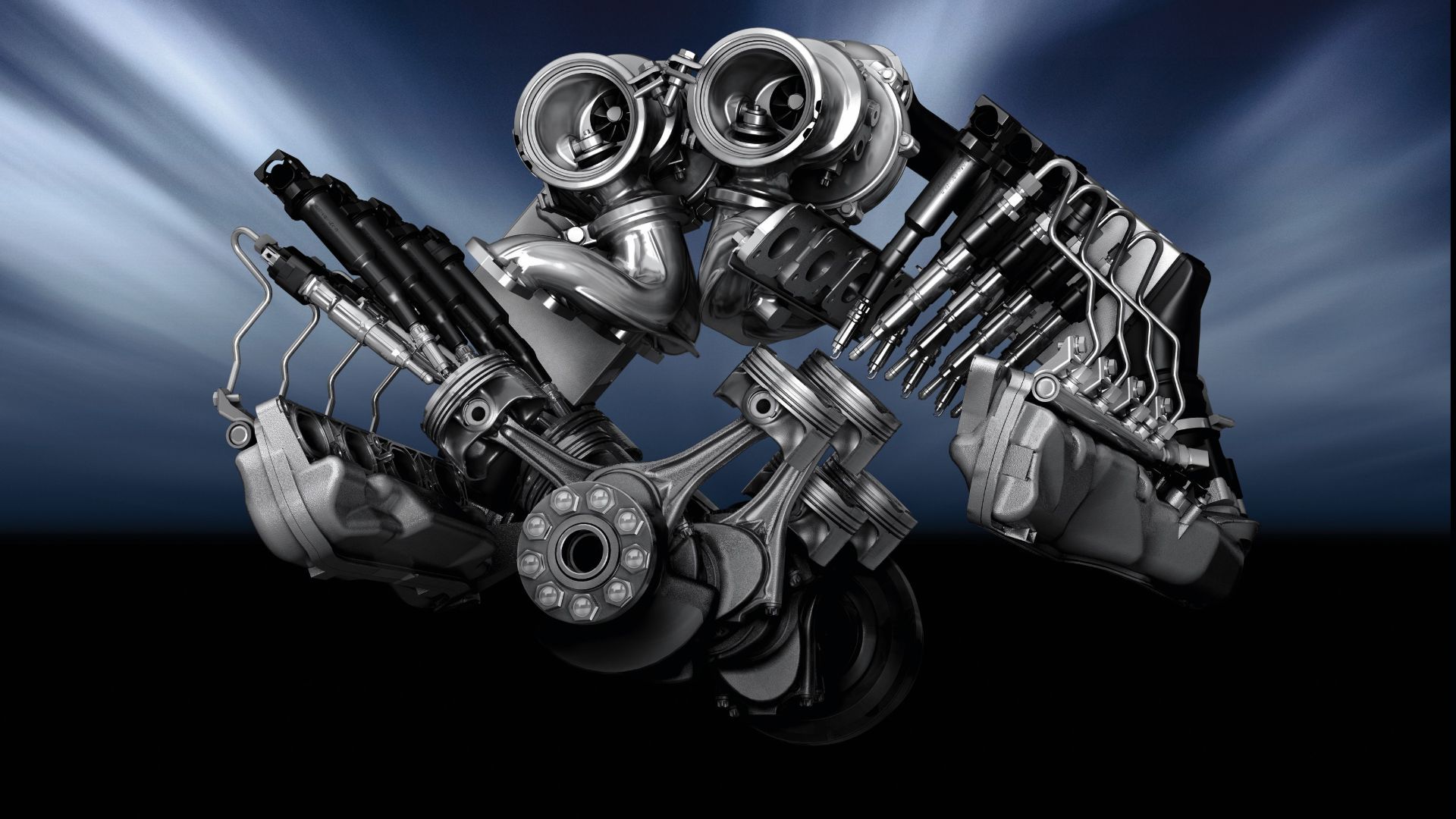
This was the world’s first V8 to contain the turbochargers and catalytic converters within the V of the engine’s cylinder banks, effectively reversing the flow of the engine and routing the spent exhaust gasses straight out of the compressors and down the backside of the engine, around the transmission.
This positions the turbochargers very closely to the combustion chambers, dramatically improving throttle response. The engine ran liquid-to-air intercooling (unlike the air-to-air setup of the N54), helping draw heat out of the compressed air charge before it entered the engine, but without the need to pressurize the plumbing associated with a conventional intercooler. The result was a V8 that operated with near-nil levels of turbo lag, and delivered pulling power on par with a much larger engine.
|
BMW N63 Engine Specifications (2008 BMW X6 xDrive50i) |
|||
|---|---|---|---|
|
Engine |
4.4-liter V8 gas twin-turbo |
||
|
Horsepower |
407 hp |
||
|
Torque |
442 lb-ft |
||
|
Drive |
AWD |
||
|
Transmission |
6-speed automatic |
||
|
0-60 |
5.4 sec |
||
“Our customers expect us to deliver them wins”, my engineer pal said. “This is a win because we’re improving everything: throttle response, fuel economy, emissions, even warm-up performance. It’s the sort of thing the customer expects”.
I’ve carried that memory with me for the 19 years since. To this day, I hold it as a reminder of the passion and intellect required to deliver a great driving experience, and one of the reasons shoppers spend the big bucks on their favorite BMWs.
Sources: BMW