One Of The Best Roadsters Ever Made Was Ruined By Its Gearbox

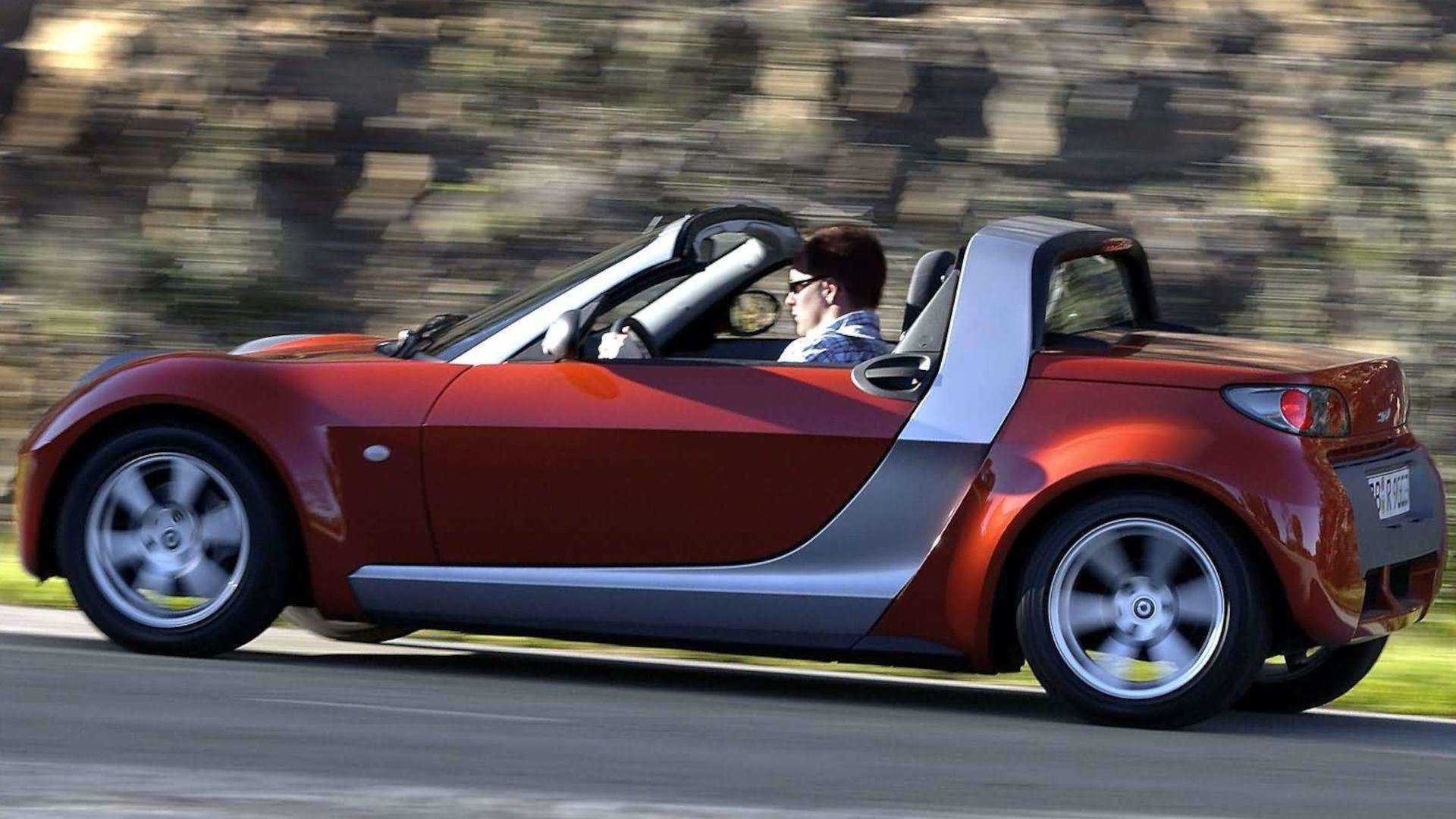
There is a key difference between a roadster and a sports car. While the latter describes a vehicle designed to thrill its driver and feel electric in all areas of driving, a roadster tends to be more luxurious in nature and built to pose and cruise at slower speeds. The Smart Roadster is a strange crossover of the two, where it handles as well as most sports cars on the market, but is too slow to really be classed as one.
Available Models
smart
- Founded
-
1994
- Headquarters
-
Ningbo, China
- Owned By
-
Mercedes-Benz/Geely
- Production Status
-
Discontinued
Its choice of gearbox also muddied the waters significantly, to the point where one of the sweetest handling drop-tops around was nearly completely ruined.
This piece explores the Smart Roadster, and how the project was very nearly destroyed by a poor choice of gearbox for sporty driving. All technical data was sourced from trusted providers such as the vehicle manufacturer.
The Smart Roadster Was Like A German Lotus
When you think of Smart, most gearheads will likely cast their minds to the FourTwo city car, a minuscule little devil that was famous for being able to park side-on in spaces across busy cities, due to being about as long as normal cars were wide. Despite its tiny frame and distinguishable looks, it didn’t perform well from a sales perspective. Looking to build the brand further, parent company Mercedes-Benz greenlit a project to offer a small sports car/roadster that employed a small engine, but was ultra-lightweight.
Being an economy-minded company, Smart wanted to allow drivers to have their cake and eat it; producing a coupe that offered a thrilling driving experience, but was affordable to run and maintain. As a result, the marque took somewhat of a Lotus approach; simplify and add lightness. A concept version of the new offering was first shown at the 2000 Paris Motor Show, before the production specimen eventually landed in 2002.
The Little Smart Was priced Similarly To Its Rivals
The Roadster was never available in the US, and was limited to being sold solely in Europe. It was priced similarly to other small sports cars like the Mazda MX-5 at the lower end of the performance market, the Smart coming in at the equivalent of $21,000 in 2003. As a result, it wasn’t the plushest automobile ever produced, but it was designed to keep weight to an absolute minimum.
Plastics were utilized throughout the interior and exterior body panels in an effort to save production costs and weight. Despite being called Roadster, it was also available in hard-top coupe form.

Discussion
What are the lightest small sports cars on sale in 2024?
The Mazda MX-5 Miata is one of the lightest new cars you can buy at under 2,400 pounds. The Toyota GR86/Subaru BRZ are pretty light at 2,800 pounds. Technically, the BAC Mono is the lightest at 1,257 lbs.
The Roadster Was Light, But It Struggled For Outright Grunt
Smart’s weight-saving program bore fruit, as it tipped the scales at a featherweight 1,741 pounds. This was despite it coming with an electrically-operated soft top roof, which can be tough to maintain if you don’t know how, rather than a manually-operated component like many cheaper sports cars of the time. This was good, as its engine didn’t bring a huge amount to the party. It was a 700cc inline-three unit lifted from the Smart ForTwo, though with a turbocharger attached.
|
2002-2005 Smart Roadster |
|
|---|---|
|
Engine |
0.7L turbocharged I3 |
|
Power |
80 hp |
|
Torque |
81 lb-ft |
|
0-60 mph |
10.9 seconds |
|
Top Speed |
109 mph |
While even the lowest-powered MX-5s of the day came with 110 hp, and the Toyota MR2 got 140 hp, the Roadster had to make do with just 80 hp. Despite the lack of weight, this power figure only allowed it to cruise past the 60 mph barrier after 10.9 seconds, well off its rivals. The powerplant was mated to a six-speed Softtouch automatic gearbox, which could be used in full auto mode or a clutchless manual setting.
Smart’s Sports Car Was A Breath Of Fresh Air In The Bends
While the powertrain wasn’t anything to shout about, the way the Smart handled certainly turned heads. It was designed from the ground up to eat corners for breakfast, with its lightweight construction and mid-engined layout, one affordable sports cars sadly don’t follow these days, illustrating this. Each of the car’s four wheels was also placed as far in each corner of the chassis as possible to help improve stability and weight distribution, something further boosted by the fact it was just four feet high as Smart’s engineers looked to keep the weight as close to the ground as possible.
The Roadster’s cornering ability was widely praised by reviewers at the time, with the responsiveness and stability of the car impressing, though slightly vague steering took away from the experience a little. The Smart’s worst sin was not its steering though, rather its gearbox.

Related
10 Affordable Sports Cars That Failed To Beat The Miata, And The One That Finally Did
The Miata has ruled the affordable sports car world for decades. Here are 10 cars that tried to beat it and the one that finally did.
The Roadster’s Dim-Witted Transmission Went A Long Way To Stunting The Sports Car
Rather than offer a full manual gearbox like most sports cars of the period, Smart’s automated six-speed sequential unit was meant to offer a more straightforward shifting experience that was easier to use every day. While the latter box was ticked, with base cars coming with a sequential gear lever that could be moved forwards or backward to shift or left in full auto mode, the transmission was panned for its slow reaction time.
The beauty of a full manual is that you can grab a gear the moment you need it but Smart’s automated manual doesn’t afford you this luxury. While you could improve things if you backed off the throttle before upshifting, its downshifts were frustratingly slow no matter the situation. Should you fancy keeping your hands firmly fixed to the wheel, it was at least available in flappy paddle form rather than the sequential stick.

Related
10 Funky Sports Cars You’ve Never Heard About
We all know Ferrari, Lamborghini and Porsche. But what about a TaMo, Mazel, Lobini or Yes? This list covers some lesser-spotted, funky sports cars.
Poor Gearbox Reduced Roadster’s Sporting Pretensions
The relaxed gearbox, and the lack of power and resulting outright pace, mean that it’s difficult to class the Roadster as a pure-blooded sports car in the same vein as an MX5 or MR2. Its balanced and responsive handling ensures it’s a heavily underrated one but drivers after a purer experience would be better opting for its legendary Japanese rivals, or perhaps lower-end BMW Z4s or Porsche Boxsters.
A Brabus Variant Was Available For Those After A Little More Poke
The Roadster’s story doesn’t end there though, as a special Brabus version was also on the menu. Brabus is one of the best-known manufacturer-specific tuning companies in the automotive space, the shop having worked its magic on pretty much all of Mercedes’ models over the past several decades. It also extended its efforts to the Smart brand, treating the Roadster to a considerable overhaul.
|
2002-2005 Smart Brabus Roadster |
|
|---|---|
|
Engine |
0.7L turbocharged I3 |
|
Power |
101 hp |
|
Torque |
95 lb-ft |
|
0-60 mph |
9.8 seconds |
|
Top Speed |
119 mph |
First things first, it had more grunt. Brabus introduced a more aggressive dual-exit sports exhaust and re-tuned the engine slightly, which boosted power to 101 hp. The suspension was also lowered to improve handling even further, while it was made to look more purposeful than the standard car. Brabus badges were seemingly loaded into a shirt gun and fired around the vehicle, inside and out, while purposeful new body kit and wheels made their debut.

Related
Smart’s First Sedan Will Be Serious With More Than 600 HP
Remember when all Smart made were tiny two-door city cars?
The interior was also jazzed up somewhat, with elements like the pedals and handbrake now being dressed in sporty aluminum. Heated leather seats were also included as standard, ensuring it was a nice step-up in performance and luxury when compared to the base Roadster. Sadly, the dim-witted gearbox remained, so the Brabus suffered from the same issues as its sibling.
Poor sales ultimately meant the Roadster was axed in December 2005, bringing an end to a story that promised much but never realized its ultimate potential.
Sources: Smart