These Are The 10 Best 1990s Car Wheel Designs

It’s been said that wheels make or break a car. Though automakers really began paying attention to wheel designs in the 1980s, thanks largely to advances in CAD design and widespread adoption of once-costly aluminum alloy construction, they didn’t really hit their stride until the 1990s. By then, automakers began experimenting with more stylish designs — and they had more room to do so since rapidly improving tire technology also allowed for increasingly larger wheel diameters.
Here, we’ve put together a list of 10 of our very favorite wheel designs from the 1990s. Each helped define a particular make and model at the time, and they’ve all aged incredibly well.
Picking our favorite wheels is, of course, a highly subjective task. These wheels not only looked good when new. They’ve also passed the test of time.
10
Porsche 911 and Boxster Turbo Twist
A directional icon.
The final air-cooled Porsche 911 was a special car for a variety of reasons, one of which was the introduction of the directional 18-inch alloy wheels colloquially known as Turbo Twist. They came standard on the 993-generation Porsche 911 Turbo, though they were an optional upgrade over either the standard 16-inch and optional 17-inch alloy wheels that buyers could specify out of the seemingly endless list of extra-cost features.
The Turbo Twist wheel design was also available on the first-generation Boxster as well as the first water-cooled 911, the 996-generation model. Though Porsche has moved away from an angled spoke design for the bulk of its wheel designs today, the Turbo Twist inspired various versions well into the early 2010s.
9
Mercedes-Benz AMG Monoblock
A hammer of a wheel.
Consider this one a technicality. The original Monoblock wheel design arrived in the 1980s bolted to the AMG Hammer, a tuned version of the 1980s Mercedes-Benz E-Class sedan. However, the “Monoblock” design didn’t actually get installed at the factory on Mercedes-Benz models until the mid-1990s when the C36 AMG arrived. This rather quick version of the small C-Class sedan was the first production model actually co-developed by Mercedes-Benz and AMG. (Previous models were modified by AMG after they were built by Mercedes.) Soon, AMG became a subsidiary of Mercedes-Benz parent Daimler.
The flat-face Monoblock wheels have become a major part of AMG’s design language. Even now, you’ll find a Monoblock-style wheel as an option on some AMG models, including the Mercedes-AMG GLS 63. (Save up; the 23-inch Monoblock-style wheels cost upward of $5,000 in 2025.)
8
BMW M5 Throwing Star
A weapons-grade wheel.
|
Wheel Size |
17 inches |
|---|---|
|
Horsepower |
138 hp |
|
Torque |
105 lb-ft |
|
0-60 |
4 seconds |
BMW fans know the Throwing Star wheels by a far less glamorous name: Style 21. Don’t let that boring name fool you; these wheels, which most famously came on the early-1990s BMW M5 (known as the E34 generation to BMW fans), may very well be the German automaker’s best. Their directional design is similar to the Porsche Turbo Twist described above, and yet they have a sharper edge.
They were one of several wheel designs available for the M5, and they were also offered for certain versions of the 7-Series and the 8-Series. Fun fact: the large, angled center section is actually a plastic insert that attaches to a less stylish alloy wheel.
The Style 21, or Throwing Star, inspired another fantastic BMW wheel from the 1990s: the Style 23 Contour wheel that was included in certain configurations of the automaker’s E36-generation M3. That one, however, was all made of a single piece.
7
Dodge Viper RT/10
If 1992 was a wheel.
The 1992 Dodge Viper RT/10 was the most outlandish car to come out of Detroit in decades. Conceived as a show car in the late 1980s, it was green-lit for production as a largely hand-assembled halo car for Chrysler’s Dodge performance division. Its wheels were as outrageous as its big V10 engine, albeit with just three spokes.
Sadly, the Viper’s three-spoke wheels only lasted the first few years of production. The Viper GTS coupe brought with it a set of five-spokers in 1995, which soon became standard fare for the whole lineup. Sourcing tires for a Viper RT/10 was once a challenge, though Michelin now offers a set of its Pilot Sport PS2s in a manufacturer-correct staggered 275/40 and downright outlandish 335/35 configuration.
Sadly, the production version of the Viper RT/10’s wheels lacked the red accent seen on the show car. Eh, we can’t have everything, can we?
6
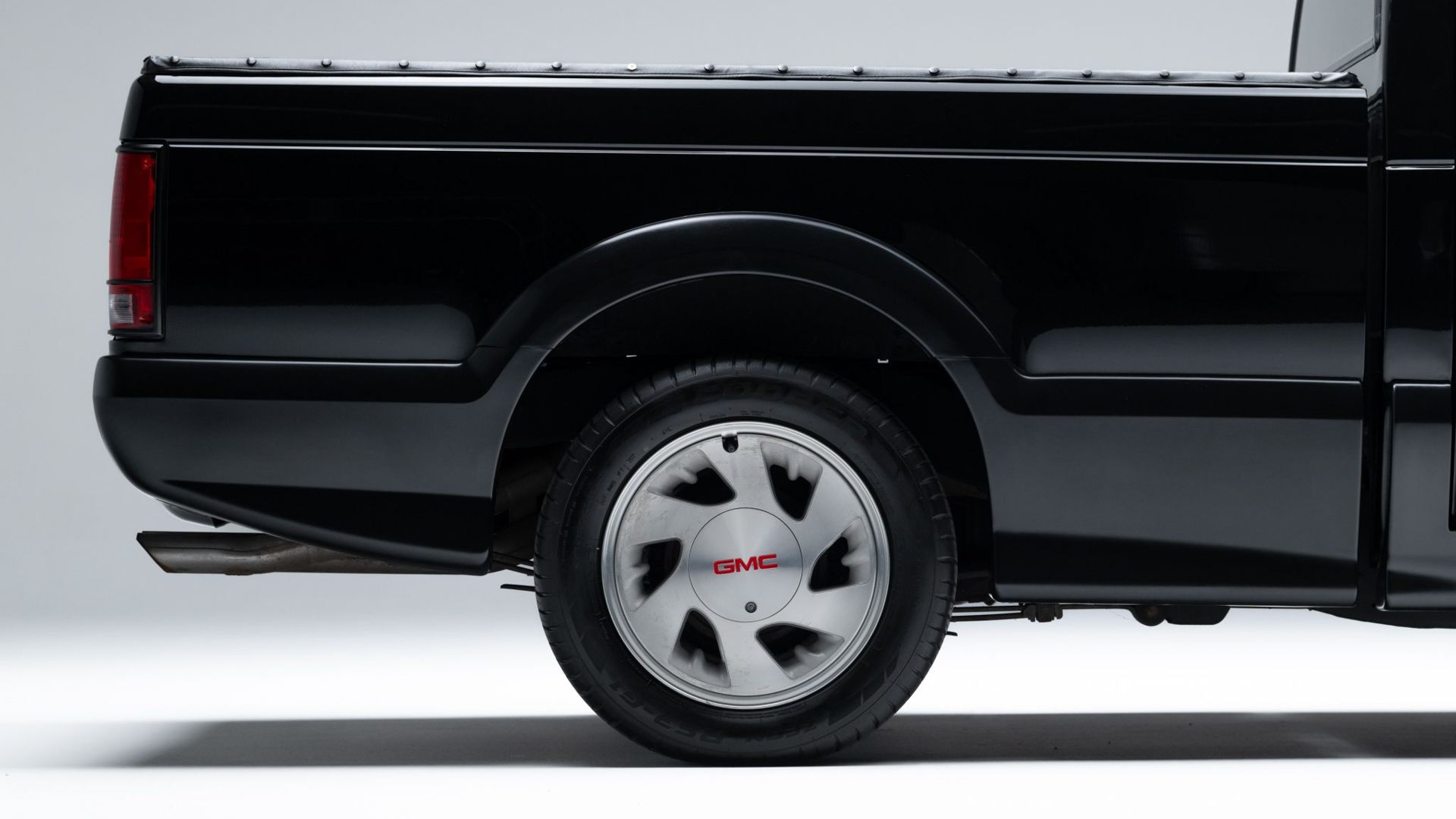
GMC Syclone and Typhoon
Who says trucks and SUVs can’t have cool wheels?
The idea of a performance-oriented pickup truck was so foreign in 1991 when GMC introduced a turbocharged version of its compact Sonoma. The boosted V6 gave the GMC Syclone a 280-horsepower rating, resulting in a mere 5.3-second 0-60 mph run. Soon, an SUV version called the GMC Typhoon that was based on the GMC Jimmy arrived with similar performance and styling modifications and slightly higher production numbers.
Of course, these fast pickups and SUVs needed a cool wheel design. GMC’s angled six-spoke design looked like something from a sports car rather than an SUV, and they have aged so well.
5
Audi Avus
Show car wheels for everyone.
Legendary American car designer J Mays was inspired by 1930s-era race cars when he created the Audi Avus show car for the 1991 Tokyo Motor Show. The car’s basic look soon inspired numerous Audi models, while versions of its big wheels ended up on just about every Audi model well into the 1990s and 2000s. The Avus look is, unfortunately, entirely gone from Audi’s current lineup.
They were arguably at their best on the S4 sedan and wagon that arrived for the 1998 model year. The small car’s trim proportions fit these flat-face wheels with their claw-like spokes oh so well. Audi also used a version of its basic Avus wheel shape for its true style icon, the TT.
4
Infiniti Q45
A Q-Ship of a wheel design.
History should remember the Infiniti Q45 better. The automaker’s launch model was a delicately styled vehicle with brilliant details throughout, though it was perhaps far too subtle for its intended audience. It had no slatted grille, for instance, and its interior was devoid of the wood trim that luxury buyers expected in the 1990s.
One of its least-appreciated details was its original wheel design, which paired a silver-finish flat face with a big chrome center cap. It was distinct, unusual, and elegant — a perfect fit for the Q45 itself.
Of all the cars on our list, the Q45 is likely the rarest sight today. These cars simply haven’t been preserved in the way that the Q45’s arch rival, the Lexus LS 400, seems to have been.
3
Saab Super Aero
Thor’s own wheel.
The Saab 9000 Aero existed at an unusual (and yet decidedly Swedish) intersection of performance, utility, and safety. While not a “pretty” car by conventional standards, the 9000 nonetheless looked especially purposeful in sporty Aero trim with its color-matched body kit and, of course, its 16-inch Super Aero three-spoke alloy wheels.
Admittedly, the 9000 Aero was not the first Saab with this wheel design, though it waved the three-spoke flag for the 1990s and thus is the model that qualifies for this list. In the 1980s and the early 1990s, the Saab 900 SPG was first on the scene with its own three-spokers.
Well into the 2000s, Saab stuck with the three-spoke theme for many of its wheel designs across its entire lineup. Its 900, 9-3, and 9-5 models all came with different three-spoke designs, though the look began to vanish from the Saab lineup once General Motors fully took over the Swedish brand in the early 2000s.
2
Chevrolet Corvette Magnesium
Ultra-light and ultra-stylish.
The fifth-generation Chevrolet Corvette tossed aside the pizza-cutter-style wheels of its predecessors for a lineup of five-spoke designs. The most intriguing option was the subtle gold-finish “Custom Sport” magnesium wheels, which cost a hefty $3,000 all the way back in 1999.
The wheels were very light, allegedly a couple of pounds trimmer than the standard setup. Moreover, they also look great with a subtle gold finish. In fact, these wheels may be one of the most under-appreciated aspects of the C5, a highly accessible sports car.
Chevrolet lightly modified the magnesium wheels’ styling as the C5 aged, but the basic idea was the same: a matte gold finish, five narrow spokes, and little else.
1
Volvo 850 T-5R
The beginning of cool Volvo wheels.
Sometimes simplicity works best. Such is the case with the Volvo 850 T-5R, which may very well wear the best-looking five-spoke wheels ever created. Their subtle gray finish, flat face, and lack of adornment perfectly fit the mission of Volvo’s high-performance grocery getter.
The race-inspired 850 T-5R was unlike any Volvo to have come before it, though the brand did admittedly dabble in zippy turbocharged wagons in the 1980s. The 850R that followed wore seven-spoke wheels that retained the gray finish but lacked the iron-block look of those bolted onto the T-5R.
Sources: Porsche, BMW, Mercedes-AMG, Dodge, GMC, Audi, Infiniti, Saab, Chevrolet, Volvo.