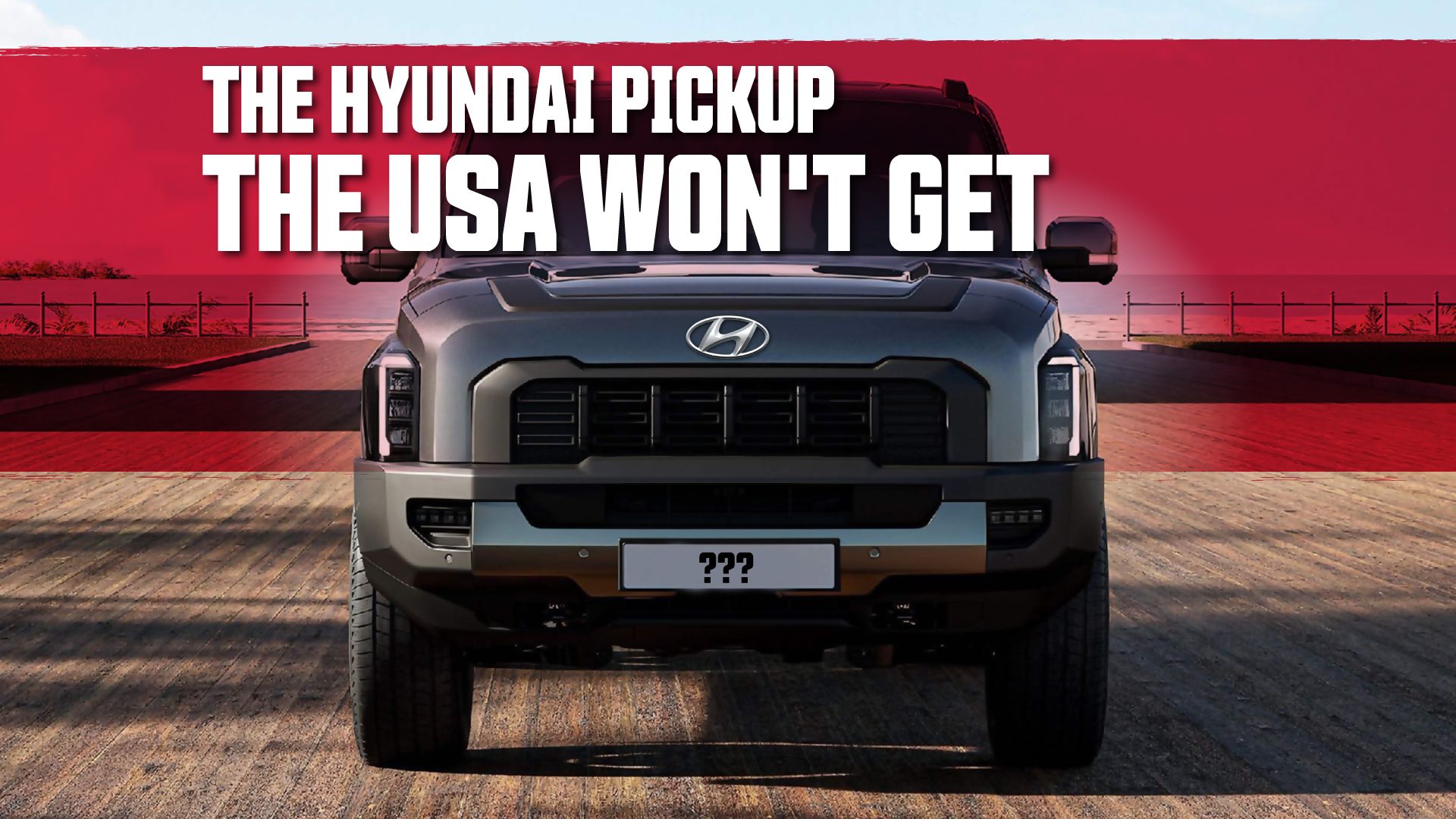
What You Need To Know About The Hyundai Pickup The USA Won’t Get

We could sit here all day listing pickup trucks that are not available in the US. Trucks like the Ram 1200, a rebadged Peugeot Landtrek, you’ll find throughout the forests and backroads of Mexico. And then there’s the Volkswagen Amarok, a Europe/Africa/South America exclusive that was too expensive to import even before these recent rounds of tariffs.
Hyundai
- Founded
-
29 December 1967
- Founder
-
Chung Ju-yung
- Headquarters
-
Seoul, South Korea
- Owned By
-
Hyundai Motor Group
- Current CEO
-
Jose Munoz
So you know what, Hyundai? Fine. We’re used to it. Don’t bring your cool new pickup Stateside, we’ll just wait twenty-five years and import them and see how you like them apples. With that out of the way, let’s dive into what we know about Hyundai’s new truck for the Australian market.
The following is based primarily on information made available by Kia and Hyundai, with additional research into automotive sales by segment, and Australian pickup truck culture. Any opinions offered thereupon are those of the author unless otherwise attributed.
It’s Almost Definitely The Hyundai Version Of The Kia Tasman
According to Hyundai Australia CEO Don Romano, the company is currently working on a mid-size pickup that will compete against like-sized body-on-frame trucks like the Ford Ranger and the Toyota Hilux. If you ask us, that’s about as close as you can get to an official confirmation that the new Hyundai pickup is going to be a rebadged Tasman without coming out and saying it in plain English. Developing a brand-new pickup can cost billions of dollars, and rebadging an American, Japanese, or European pickup when you’ve got the Tasman sitting right there makes no sense.
That said, we wouldn’t be surprised to see a handful of tweaks, making them fraternal rather than identical twins, and giving the Hyundai version its own distinct identity. The Hyundai Tucson and Kia Sportage, for instance, are considered by some to be “basically the same SUV,” but the Tucson offers a bit more cargo space and has been noted for its superior interior build quality, while the Sportage actually tows a full 500 pounds more than its sibling, and costs a bit less.

Related
Kia Almost Ready To Announce Its First American Pickup, And It’s Not The Tasman
Expect more on the new truck next week.
At the very least, we would bet on the Hyundai pickup having a more rugged, utilitarian appearance in comparison to the Tasman’s Jeep-meets-Super-Nintendo body style, and slightly more upscale interior trim materials.
Hyundai Will Likely Borrow The Whole Powertrain Lineup From The Tasman
We would bet on Hyundai bringing the whole powertrain lineup over directly from the Tasman, which is planned to give drivers a choice of pretty much every major energy source you can name, including:
- A 277-hp 2.5-liter turbocharged 4-cylinder.
- A 207-hp turbodiesel 4-cylinder.
- A fully-electric version, power output to be declared.
- A hybrid version, power output to be declared.
There has been some speculation that the Kia Tasman will be on the way to America at a later date, but we’ve already voiced our suspicions that we’re never going to see the ICE models here in the good ol’ US of A. If the Tasman does come to the US, which, again, is mere speculation at this point, and it proves to be a hit, the Hyundai version could conceivably make its way to America at some point in the future, but we’re not holding our collective breath on this one.
Why Does Australia Get All The Fun Stuff?
In most of the world, we call trucks trucks, and if you’re talking about a ‘ute, you’re talking about a utility coupe like an El Camino or a Ranchero. Down under, pretty much anything with a bed in the back is called a ‘ute. According to a Reddit thread on r/AskAnAustralian, the difference in terminology comes down to the simple fact that Aussies love to shorten any word they can, and hell, ‘ute is two letters shorter than truck, so there you go.
It Almost Always Comes Down To The Price Of Gas
Terminology aside, a much bigger difference in pickup truck culture between Australia and America comes down to gas prices. You’ll see this pretty much all over the world. Americans pay lower taxes and lower prices overall on fuel, resulting in a culture of big SUVs and full-size pickups. A gallon of regular gasoline costs around $3.90 in Australia as of the time of this writing. In the US, that price is more like $3.14. That might not seem like a huge difference, but imagine the giddy backflips you’d do if the 7-11 down the street lowered their price by sixty-six cents.

Related
Why Turbodiesel Cars Will Never Make A Comeback
The world is moving on from a fuel beset by soot and scandal.
These considerations are obviously going to play into an automaker’s decisions when it comes to which trucks you’re selling where. A mid-size pickup with a turbodiesel i4 makes a lot of sense in Australia. In the US, that would be a niche market, and if you drop the diesel engine, then you’re trying to sell a mid-size in the land where the half-ton is king, because last we checked, the Ford F-150 is still the top-selling vehicle this year.
In short, the perception among automakers seems to be that you need to have something very special before you bring a small or mid-size truck to the American market, and it remains to be seen just how special the Kia Tasman will turn out to be.
Full-Size Pickups Seem To Be The Only Ones Australia Doesn’t Want
To get an idea of what Australians think of full-size trucks, we’ve linked in our sources a report published on news.com.au late last year. The writer of this piece addresses an influx of large “American-style” pickups like the Toyota Tundra, which was announced for the Australian market last year. The report read that “despite costing more than a house deposit,” the “behemoth Toyota Tundra” will no doubt be a hit, even though large trucks can “increase blind spots and reduce sightlines for other drivers.”

Related
The Australian Pickup Truck That Secretly Became The Mid-Engined Corvette
Did you know that when developing the C8 Corvette, Chevrolet used an Australian pickup truck as a test mule?
Carla Hoorweg, head of the Australasian New Car Assessment Program, said that “We’re looking at cars that are being designed for the US market. They’re not necessarily going to have a focus on pedestrian protection or vulnerable road user protection.”
So all of this is to say that, yes, there’s a market for big pickups in the land of even bigger spiders, but full-size trucks are still novel enough Down Under to generate controversy and think pieces about whether Australia needs these enormous trucks in the first place.
It’s Not Much Of An Influx
You’ll never guess how many full-size pickups sold in Australia in 2024. Give up? 10,611. Doing the math, Australia is home to around 26,660,000 people. This means that Australia is buying around one full-size pickup for every 2,500 people. That’s about 0.04% of the population driving a new full-size Tundra or Silverado last year.
Meanwhile, Americans bought 2.9 million full-size pickups in 2024, according to the American Bureau of Economic Analysis. That comes out to one full-size pickup sold for every 117 people, or closer to a full one percent of this country buying a new full-size pickup in 2024.

Related
Trump Administration Wants To Make Cars Less Fuel Efficient
The new Transport Secretary tells the NHTSA to review all fuel economy rules. This will have massive effects across the industry.
So there’s your final piece of the puzzle: Australia gets the fun stuff because they’re not buying the 1500s and F-150s and Super Duties. At least, not in large enough volume that small and mid-size sellers are wringing their hands wondering how they’re going to stay competitive.
Sources: BEA.gov, Hyundai, Kia, news.com.au.