You Have This Mazda To Thank For A Feature Found In Almost Every New Car Today

Quick Links
Where would we be without GPS? Probably not where we need to be most of the time. Short for Global Positioning System, GPS navigation has become one of the most common modern amenities we, as automotive consumers, are accustomed to using daily, both on our mobile devices and in our cars.
Mazda
Mazda is a Japanese automaker founded in 1920 as the Toyo Cork Kogyo Co and only started producing vehicles in 1931 when it made the Mazda-Go auto rickshaw. The Japanese automaker’s first official car arrived in May 1960 when the Mazda R360 launched, starting Mazda as we know it today, although the Mazda name was only adopted in 1984. Mazda has a rich history in motorsport, including the honor of being the only manufacturer to win the 24 Hours of Le Mans with a car not powered by a reciprocating engine.
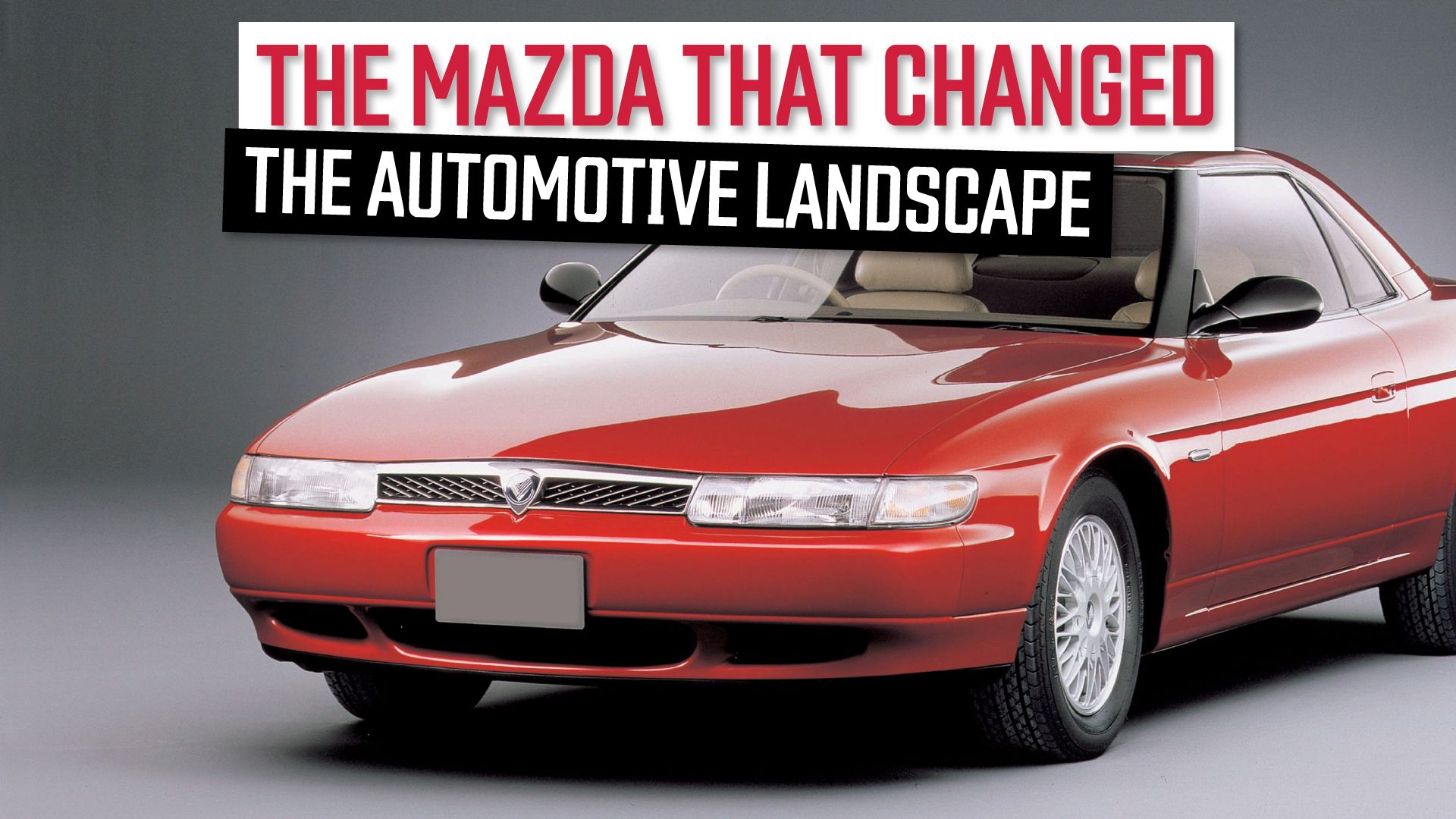
Almost all small cars, luxury cars, pickup trucks, minivans, supercars, hypercars, and every type of vehicle that leaves the production line today are equipped – in some form or another – with a type of built-in satellite navigation system. The first model to ever have it as we know it today was the Mazda Eunos Cosmo, which debuted in 1990.
We will cover the evolution of GPS and the history of the Mazda Eunos Cosmo chronologically.
The Mazda Eunos Cosmo
The pioneer of the Eunos model range was introduced in 1967. Known as the Mazda Cosmo, it was a rotary-powered coupe with styling akin to the Jaguar E-Type. It was a gorgeous road car with a steel unibody and a plucky twin-rotor Wankel engine that would be reimagined to be used in the Marathon de la Route, an 84-hour endurance race that spanned from 1965 to 1971 and held at the Nürburgring. Mazda would enter two modified models to test its mettle, with only one car crossing the finishing line.
|
Engine |
2.0-liter, twin-turbocharged, three-rotor |
|---|---|
|
Horsepower |
276 hp @ 6,500 rpm |
|
Torque |
296 lb-ft @ 3,000 rpm |
|
0-60 |
6 seconds (est) |
|
Top speed |
155 mph |
Four generations of this Mazda coupe were produced, with the JC-generation Eunos Cosmo being the final iteration of the coupe model range. Debuting in 1990, it was a sultry two-seater model that was the successor to the original Cosmo model. The Eunos Cosmo model tried blending a luxurious and well-appointed interior with the inherent athleticism of a rotary-powered sports car and did a fine job at offering both. One of the most significant aspects of the Mazda Eunos Cosmo was its navigation system, which Mazda Electric developed and called the Car Communication System (CCS). Mazda worked with Mitsubishi Electric to develop the CCS, which relied on satellites to calculate the vehicle’s location, which could also be used to help track vehicles if stolen.

A screen was mounted centrally on the Cosmo’s dashboard. It would display a 2D map and function similarly to the navigation system offered in modern vehicles, essentially allowing a destination to be selected. Then, a route would be plotted on a digital map. Models with this system were only offered in certain trim levels and available only for the Japanese market. This touchscreen display was relatively primitive compared to the systems offered in the modern age.

Add CarBuzz to your Google News feed.
The color touchscreen still used cathode-ray tube (CRT) technology – the old-style glass TV tubes – and allowed occupants to control the climate control system and other infotainment options. The first car touchscreen ever was, of course, fitted to the 1986 Buick Riviera. While it was revolutionary and undoubtedly the first production car to feature built-in satellite navigation included in an infotainment screen, it was not the first time a navigation system was offered.
Technically, It Wasn’t The First
Mazda’s Eunos Cosmo was the first production car to feature a built-in navigation system; manufacturers like Honda and Toyota had offered navigation systems years before. Honda was the first manufacturer to offer a commercially available navigation system. The Electro Gyrocator was a map-based navigation system that was offered in 1981 as an option for Honda’s vehicles. It was based on an inertial navigation system consisting of a medley of components and systems like a direction sensor, driving distance sensor, microcomputer, and other technologies to monitor direction and distance, allowing the system to calculate the vehicle’s position. A CRT display would work in tandem with a transparent map overlay. However, this inertial navigation was less accurate than GPS.
Toyota was another manufacturer that dabbled in earlier car navigation systems, and its claim to fame was a CD-ROM mapped dead-reckoning navigation system in 1987, which was also the first color display. Dead reckoning was a navigation technique that used fixed positions to measure distance and direction. Interestingly, it was one of Amelia Earhart’s navigation techniques when she flew solo across the Atlantic Ocean and on her final flight. This system was introduced in the Toyota Crown Royal Saloon G model and consisted of a color CRT display on the dashboard.

Related
The Evolution Of In-Car Media And Infotainment
The history of infotainment, from AM radios to today’s tablets on wheels.
Beyond manufacturers, other companies like Etak, a US-based vehicle navigation system equipment, digital maps, and mapping software, debuted a navigation system in 1985, which is considered the ancestor of the modern GPS navigation systems. One of its most characterizing elements was the cassette tapes that had digital maps and some of the Navigator’s operating system stored on them. These were clunky devices, albeit extremely significant in the evolution of vehicle navigation systems. An area like Los Angeles would need four separate cassette tapes, and when a driver reached the end of the map, a new cassette would need to be inserted. However, since then, GPS navigation systems have evolved considerably.
The Evolution Of GPS
Like most fields of technology, GPS navigation systems have evolved significantly in the last two decades, with the technology first appearing in cell phones in 1999. GPS was originally known as Navstar GPS, a satellite-based radio navigation system owned by the US. It was one of the global navigation satellite systems that offered geolocation to GPS receivers. By 1993, 24 GPS satellites were established, and soon after, other major countries followed suit, which resulted in more than 100 satellites.
In 1998, Garmin debuted its first portable GPS navigation system for use in vehicles, which had a black and white screen. By 2000, there was a need to expand and improve the GPS satellite system, and just five years later, new satellites were launched that were more modern. The advancements in the aerospace field have allowed for the evolution of GPS navigation systems. By 2010, the first modern GPS IIF satellites were launched, which would improve accuracy and security in applications for the military and civilians worldwide. The last of this series was launched in 2017, and the successor of this satellite series, the GPS IIIF, was launched in 2018. With the improvement of satellite systems, GPS navigation systems in vehicles have improved tremendously, with greater accuracy and usability with each passing year.

Related
Why Infotainment And Safety Systems Are Hurting Vehicle Reliability
Dependability is at an all-time low, and it’s technology’s fault.
Modern navigation systems allow for route calculations that factor in traffic conditions and have improved the efficacy and accuracy of GPS navigation systems. Beyond that, the range of modern navigation systems is virtually boundless, with earlier applications like the Etak Navigator needing cassette tapes and transparent maps; the newer systems have access to the entire globe with no delay and almost no limitations.
Not A One-Trick Pony
Aside from being the pioneer of production cars with built-in navigation systems, the Mazda Eunos Cosmo also featured several other noteworthy elements that only elevated its appeal. The Eunos Cosmo featured frameless windows, which were available in four-door models at the time, but the Eunos Cosmo stood out because of its coupe body style. To meet safety regulations, the coupe needed a fixed B-pillar. Mazda also configured the Eunos Cosmo with a well-appointed cabin that featured LCD displays integrated into the dashboard alongside its GPS navigation system and touchscreen display.
One of the most significant aspects of the Mazda Eunos Cosmo was its engine. Mazda offered two engine options, both of which were Wankel rotary engines. The most powerful option offered to the Eunos Cosmo was the 20B-REW, which featured three rotors and a sequential twin-turbocharger system, an uncommon offering. This added performance with a more potent engine also came at the cost of a higher MSRP, which was more than a 1990 Chevrolet Corvette coupe.
The Mazda Eunos Cosmo was a striking car that pioneered built-in vehicle navigation, had sultry styling that aged like fine wine, offered a sumptuous interior, and featured enough power to contend with some of the most athletic Japanese nameplates available at the time.
Sources:
Mazda
.